Author

admin

Browsing

Investor Insight

Sirios Resources is advancing one of Québec’s largest undeveloped gold deposits, combining a multi-million-ounce resource base, strong infrastructure access and deep regional expertise backed by the Osisko development ecosystem, creating a clear pathway toward re-rating and growth.

Overview

Sirios Resources (TSXV:SOI,OTCQB:SIREF) is a Québec-based gold exploration and development company focused on advancing a portfolio of high-potential projects in the Eeyou Istchee James Bay region of Québec. The company’s flagship asset, the Cheechoo gold project, ranks among the largest gold projects in the province by resource size. The project benefits from favourable geology, near-surface mineralization, and proximity to existing infrastructure, including road access, power lines and the nearby Éléonore mine. Sirios is advancing Cheechoo through systematic drilling, resource expansion and technical studies with the objective of progressing the project toward a PEA.

In December 2025, Sirios announced a transformational combination with OVI Mining, creating a district-scale gold platform anchored by Cheechoo and complemented by the Corvet Est and PLEX projects. The transaction brings Sirios into the Osisko development ecosystem, strengthening the company’s leadership team with proven mine-building and capital markets expertise, while retaining Sirios’ long-standing geological knowledge of James Bay.

With over three decades of continuous exploration in the region and strong relationships with local and Indigenous communities, Sirios is well-positioned to unlock value through disciplined project advancement and exploration-driven growth.

Company Highlights

  • Flagship Cheechoo gold project hosts approximately 3 million ounces of gold, including 1.3 million ounces indicated and 1.7 million ounces inferred, including additional underground resources
  • Located in Eeyou Istchee James Bay, Québec, a Tier-1 mining jurisdiction with strong government and community support
  • Low strip ratio (2.9:1) and high gold recoveries (92 percent) support attractive open-pit development potential at Cheechoo
  • Strategic combination with OVI Mining brings Osisko-backed leadership, capital markets strength and additional district-scale exploration assets

Key Projects

Cheechoo Gold Project

The 100 percent owned Cheechoo gold project is Sirios’ flagship asset located in Eeyou Istchee James Bay, Québec, near existing infrastructure and operating mines. The project hosts a large, near-surface gold deposit with scalable, open-pit potential and higher-grade underground extensions.

A 2025 mineral resource estimate outlines approximately 3 million ounces of gold, including 1.3 million ounces indicated at 1.12 grams per ton (g/t) gold and 1.7 million ounces inferred at 1.23 g/t gold, which includes 446,000 ounces of underground resources grading 3.09 g/t gold. The deposit exhibits a low strip ratio of 2.9:1 and high metallurgical recoveries of approximately 92 percent, supporting favourable development characteristics.

In addition to the current resource, Cheechoo hosts a significant exploration target ranging from 31 to 40 million tonnes grading between 1.27 and 1.45 g/t gold, highlighting strong potential for further resource growth. Sirios’ ongoing work is focused on expanding the resource base and advancing the project toward a preliminary economic assessment.

Corvet Est Gold Project

Corvet Est is a 6,500-hectare district-scale land package located east of Cheechoo within the same highly prospective James Bay geological corridor. The project comprises a historically drilled gold system that has seen limited modern exploration since 2012. Following consolidation by OVI Mining, Corvet Est now offers Sirios exposure to a large land package with multiple mineralized zones and significant upside potential.

Plex Gold Project

The PLEX project is a 21,000-hectare district-scale land package hosting the Orfée gold zone, characterized by multiple structural corridors and underexplored depth and strike potential. Historical drilling has confirmed gold mineralization, and Sirios plans to advance compilation, target refinement and exploration programs to unlock the project’s discovery potential.

Aquilon Gold Project

The Aquilon project is an optioned gold asset located in James Bay and hosts numerous high-grade gold showings, including some of the highest gold grades historically reported in Québec. Recent drilling has outlined a broad gold-mineralized halo with strong expansion potential. Exploration at Aquilon is currently being advanced in partnership with Sumitomo Metal Mining Canada, providing Sirios with continued exposure to exploration upside while limiting capital commitments.

Management Team (Post-Transaction)

Dominique Doucet. – Executive Chairman

Dominique Doucet is a veteran of Québec’s mineral exploration industry with more than 40 years of experience, including over 30 years in the Eeyou Istchee James Bay region. He founded Sirios Resources and has led the discovery of several significant gold occurrences, including the Cheechoo and Aquilon deposits.

Jean-Félix Lepage – Chief Executive Officer

Jean-Félix Lepage is a mining engineer with over 15 years of experience in mine operations and project development. Prior to joining Sirios, he served as vice-president of Projects at O3 Mining, where he advanced the Marban project, and previously held senior operational roles at Newmont, including at the Éléonore mine.

Sean Roosen – Board Member

Sean Roosen is the founder and executive chairman of Osisko Development and former CEO of Osisko Gold Royalties. He played a central role in the discovery, financing and development of the Canadian Malartic mine and is widely recognized as a leader in the global mining industry.

Laurence Farmer – Board Member

Laurence Farmer is CEO of Electric Elements Mining and General Counsel and vice-president of corporate development at Osisko Development. He brings extensive experience across mining, law and finance, with a strong background in corporate transactions and resource development.

This post appeared first on investingnews.com

(TheNewswire)

Vancouver, British Columbia, February 12th, 2026 TheNewswire — Prismo Metals Inc. (‘Prismo’ or the ‘Company’) (CSE: PRIZ,OTC:PMOMF | OTCQB: PMOMF) is pleased to announce that it has received formal permit approval from the U.S. Forest Service to proceed with its fully funded drill program at the Company’s historic Silver King Mine project located in Arizona’s prolific Copper Belt.

The approved permit authorizes drilling from multiple drill pads in the area of the historic mine designed to test the upper part of the Silver King mineralized body that was mined on nine levels over about 300 meters depth (Fig. 1).

Additional high-priority targets identified through recent exploration work can also be tested with some of the planned drill locations. Testing of other targets on private ground is being considered. Mobilization on site is scheduled for February 20th followed by preparatory site work and access improvements followed by drilling.

Dr. Craig Gibson, Chief Exploration Officer of Prismo Metals, commented: ‘Receiving approval for drilling at Silver King is a key milestone as we transition from surface exploration into active testing of the system. With funding in place for multiple phases of drilling, we are well positioned to evaluate the significant exploration potential of this historic, high-grade silver system.’

Alain Lambert, CEO of Prismo commented: ‘Following a very smooth permitting process with Forest Service, we are now ready to conduct the first ever comprehensive drill program at Silver King. Our exploration work to date has attracted the attention of many given the results we have published and our proximity (3.4 km) to Resolution Copper, a Rio Tinto/BHP joint venture. I expect the drilling program to heighten attention.’

Phase 1 Drill Program Highlights:

  • Fully funded program 

  • 1,000 meters of diamond drilling to test the upper portion of the steeply plunging, pipe-like Silver King mineralized body 

  • Mobilization to Silver King Project scheduled for February 20th, 2026 

  • Additional drilling to test lower down in the mineralized structure and mineralized areas adjacent to the historic mine may also be completed 


Click Image To View Full Size

Fig. 1.  Permitted drill sites planned for initial Phase I drilling at the Silver King mine shown by white dots.  The orange line indicates the approximate location of the cross section in Fig. 2.  View looking south-easterly.

Drilling will initially focus on testing the upper portion of the steeply west-dipping pipelike stockwork and breccia zone that historically produced high-grade silver and base metals (Fig. 2), as well as targets adjacent to and beneath historic workings. Initial drilling is estimated at 1000 meters in nine holes.  A second phase of drilling will be dedicated to testing at deeper levels and areas adjacent to the historic mine.

Dr. Gibson, added: ‘We are pleased to engage Godbe Drilling, a highly respected contractor with substantial experience in Arizona and a staging area near the project. The objective is to test the upper half of the steeply dipping pipelike Silver King mineralized body, as well as potential mineralization adjacent to the dense stockwork zones that were the focus of historic mining.’

Drilling Contractor Engagement

Prismo has engaged Godbe Drilling LLC to conduct this Phase 1 drilling program. Godbe Drilling LLC is a Colorado-based family-owned diamond core drilling and mineral exploration business with extensive operating experience in the southwestern United States, including Arizona.


Fig. 2.  Cross section through Silver King mine showing workings and first four planned drill holes.


Silver King Project Overview

The Silver King mine was discovered in 1875 and is one of Arizona’s most significant historic silver producers, with nearly six million ounces of silver produced at average grades ranging from approximately 61 to 21 ounces per ton during early production. Limited small-scale mining in the late 1990s yielded samples with exceptionally high silver and associated gold values, suggesting that high-grade mineralization remains within the system. The project is located within the same geological framework as other world-class deposits in the Arizona Copper Belt, and its proximity to active mining operations enhances its strategic significance.

Qualified Person

Dr. Craig Gibson, PhD., CPG., a Qualified Person as defined by NI-43-01 regulations and Chief Exploration Officer and a director of the Company, has reviewed and approved the technical disclosures in this news release.  

About Prismo Metals Inc.

Prismo (CSE: PRIZ,OTC:PMOMF) is a mining exploration company focused on advancing its Silver King, Ripsey and Hot Breccia projects in Arizona and its Palos Verdes silver project in Mexico.

Please follow @PrismoMetals on Twitter, Facebook, LinkedIn, Instagram, and YouTube

Prismo Metals Inc.

1100 – 1111 Melville St., Vancouver, British Columbia V6E 3V6 Phone: (416) 361-0737


Contact:

Alain Lambert, Chief Executive Officer alain.lambert@prismometals.com

Gordon Aldcorn, President gordon.aldcorn@prismometals.com

Neither the Canadian Securities Exchange nor its Market Regulator (as that term is defined in the policies of the Canadian Securities Exchange) accepts responsibility for the adequacy or accuracy of this release.

Cautionary Note Regarding Forward-Looking Information

This release includes certain statements and information that may constitute forward-looking information within the meaning of applicable Canadian securities laws. Forward-looking statements relate to future events or future performance and reflect the expectations or beliefs of management of the Company regarding future events. Generally, forward-looking statements and information can be identified by the use of forward-looking terminology such as intends’ or anticipates‘, or variations of such words and phrases or statements that certain actions, events or results may’, could’, should’, would’ or occur’. This information and these statements, referred to herein as ‘forward-looking statements’, are not historical facts, are made as of the date of this news release and include without limitation, statements regarding discussions of future plans, estimates and forecasts and statements as to management’s expectations and intentions with respect to, among other things: the timing, costs and results of drilling at Silver King; and the intended use of any proceeds raised under recent financings.

These forward-looking statements involve numerous risks and uncertainties, and actual results might differ materially from results suggested in any forward-looking statements. These risks and uncertainties include, among other things: the potential inability of the Company to utilize the anticipated proceeds of the Private Placement as anticipated; and those risks set out in the Company’s public disclosure record on SEDAR+ (www.sedarplus.com) under the Companys issuer profile.

In making the forward-looking statements in this news release, the Company has applied several material assumptions, including without limitation, that the Company will use the proceeds of the Second Tranche as currently anticipated and on the timeline currently expected.

Although management of the Company has attempted to identify important factors that could cause actual results to differ materially from those contained in forward-looking statements or forward- looking information, there may be other factors that cause results not to be as anticipated, estimated or intended. There can be no assurance that such statements will prove to be accurate, as actual results and future events could differ materially from those anticipated in such statements. Accordingly, readers should not place undue reliance on forward-looking statements and forward- looking information. Readers are cautioned that reliance on such information may not be appropriate for other purposes. The Company does not undertake to update any forward-looking statement, forward-looking information or financial outlook that are incorporated by reference herein, except in accordance with applicable securities laws. We seek safe harbor.

Copyright (c) 2026 TheNewswire – All rights reserved.

News Provided by TheNewsWire via QuoteMedia

This post appeared first on investingnews.com

Sirios Resources (TSXV:SOI,OTCQB:SIREF) is a Québec-based gold exploration and development company focused on high-potential projects in the Eeyou Istchee James Bay region. Its flagship Cheechoo gold project ranks among the largest in the province by resource size and benefits from favourable geology, near-surface mineralization, and existing infrastructure, including road access, power lines, and proximity to the Éléonore mine. Sirios is advancing Cheechoo through systematic drilling, resource expansion, and technical studies, aiming to progress the project toward a Preliminary Economic Assessment (PEA).

In December 2025, Sirios completed a transformational combination with OVI Mining, creating a district-scale gold platform anchored by Cheechoo and complemented by the Corvet Est and PLEX projects. The transaction integrates Sirios into the Osisko development ecosystem, strengthening the leadership team with proven mine-building and capital markets expertise while maintaining the company’s deep geological knowledge of the James Bay region.

With over 30 years of continuous exploration in James Bay and strong partnerships with local and Indigenous communities, Sirios is well-positioned to create value through disciplined project advancement and exploration-driven growth. The company’s combination of experience, strategic assets, and community engagement underpins its long-term growth strategy.

Company Highlights

  • Flagship Cheechoo gold project hosts approximately 3 million ounces of gold, including 1.3 million ounces indicated and 1.7 million ounces inferred, including additional underground resources
  • Located in Eeyou Istchee James Bay, Québec, a Tier-1 mining jurisdiction with strong government and community support
  • Low strip ratio (2.9:1) and high gold recoveries (92 percent) support attractive open-pit development potential at Cheechoo
  • Strategic combination with OVI Mining brings Osisko-backed leadership, capital markets strength and additional district-scale exploration assets
  • Well-funded with recent treasury additions, supporting advancement of Cheechoo toward a preliminary economic assessment (PEA) and ongoing exploration across the portfolio

This Sirios Resources profile is part of a paid investor education campaign.*

Click here to connect with Sirios Resources (TSXV:SOI) to receive an Investor Presentation

This post appeared first on investingnews.com

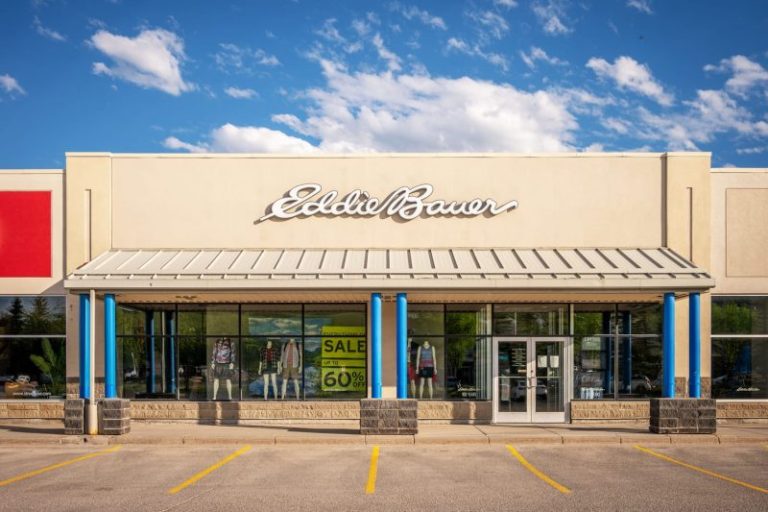
The operator of roughly 180 Eddie Bauer stores across the U.S. and Canada has filed for Chapter 11 bankruptcy protection, blaming declining sales and a litany of other industry headwinds.

The bankruptcy filing marks the third time in a little over two decades for the storied-but-now-tired brand that began as a Seattle fishing shop, later outfitted the first American to climb Mount Everest and made thousands of newfangled down jackets and sleeping bags for the military during World War II.

Eddie Bauer LLC said Monday it had entered into a restructuring pact with its secured lenders as it made the filing in the U.S. Bankruptcy Court for the District of New Jersey.

Most Eddie Bauer retail and outlet stores in the U.S. and Canada will remain open as the company winds down certain locations. It noted that it will conduct a court-supervised sales process, and if a sale can’t be executed, it will begin a wind-down of its U.S. and Canadian operations.

“This is not an easy decision,” said Marc Rosen, CEO of Catalyst Brands, which maintains the license to operate Eddie Bauer stores in the U.S. and Canada. “However, this restructuring is the best way to optimize value for the retail company’s stakeholders and also ensure Catalyst Brands remains profitable and with strong liquidity and cash flow.”

Eddie Bauer’s stores outside of the U.S. and Canada are operated by other licensees, are not included in the Chapter 11 filings, and will stay open, according to the release.

Authentic Brands Group continues to own the intellectual property associated with the Eddie Bauer brand and may license the brand to other operators, the company said. The operations of other brands in the Catalyst Brands portfolio are not affected by this filing and will continue in the normal course, according to the company.

Eddie Bauer’s e-commerce and wholesale operations will also not be impacted by the wind down, as they are operated by a company called Outdoor 5, LLC. That was a transition it made in January and became effective Feb. 2.

Eddie Bauer joins a growing list of U.S. retailers this year that are closing stores, as companies reorganize under bankruptcy protection or pare down their operations to focus on the most profitable businesses.

The parent company of Saks Fifth Avenue said last month that it was seeking bankruptcy protection, buffeted by rising competition and the massive debt it took on to buy its rival in the luxury sector, Neiman Marcus, just over a year ago. A few days later, the parent company said it was closing most of its Saks Off 5th stores.

Amazon said earlier this month that it was closing almost all of its Amazon Go and Amazon Fresh locations within days as it narrows its focus on food delivery and its grocery chain, Whole Foods Market.

Eddie Bauer’s namesake founder — an avid outdoorsman — started the company in Seattle in 1920 as Bauer’s Sports Shop, according to the brand’s website. In 1945, after making more than 50,000 jackets for the military, it launched a mail-order catalog.

“Bauer’s Sports Shop was not just a place where people purchased clothing and gear, it was a community hub where folks gathered to share their wisdom, learn, and talk about their experiences in the outdoors,” the website says.

The company created an American goose-down insulated jacket, known as the “Skyliner,” in 1936, and it became the company’s first patented jacket. It also outfitted the first American to climb Mount Everest — James W. Whittaker — with an Eddie Bauer parka in 1963.

After Bauer retired in 1968 and sold the business to his partner, the outdoor brand shifted more toward casual apparel and was bought by General Mills Inc. in 1971 and then by Spiegel Inc. in 1988. After Spiegel filed for bankruptcy in 2003 and most of its assets were sold, the remainder of the company was reorganized in 2005 as Eddie Bauer Holdings Inc.

In June 2009, Eddie Bauer filed bankruptcy and was acquired by Golden State Capital, the following month. In 2021, it was acquired by Authentic Brands and SPARC Group LLC.

A year ago, Catalyst was formed by the merger of SPARC and JCPenney, which Simon Property Group and fellow mall landlord Brookfield bought out of bankruptcy.

Rosen noted that even prior to the inception of Catalyst Brands last year, Eddie Bauer was in a “challenged situation.”

“Over the past year, these challenges have been exacerbated by various headwinds, including increased costs of doing business due to inflation, ongoing tariff uncertainty, and other factors,” he said.

He noted that while Catalyst’s leadership was able to make improvements in product development and marketing, those changes could not be implemented fast enough to fully address the problems created over several years.

Eddie Bauer had nearly 600 stores at its peak in 2001, according to CoStar Group Inc., a commercial real estate data firm.

In a note published earlier this month, Neil Saunders, managing director of GlobalData Retail, wrote that while the Eddie Bauer name is “well known,” the brand hasn’t kept pace with rivals like Swedish outdoor brand Fjallraven and Canadian label Arc’teryx. He also cited issues with quality deteriorating, which, for an outdoor brand measured by the performance of its products, is very problematic.

“And for many younger shoppers, the brand is seen as somewhat old-fashioned and a bit irrelevant,” he said.

This post appeared first on NBC NEWS

Senate Democrats aren’t ready to concede in their push for stringent reforms to the Department of Homeland Security (DHS) and are ready to buck Senate Republicans’ plans to avert a partial shutdown. 

Their resistance comes as Senate Republicans and the White House have floated a counteroffer to Democrats’ proposed DHS and Immigration and Customs Enforcement (ICE) reforms. But the two sides remain far apart on a deal to fund the agency, and they are quickly running out of time.

Sen. Chris Murphy, D-Conn., the top-ranking Senate Democrat on the Homeland Security spending panel, said he would not support another short-term DHS funding extension unless Republicans made meaningful concessions on immigration enforcement.

Murphy also dismissed the White House’s proposal as a list of ‘sophomoric talking points.’

‘We had plenty of time, they wasted two weeks,’ Murphy said. ‘They still haven’t given us any meaningful answer or response.’ 

His position is shared by several Senate Democrats who have unified around a push to codify a list of 10 DHS reforms. Those include requirements that ICE agents obtain judicial warrants, unmask and display identification, provisions Republicans have labeled red lines.

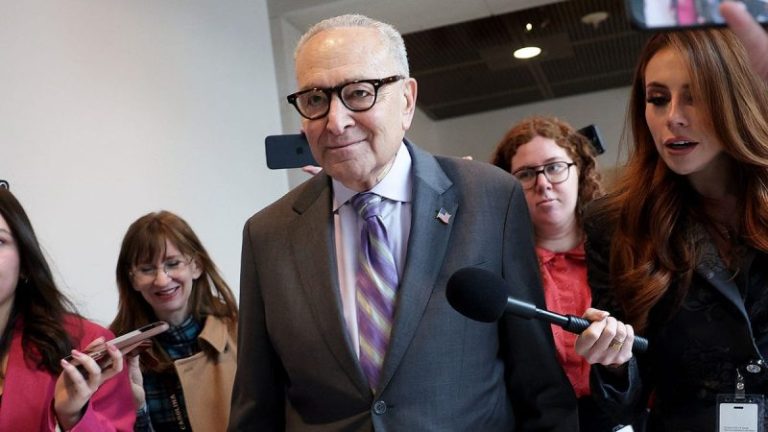
The standoff follows criticism late Monday from Senate Minority Leader Chuck Schumer, D-N.Y., and House Minority Leader Hakeem Jeffries, D-N.Y., who rejected President Donald Trump’s counteroffer.

In a joint statement, the leaders said the proposal ‘is both incomplete and insufficient in terms of addressing the concerns Americans have about ICE’s lawless conduct.’ Jeffries added he would not support another short-term funding patch, known as a continuing resolution (CR), Tuesday morning. 

Schumer argued that there was plenty of time to hash out a deal. 

‘There’s no reason we can’t get this done by Thursday,’ he said. 

With Friday’s funding deadline approaching, Senate Majority Leader John Thune, R-S.D., teed up a backup plan Tuesday night as the risk of a shutdown grew.

Thune and Senate Republicans have warned since Trump and Schumer finalized a broader funding agreement earlier this month that Congress did not have enough time to negotiate and pass a revised DHS funding bill in just two weeks.

‘I understand that, on the other side of the Capitol, the Democrats are already objecting to that, which is no big surprise since they haven’t voted for anything yet,’ Thune said.

‘I think there are Democrats in both the House and the Senate who do want to see this addressed,’ he added. ‘I’m hopeful the conversations lead to an outcome, but we probably won’t know by the time the current CR expires.’

As with most funding fights, both parties accuse the other of failing to negotiate in good faith.

‘I’m not for putting DHS on a CR until they show us they are serious about doing something,’ Sen. Patty Murray, D-Wash., the top-ranking Democrat on the Senate Appropriations Committee, told Fox News Digital.

Republicans counter that Democrats spent more than a week drafting their proposal, while the White House produced a counteroffer in less than two days.

Sen. Markwayne Mullin, R-Okla., told Fox News Digital Republicans didn’t expect their counterparts to accept their offer, ‘but we didn’t accept theirs either.’ 

‘Hopefully, this is a working footprint,’ Mullin said. ‘We can start negotiating because we’re definitely not accepting their things. But the thing is, what we’re trying to do is protect the ability for ICE and our border agents to do their job. I think it’s pretty clear, though, unless the Democrats want to shut down DHS, we’re going to have to do another CR.’

This post appeared first on FOX NEWS

The Justice Department has installed a Missouri-based U.S. prosecutor to head the Trump administration’s election probe in Fulton County, Georgia, according to recent court records, marking the latest instance in which an out-of-state prosecutor has been tasked with a leading role in a politically charged case.

The involvement of Thomas Albus, U.S. attorney for the Eastern District of Missouri, was revealed last month when he signed off on a Fulton County search warrant that authorized the FBI’s raid of a key Georgia election hub. The warrant authorized federal agents to seize a broad range of election records, voting rolls, and other data tied to the 2020 election, according to a copy reviewed by Fox News Digital.

The news, and the timing of Albus’ appointment, have sparked questions over the scope of the effort, including whether it is a one-off designed to shore up election-related vulnerabilities ahead of the midterms or part of a broader test case for expanded federal authority.

It also prompted Fulton County officials to sue the FBI earlier this month, demanding the return of the seized ballots.

The FBI’s decision to order the raid remains unclear, adding further uncertainty as to why Trump may have tapped Albus.

But the scope of the case is significant. Fulton County officials told reporters this month that FBI agents were seen carrying some 700 boxes of ballots from a warehouse near the election hub and loading them into a truck.

More answers could be revealed soon. The judge assigned to rule on Fulton County’s motion ordered the Justice Department to file by 5 p.m. Tuesday the arguments it made in its effort to obtain the search warrant. 

But it’s unclear how much information will be revealed as many of the documents are widely expected to remain under seal. 

Still, the installation comes as Fulton County emerged as ‘ground zero’ for complaints about voter fraud in the wake of the 2020 presidential elections, including from Trump, who lost the state to former President Joe Biden by a razor-thin margin.

And while it’s not the first time Trump’s Justice Department has sought to assign prosecutors to issues outside their district lines, unlike other efforts, the legality of Albus’s role in the district is likely to be upheld. 

Attorney General Pam Bondi reportedly tapped Albus last month to oversee election integrity cases nationwide, according to multiple news outlets. 

The DOJ did not immediately return Fox News Digital’s request for comment on the nature of his role in Georgia or elsewhere.

Under federal law — 28 U.S. Code § 515 — Bondi has the legal authority to appoint an individual to coordinate civil and criminal cases, including grand jury proceedings, across all federal districts nationwide. 

Albus also spent years as an assistant U.S. attorney for the Justice Department, where he helped prosecute hundreds of federal cases and jury trials, including on charges of white-collar crime, tax offenses, public corruption, and more.

Still, his installment is not completely without criticism. 

Some have played up his role as a former deputy attorney for then-Missouri Attorney General Eric Schmitt in 2020. 

Schmitt, now a U.S. senator, was one of 17 Republican attorneys general who filed a brief supporting Trump’s push to invalidate the election results of four battleground states after the election. 

There are key differences between his installment and the installment of former Trump lawyer Lindsey Halligan, tapped last year to serve as interim U.S. attorney for the Eastern District of Virginia. She was also the sole prosecutor who secured the indictments against former FBI director James Comey and New York Attorney General Letitia James.

A judge ruled in November she was illegally appointed to her role, prompting the dismissals of both cases.

Legal experts have cited differences between Halligan’s role and Albus’s role, which appears to enjoy wide protection under federal law.

‘Unlike Halligan, Albus’ appointment appears to be lawful under a federal statute that permits the attorney general to direct ‘any other officer of the Department of Justice’ to ‘conduct any kind of legal proceeding, civil or criminal … whether or not he is a resident of the district in which the proceeding is brought,’’ Barbara McQuade, a former U.S. attorney and University of Michigan Law School professor, said in a Bloomberg op-ed.

‘But sidelining Atlanta U.S. Attorney Theodore Hertzberg in favor of Albus is concerning nonetheless — especially given his ties to Trump allies.’

This post appeared first on FOX NEWS

Israeli Prime Minister Benjamin Netanyahu will meet President Donald Trump at the White House on Wednesday in a visit expected to center on Iran, as Washington weighs diplomacy against the threat of military action and Israel pushes to shape the scope of negotiations.

Trump has signaled the Iranian file will dominate the agenda. In a phone interview with Axios, the president said Tehran ‘very much wants to reach a deal,’ but warned, ‘Either we make a deal, or we’ll have to do something very tough — like last time.’

Netanyahu, speaking before departing Israel for Washington, said he intends to present Israel’s position. ‘I will present to the president our concept regarding the principles of the negotiations — the essential principles that are important not only to Israel but to anyone who wants peace and security in the Middle East,’ he told reporters.

The meeting comes days after U.S. and Iranian officials resumed talks in Oman for the first time since last summer’s 12-day war, while the United States continues to maintain a significant military presence in the Gulf — a posture widely viewed as both deterrence and for holding leverage in negotiations with Tehran.

From the U.S. perspective, Iran is seen as a global security challenge rather than a regional one, according to Jacob Olidort, chief research officer and director of American security at the America First Policy Institute. ‘It’s an important historic time of potentially seismic proportions,’ he told Fox News Digital.

‘Iran is not so much a Middle East issue. It’s a global issue affecting U.S. interests around the world,’ he added, calling the regime ‘probably the world’s oldest global terror network… [with] thousands of Americans killed through proxies.’

Olidort said the administration’s strategy appears to combine diplomacy with visible military pressure. ‘The president has been clear… should talks not be successful, the military option cannot be off the table,’ he said. ‘Military assets in the region serve as part of the negotiation strategy with Iran.’

For Israel, the main concern is not only Iran’s nuclear program but also its ballistic missile arsenal and regional network of armed groups.

Trump indicated to Axios that the United States shares at least part of that view, saying any agreement would need to address not only nuclear issues but also Iran’s ballistic missiles. 

Israeli intelligence expert Sima Shein has warned that negotiations narrowly focused on nuclear restrictions could leave Israel exposed. ‘The visit signals a lack of confidence that American envoys, Witkoff and Kushner, alone can represent Israel’s interests in the best way. They were in Israel just a week ago — but Netanyahu wants to speak directly with Trump, so there is no ambiguity about Israel’s position,’ she added.

Shein says Iran may be stalling diplomatically to see whether Washington limits talks to nuclear issues while avoiding missile constraints. Her analysis further suggests that a sanctions-relief agreement that leaves Iran’s broader capabilities intact could stabilize the regime at a moment of internal pressure while preserving its military leverage. 

‘An agreement now would effectively save the regime at a time when it has no real solutions to its internal problems. Lifting sanctions through a deal would give it breathing room and help stabilize it,’ she said.

‘If there is an agreement, the United States must demand the release of all detainees and insist on humanitarian measures, including medical support for those who have been severely injured. Washington would need to be directly involved in enforcing those provisions.’

Netanyahu said before leaving Israel that he and Trump would discuss ‘a series of topics,’ including Gaza, where a U.S.-backed postwar framework and ceasefire implementation remain stalled. 

According to Israeli reporting, Netanyahu plans to tell Trump that phase two of the Gaza peace plan ‘is not moving,’ reflecting continued disputes over disarmament, governance and security arrangements.

The timing of Netanyahu’s visit may also allow him to avoid returning to Washington the following week for the inaugural session of the Board of Peace, Shein said, noting the initiative is controversial in Israel’s parliament. 

‘Israel is deeply concerned about the presence of Turkey and Qatar on the board of peace and their malign influence on other members as well as on the Palestinian authority’s technocratic government,’ Dan Diker, president of the Jerusalem Center for Security and Foreign Affairs, told Fox News Digital.

‘Hamas’s control of Gaza has not weakened, while international commitments to disarm Hamas have appeared to weaken,’ he added, ‘The longer the U.S. waits before taking action against the Iranian regime, the more compromised Israel is in its ability and determination to forcibly disarm Hamas, both of which require the sanction and the blessing of the new international structures on Gaza.’

‘The prime minister’s deep concern is the stalled state of affairs both against the Iranian regime and apparently in Gaza. Timing is critical on both fronts. And for Israel, the window seems to be closing,’ Diker said.  


This post appeared first on FOX NEWS

The U.S. Food and Drug Administration (FDA) refused to consider Moderna’s application for a new flu vaccine using mRNA technology, the company announced Tuesday, a decision that could delay the introduction of a shot designed to offer stronger protection for older adults.

Moderna said it received what’s known as a ‘refusal-to-file’ (RTF) letter from the FDA’s Center for Biologics Evaluation and Research (CBER), citing the lack of an ‘adequate and well-controlled’ study with a comparator arm that ‘does not reflect the best-available standard of care.’

Stéphane Bancel, chief executive officer of Moderna, said the FDA’s decision did not ‘identify any safety or efficacy concerns with our product’ and ‘does not further our shared goal of enhancing America’s leadership in developing innovative medicines.’

‘It should not be controversial to conduct a comprehensive review of a flu vaccine submission that uses an FDA-approved vaccine as a comparator in a study that was discussed and agreed on with CBER prior to starting,’ Bancel said in a statement. ‘We look forward to engaging with CBER to understand the path forward as quickly as possible so that America’s seniors, and those with underlying conditions, continue to have access to American-made innovations.’

The rare decision from the FDA comes amid increased scrutiny over vaccine approvals under Health Secretary Robert F. Kennedy Jr., who has criticized mRNA vaccines and rolled back certain COVID-19 shot recommendations over the past year.

Kennedy previously removed members of the federal government’s vaccine advisory panel and appointed new members, and moved to cancel $500 million in mRNA vaccine contracts.

The FDA authorized COVID-19 vaccines for the fall for high-risk groups only. Last May, Kennedy announced the vaccines would be removed from the CDC’s routine immunization schedule for healthy children and pregnant women.

According to Moderna, the refusal-to-file decision was based on the company’s choice of comparator in its Phase 3 trial — a licensed standard-dose seasonal flu vaccine — which the FDA said did not reflect the ‘best-available standard of care.’

Moderna said the decision contradicts prior written communications from the FDA, including 2024 guidance stating a standard-dose comparator would be acceptable, though a higher-dose vaccine was recommended for participants over 65.

Moderna said the FDA ‘did not raise any objections or clinical hold comments about the adequacy of the Phase 3 trial after the submission of the protocol in April 2024 or at any time before the initiation of the study in September 2024.’

In August 2025, following completion of the Phase 3 efficacy trial, Moderna said it held a pre-submission meeting with CBER, which requested that supportive analyses on the comparator be included in the submission and indicated the data would be a ‘significant issue during review of your BLA.’

Moderna said it provided the additional analyses requested by CBER in its submission, noting that ‘at no time in the pre-submission written feedback or meeting did CBER indicate that it would refuse to review the file.’

The company requested a Type A meeting with CBER to understand the basis for the RTF letter, adding that regulatory reviews are continuing in the European Union, Canada and Australia.

Fox News has reached out to the Department of Health and Human Services for comment.

Fox News Digital’s Alex Miller and The Associated Press contributed to this report.

This post appeared first on FOX NEWS

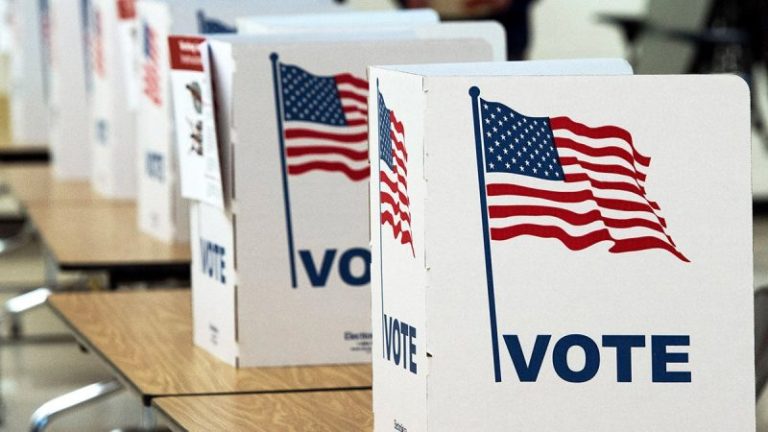
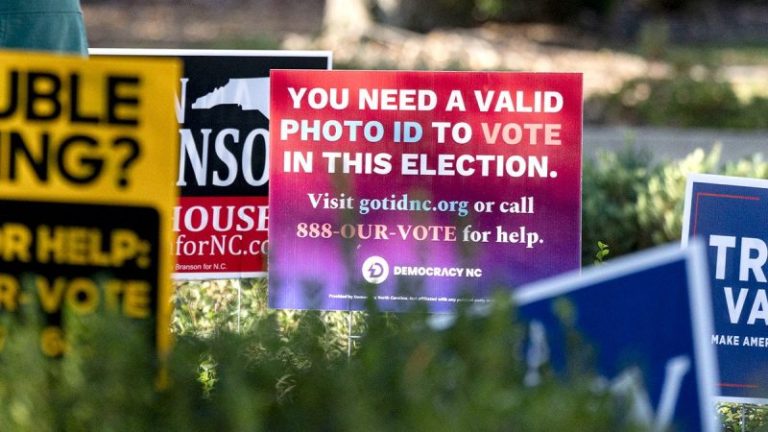
The House of Representatives is readying to vote on a bill that would mandate photo identification for voters across the United States in the coming 2026 midterm elections.

The House Rules Committee, the final gatekeeper before most bills see a chamber-wide vote, advanced the SAVE America Act on Tuesday as conservatives continue to pressure the Senate to take up the bill after its likely House passage.

It’s a sweeping piece of legislation aimed at keeping non-citizens from participating in U.S. elections.

Democrats have attacked the bill as tantamount to voter suppression, while Republicans argue that it’s necessary after the influx of millions of illegal immigrants who came to the U.S. during the four years of the Biden administration.

Speaker Mike Johnson, R-La., told reporters it would get a vote on Wednesday.

The legislation is led by Rep. Chip Roy, R-Texas, in the House, and Sen. Mike Lee, R-Utah, in the Senate.

It is an updated version of Roy’s Safeguarding American Voter Eligibility (SAVE) Act, which passed the House in April 2025 but was never taken up in the Senate.

Whereas the SAVE Act would create a new federal proof of citizenship mandate in the voter registration process and impose requirements for states to keep their rolls clear of ineligible voters, the updated bill would also require photo ID to vote in any federal elections.

It would also require information-sharing between state election officials and federal authorities in verifying citizenship on current voter rolls and enable the Department of Homeland Security (DHS) to pursue immigration cases if non-citizens were found to be listed as eligible to vote.

The legislation is highly likely to pass the House, where the vast majority — if not virtually all — Republicans have supported similar pushes in the past.

But in the Senate, where current rules say 60 votes are needed to overcome a filibuster and hold a final vote on a bill, at least seven Democrats would be needed even if all Republicans stuck together.

It’s why House conservatives are pushing Senate GOP leaders to change rules in a way that would effectively do away with the 60-vote threshold, even if alternative paths mean paralyzing the upper chamber with hours of nonstop debate.

‘[Senate Majority Leader John Thune, R-S.D.] will take it up. The only question is, will he take it up in an environment where it can pass?’ Roy posed to Fox News Digital on Tuesday. 

‘My view is that the majority leader can and should. I’m not afraid of amendment votes…we should table all their amendments, force them to run through all their speaking, make them take the floor and filibuster.’

This post appeared first on FOX NEWS

(TheNewswire)


February 10, 2026 TheNewswire – Vancouver, British Columbia, Canada – JZR Gold Inc. (the ‘Company’ or ‘JZR’) (TSX-V: JZR) today announces that subject to applicable shareholder and TSX Venture Exchange approvals, the Board of Directors of the Company has approved the amendment of an aggregate of 725,000 incentive stock options (the ‘Amended Options’) previously granted to certain directors, officers, employees and consultants of the Company under the Company’s Equity Incentive Plan (the ‘Option Amendments’). Pursuant to the Option Amendments, the expiry date has been extended to February 12, 2031, with no change to the exercise price.


For further information, please contact:


Robert Klenk

Chief Executive Officer

E: rob@jazzresources.ca
T: 604.329.9092


Forward-Looking Statements


This news release contains forward-looking statements, which includes any information about activities, events or developments that the Company believes, expects or anticipates will or may occur in the future.  Forward-looking statements in this news release include statements with respect to the anticipated use of proceeds from the exercise of the Warrants.  Forward-looking information reflects the expectations or beliefs of management of the Company based on information currently available to it.  Forward-looking information is subject to known and unknown risks, uncertainties and other factors that may cause the actual results, level of activity, performance or achievements of the Company to be materially different from those expressed or implied by such forward-looking information.  These factors include, but are not limited to: risks associated with the business of the Company; business and economic conditions in the mineral exploration industry generally; the supply and demand for labour and other project inputs; changes in commodity prices; changes in interest and currency exchange rates; risks related to inaccurate geological and engineering assumptions; risks relating to unanticipated operational difficulties (including failure of equipment or processes to operate in accordance with the specifications or expectations, unavailability of materials and equipment, government action or delays in the receipt of government approvals, industrial disturbances or other job action and unanticipated events related to health, safety and environmental matters); risks related to adverse weather conditions; geopolitical risk and social unrest; changes in general economic conditions or conditions in the financial markets; and other risk factors as detailed from time to time in the Company’s continuous disclosure documents filed with the Canadian securities regulators.  The forward-looking information contained in this press release is expressly qualified in its entirety by this cautionary statement.  The Company does not undertake to update any forward-looking information, except as required by applicable securities laws.


Neither the TSX Venture Exchange nor its regulation services provider (as that term is defined in the policies of the TSX Venture Exchange) accepts responsibility for the adequacy or accuracy of this press release.


None of the securities of JZR have been registered under the U.S. Securities Act of 1933, as amended (the ‘U.S. Securities Act’), or any state securities law, and may not be offered or sold in the United States or to, or for the account or benefit of, persons in the United States or ‘U.S. persons’ (as such term is defined in Regulation S under the U.S. Securities Act) absent registration or an exemption from such registration requirements. This news release shall not constitute an offer to sell or the solicitation of an offer to buy in the United States nor shall there be any sale of the securities in any State in which such offer, solicitation or sale would be unlawful.

NOT FOR DISTRIBUTION TO U.S. NEWSWIRE SERVICES OR FOR RELEASE, PUBLICATION, DISTRIBUTION OR DISSEMINATION, DIRECTLY OR INDIRECTLY, IN WHOLE OR IN PART, IN OR INTO THE UNITED STATES.

Copyright (c) 2026 TheNewswire – All rights reserved.

News Provided by TheNewsWire via QuoteMedia

This post appeared first on investingnews.com