Author

admin

Browsing

The gold price started off the new year on a strong note, approaching the US$4,500 per ounce level midway through the week and breaking through it on Friday (January 9).

As is often the case, silver put on a bumpier performance, trading within about a US$10 range. It recorded lows under US$73 per ounce and highs above US$82.

Beyond day-to-day price moves, there’s a lot of focus right now on how gold and silver will perform in 2026, and I want to spend some time looking at what experts see coming.

When it comes to gold I’m now seeing US$5,000 mentioned frequently, with multiple market watchers calling for it to reach that level as soon as the first quarter.

The consensus is that all of gold’s drivers either remain in place or are intensifying, including strong central bank buying, geopolitical tensions and easy money policies.

Here’s Alain Corbani of Montbleu Finance explaining why US$5,000 gold makes sense:

‘Between the end of the quantitative tightening and the end of the quantitative easing, usually gold doubles or triples, which means that in a perfect world, gold could go … from US$4,000 to US$6,000 — this is basically the bull figure. So that’s why, when we say US$5,000, that’s only 10 percent more than what we are trading at today.’

Silver is trickier to predict. The white metal is known for being volatile, and its strong end-of-2025 performance means that some experts’ 2026 price calls were reached before last year even ended.

So where does silver stand as the year begins?

I heard this week from David Morgan of the Morgan Report, who didn’t give a specific forecast, but said he believes silver is currently in ‘price discovery’ mode:

‘I’ve stated that we’re still in the price discovery mode — I truly believe that. What the true price of silver is in US dollars, Canadian dollars, I do not know. I think it’s north of $100 in US dollar terms, but it could be much higher than that.

I also spoke about silver with Doug Casey of InternationalMan.com. He said US$100 or even US$200 silver is possible, but for him the metal itself isn’t a speculative tool:

‘Is silver at a new high where it’s going to stay there? Yeah, very possibly — not a prediction. But I’m not selling my silver. I mean, why should I sell it? I’m holding it as an asset, not as a speculative device. So is it going to US$100 or US$200? It’s possible. I don’t really care, because … I don’t use either my silver or my gold as speculative vehicles. That’s not what they’re about to me.’

Andy Schectman of Miles Franklin made a similar statement, saying that while he’s certainly bullish on silver, 2025 showed how unpredictable it can be:

‘Rather than pick a price, I say we live in a world of probabilities. The probability that we see silver well north of US$100 to me is rather strong. Could it be as high as US$200 or higher? Sure. But to say that would be a guess, and an optimistic guess.

‘But look, if I would have told you last year that we would see silver at US$80, you’d say, ‘You know, well, that’s a pretty big statement, Andy.’ Yeah, sure it is. A 150 percent gain in a year is pretty big. So rather than continue with that, I would just simply say: higher than most people would actually probably think possible.’

Bullet briefing — Rio Tinto, Glencore reopen M&A talks

Commodities giants Rio Tinto (ASX:RIO,NYSE:RIO,LSE:RIO) and Glencore (LSE:GLEN,OTCPL:GLCNF) say they have restarted talks about potentially combining forces.

The two major miners spoke previously back in 2024, but failed to reach an agreement. This time around, they say their preliminary discussions are centered on merging some or all of their businesses, and could include the acquisition of Glencore by Rio Tinto.

The news was first reported by the Financial Times, with both companies confirming the story in press releases shortly thereafter. According to the news outlet, the combination would create a massive mining company with an enterprise value of over US$260 billion.

Both companies have said there’s no guarantee that any transaction will go through. However, it’s worth noting that Rio Tinto has changed leadership since the 2024 talks ended, with Simon Trott now at the helm. For its part, Glencore has reorganized its coal assets.

The Thursday (January 8) Financial Times piece also notes that Gary Nagle, chief executive at Glencore, spoke last month about the importance of size in the mining industry, saying that bigger companies are better able to create synergies, as well as attract talent and capital.

Regulations require Rio Tinto to announce its intentions either way by February 5 of this year.

Securities Disclosure: I, Charlotte McLeod, hold no direct investment interest in any company mentioned in this article.

This post appeared first on investingnews.com

The House of Representatives has passed a federal funding package totaling nearly $180 billion, putting Congress one modest step closer to averting a government shutdown at the end of this month.

The legislation accounts for just over $174 billion aimed at partially or fully funding the departments of Commerce, Justice, Interior and Energy, including laying out the budget for NASA, the FBI and federal nuclear energy projects.

Republicans and Democrats overwhelmingly supported the final package of three bills, which passed by a 397-28 vote. Twenty-two Republicans and six Democrats voted against the bill.

It comes after the bills ran into opposition from conservative Republicans on Wednesday.

Members of the House Freedom Caucus and others on the GOP’s right flank were incensed in particular by the Commerce-Justice-Science (CJS) appropriations bill, which they felt rank-and-file lawmakers did not get proper input on putting together.

It’s one of 12 annual appropriations bills that Congress is tasked with passing each fiscal year. Congressional leaders who negotiated the legislation along bipartisan lines originally included it in a three-bill ‘minibus’ that, when passed in the House and Senate, would mean half of those dozen bills are finished.

Conservatives also threatened to kill the bill during a procedural vote on Wednesday afternoon over the inclusion of a community funding project requested by ‘Squad’ member Ilhan Omar, D-Minn.

The bill would have given $1,031,000 to Generation Hope’s Justice Empowerment Initiative, which ‘helps justice-involved Minneapolis residents break the cycle through job training and support,’ according to a description of the funding request.

But conservatives argued that the funding was just another vehicle allowing Minnesota’s Somali community to fraudulently take taxpayer funds at a time when the state is grappling with a massive fraud scandal enveloping its public service programs.

‘Fraud is running RAMPANT in Minnesota under the failed leadership of Tim Walz. Democrats want to use earmarks to funnel another $1 MILLION to a Somali-led so-called ‘Justice Empowerment Initiative’ that ABUSES taxpayer dollars,’ Rep. Ralph Norman, R-S.C., said on X.

Community project funding, also known as an ‘earmark,’ is a request that specific lawmakers make that allows their districts to directly benefit from Congress’ federal funding bills.

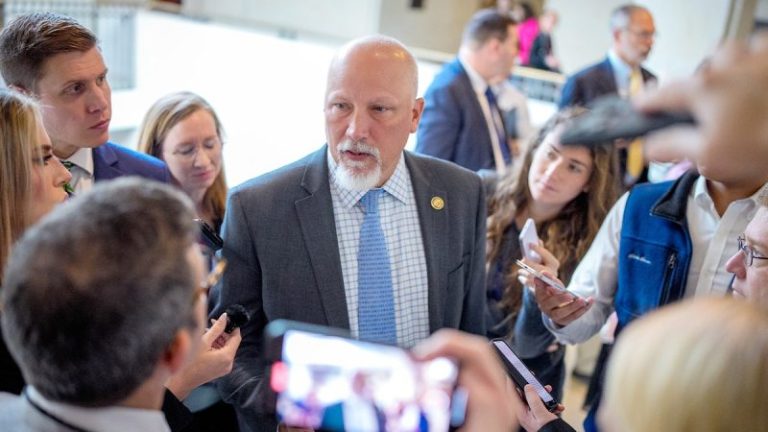
‘Earmarks, the currency of corruption, they’re coming back in full force in these products. And I just don’t support it,’ Rep. Chip Roy, R-Texas, told reporters Wednesday morning.

He was among the conservatives who Speaker Mike Johnson, R-La., negotiated with on the House floor for nearly half an hour as the minibus was in danger of failing during a procedural vote to allow for it to be debated.

In the end, House GOP leaders agreed to hold a separate vote on the CJS spending bill while also removing Omar’s earmark, which was also supported by Minnesota’s two Democrat senators.

‘Chalk one up for the good guys. Proud to work the last two days to stop the outrageous Ilhan Omar $1 million Somali earmark. Much more to do,’ Roy posted on X.

The CJS bill was first voted on, followed by the remaining two as a pair, and then a final vote on combining them before sending them to the Senate.

House Freedom Caucus Chairman Andy Harris, R-Md., told Fox News Digital he still anticipated ‘a number of’ his members will still vote against that bill specifically.

The legislation passed along bipartisan lines Thursday, with top House Appropriations Committee Democrat Rosa DeLauro, D-Conn., celebrating that the bill was free of GOP ‘poison pills’ earlier this week.

Its funding levels are above what was originally requested by President Donald Trump but below the threshold extending former President Joe Biden’s fiscal year 2024 spending levels via another continuing resolution would have brought.

The White House has also issued a statement of support for the minibus, which will be combined back into one bill before being sent to the Senate.

Congress has until the end of Jan. 30 to find a solution on the remaining six appropriations bills to avert another shutdown.

This post appeared first on FOX NEWS

European allies are working together on a plan in case the Trump administration acts on acquiring Greenland, a report said Wednesday. 

French Foreign Minister Jean-Noel Barrot told France Inter radio that the subject will be raised at a meeting with the foreign ministers of Germany and Poland. 

‘We want to take action, but we want to do so together with our European partners,’ Barrot said, according to Reuters.

A German government source also told Reuters that Germany is ‘closely working together with other European countries and Denmark on the next steps regarding Greenland.’

The White House said on Tuesday that President Donald Trump views acquiring Greenland as a national security priority and that the use of the U.S. military remains an option as his administration weighs how to pursue control of the Arctic territory.

‘President Trump has made it well known that acquiring Greenland is a national security priority of the United States,’ White House press secretary Karoline Leavitt said in a statement to Fox News.  

‘The President and his team are discussing a range of options to pursue this important foreign policy goal, and of course, utilizing the U.S. Military is always an option at the Commander in Chief’s disposal,’ she added. 

When asked Wednesday for a response to the Reuters report, the White House referred Fox News Digital to Leavitt’s remarks.

Trump told reporters on Air Force One over the weekend that the U.S. needs Greenland, a Danish territory, for ‘national security.’ 

European and Nordic leaders pushed back against the comments, with Finnish President Alexander Stubb, Norwegian Prime Minister Jonas Gahr Støre and Denmark’s Ambassador to the United States Jesper Møller Sørensen underscoring their support for Denmark’s sovereignty over Greenland and stressing that its future must be determined by Greenland and Denmark alone.

A senior European official told Reuters on Wednesday that Denmark must lead any effort to coordinate a response and ‘the Danes have yet to communicate to their European allies what kind of concrete support they wish to receive.’ 

Fox News Digital’s Jasmine Baehr and Ashley Carnahan contributed to this report. 

This post appeared first on FOX NEWS

The House of Representatives passed a bill to revive and extend COVID-19 pandemic-era enhanced Obamacare subsidies in a major victory for Minority Leader Hakeem Jeffries, D-N.Y.

Seventeen House Republicans broke ranks with GOP leaders to support the legislation after Democrats were successful in forcing a vote via a mechanism called a privileged resolution. The bill passed 230-196.

A discharge petition is a mechanism for getting legislation considered on the House floor even if the majority’s leadership is opposed to it, provided the petition gets a majority of House lawmakers’ signatures.

Jeffries filed a discharge petition late last year, which was then signed by four House Republicans — helping it clinch the critical majority threshold.

Five more House Republicans joined Democrats in a vote Wednesday evening to advance the legislation for final consideration Thursday.

The 17 Republicans who voted for the legislation were Reps. Brian Fitzpatrick, R-Pa.; Mike Lawler, R-N.Y.; Rob Bresnahan, R-Pa.; Ryan Mackenzie, R-Pa.; Mike Carey, R-Ohio; Monica De La Cruz, R-Texas; Andrew Garbarino, R-N.Y.; Will Hurd, R-Colo.; Dave Joyce, R-Ohio; Tom Kean Jr., R-N.J., Nick LaLota, R-N.Y., Max Miller, R-Ohio; Zach Nunn, R-Iowa; Maria Salazar, R-Fla.; Dave Valadao, R-Calif.; Derrick Van Orden, R-Wis.; and Rob Wittman, R-Va.

It underscores the perilously slim margins Speaker Mike Johnson, R-La., is governing with.

House Republicans hold just a two-vote majority with full attendance on both sides, numbers that could easily shift when lawmakers are absent for personal or health reasons.

As Rep. Tim Burchett, R-Tenn., put to reporters on Wednesday morning, ‘We are one flu season away from losing the majority.’

The successful vote on Thursday is a blow for Johnson, who argued for weeks that the majority of House Republicans were opposed to extending the COVID-19 pandemic-era tax subsidies.

But a significant number of GOP moderates were frustrated that their party leaders in the House and Senate had done little to avert a price hike for millions of Americans’ insurance premiums. 

A Democrat-controlled Congress voted twice, in 2020 and in 2021, to enhance Obamacare subsidies to give more people access to federal healthcare during the pandemic.

Those subsidies were only extended through 2025, however.

The vast majority of Republicans believe the subsidies are a COVID-era relic of a long-broken federal healthcare system. Conservatives argued that the relatively small percentage of Americans who rely on Obamacare meant that an extension would do little to ease rising health costs that people across the country are experiencing.

But a core group of moderates has been arguing that a failure to extend a reformed version of them would force millions of Americans to grapple with skyrocketing healthcare costs this year.

Those moderates were also frustrated with Jeffries for not working with Republicans on a bipartisan solution to the subsidies but felt they were left with little choice but to support Democrats’ bid in the end.

House Republicans passed a healthcare bill in mid-December aimed at lowering those costs for a broader swath of Americans, but that legislation has not been taken up in the Senate.

There’s also little chance the three-year extension will pass the upper chamber, however. Similar legislation led by Senate Democrats failed to reach the necessary 60-vote threshold to advance in December.

This post appeared first on FOX NEWS

President Donald Trump said on Thursday that he plans to meet with Venezuelan opposition leader Maria Corina Machado in Washington next week.

During an appearance on Fox News’ ‘Hannity,’ Trump was asked if he intends to meet with Machado after the U.S. struck Venezuela and captured its president, Nicolás Maduro.

‘Well, I understand she’s coming in next week sometime, and I look forward to saying hello to her,’ Trump said.

This will be Trump’s first meeting with Machado, who the U.S. president stated ‘doesn’t have the support within or the respect within the country’ to lead.

According to reports, Trump’s refusal to support Machado was linked to her accepting the 2025 Nobel Peace Prize, which Trump believed he deserved.

But Trump later told NBC News that while he believed Machado should not have won the award, her acceptance of the prize had ‘nothing to do with my decision’ about the prospect of her leading Venezuela.

This post appeared first on FOX NEWS

President Donald Trump announced in an early Friday morning Truth Social post that he has ‘cancelled the previously expected second Wave of Attacks’ against Venezuela in light of the ‘cooperation’ between the foreign nation and the U.S.

‘Venezuela is releasing large numbers of political prisoners as a sign of ‘Seeking Peace.’ This is a very important and smart gesture. The U.S.A. and Venezuela are working well together, especially as it pertains to rebuilding, in a much bigger, better, and more modern form, their oil and gas infrastructure. Because of this cooperation, I have cancelled the previously expected second Wave of Attacks, which looks like it will not be needed, however, all ships will stay in place for safety and security purposes,’ Trump said in the post.

He noted that he will meet with ‘BIG OIL’ figures at the White House on Friday.

‘At least 100 Billion Dollars will be invested by BIG OIL, all of whom I will be meeting with today at The White House. Thank you for your attention to this matter!’ he declared in the post.

The president’s comments come after he unilaterally ordered an attack against Venezuela last week in which U.S. forces successfully captured Nicolás Maduro.

Trump noted in a Wednesay Truth Social post, ‘I have just been informed that Venezuela is going to be purchasing ONLY American Made Products, with the money they receive from our new Oil Deal. These purchases will include, among other things, American Agricultural Products, and American Made Medicines, Medical Devices, and Equipment to improve Venezuela’s Electric Grid and Energy Facilities.’

‘In other words, Venezuela is committing to doing business with the United States of America as their principal partner – A wise choice, and a very good thing for the people of Venezuela, and the United States. Thank you for your attention to this matter!’ he added.

This post appeared first on FOX NEWS

Investor Insight

Brightstar is a cash-flowing gold producer with a 4.0Moz Mineral Resource base and two major development hubs advancing toward investment decisions. Mining from two high-grade underground mines in Laverton, continuous high-grade drilling success and near-term production expansion positions the company for significant value creation in a record gold price environment.

Overview

Gold continues to demonstrate its strength as a store of value, reaching record highs above US$4,000 per ounce in 2025 amid persistent global uncertainty, inflationary pressures and heightened geopolitical risk. In this environment, investors are increasingly turning to high-quality Australian gold producers with scale, growth visibility and near-term catalysts.

Brightstar Resources (ASX:BTR) is strategically positioned to benefit from this macro setting as a cash-flowing, multi-asset gold producer and developer with operations and growth projects across the Goldfields (Laverton–Menzies) and Sandstone regions of Western Australia. The company now controls 3.9 Moz of mineral resources across these assets, providing a diversified and scalable platform for sustained growth.

Brightstar’s unique value proposition is centered on its existing production from two underground mines, which Brightstar operates directly rather than relying on external mining contractors. The Second Fortune and Fish underground mines are delivering consistent production under an ore purchase agreement with Genesis Minerals, generating cashflow that supports ongoing drilling and development studies.

The company’s growth is anchored by a dual-hub development strategy. In the Goldfields region, the company has completed a definitive feasibility study outlining ~70,000 ounces per annum of production over an initial five-year period, with a final investment decision targeted for early 2026. Ongoing underground and near-mine drilling continues to confirm mine life extensions and additional high-grade potential.

At Sandstone, Brightstar has consolidated a 2.4 Moz district-scale gold system following the Alto and Aurumin transactions and is now progressing a major PFS evaluating a new 4 to 5 Mtpa processing facility. More than 70,000 metres of drilling has already been completed toward a material mineral resource upgrade planned for mid-2026.

Together, these hubs underpin a pipeline of near-term and long-term catalysts supported by extensive infrastructure, a strengthened technical team, and a well-funded balance sheet. As Brightstar advances feasibility work, executes its multi-rig drilling programs, and expands its production profile, the company is well placed to deliver meaningful shareholder value in a rising gold price environment.

Company Highlights

  • ASX-listed gold producer and developer with a consolidated 3.9 Moz mineral resource base at 1.5 g/t gold, spanning the Goldfields portfolio (Laverton + Menzies projects) and the Sandstone Hub in Western Australia.
  • Established Goldfields production base, with Brightstar operating two underground mines – Second Fortune and Fish – within the Laverton area, supplying continuous gold production under an ore purchase agreement with Genesis Minerals.
  • Goldfields feasibility study (June 2025) completed, outlining ~70,000 oz of annual gold production over the first five years, with a final investment decision targeted for March 2026.
  • High-grade mine life growth targeted from the Goldfields underground mines, including depth and strike extensions at Fish and strong regional hits near Second Fortune.
  • Menzies Hub is positioned for future production, with Yunndaga advancing toward underground development following significant 2025 drill results, informing upcoming mineral resource and development updates.
  • Sandstone Hub expanded to 2.4 Moz at 1.5 g/t gold, with a major pre-feasibility study (PFS) underway for a 4 to 5 Mtpa processing facility and more than 70,000 m of drilling completed toward a material mineral resource upgrade in mid-2026.
  • Strong exploration momentum, with active drilling programs at Laverton and Sandstone and exceptional 2025 results, including 10 m @ 43.8 g/t gold at the Musketeer prospect.
  • Well-funded balance sheet, with ~$41 million in cash and liquidity (as of September 2025) and a revolving stockpile finance facility supporting continuous drilling and development activities.

Key Projects

Goldfields Assets (Laverton + Menzies)

Brightstar’s Goldfields portfolio combines the Laverton and Menzies hubs into a single, development-ready production centre. Together, these assets host a significant portion of Brightstar’s consolidated resource base and provide both near-term production and long-term growth opportunities.

Laverton Hub

Brightstar’s Laverton Hub comprises two operating underground mines – Second Fortune and Fish– and a series of advanced open pit deposits, including the material Cork Tree Well and Lord Byron Deposits. These deposits sit on granted mining leases and benefit from established haul roads, existing mine infrastructure, and proximity to Brightstar’s planned processing facility.

Highlights:

  • Two operating underground mines: Second Fortune and Fish continue to deliver steady production into Genesis Minerals’ Laverton mill under the ore purchase agreement. Recent underground and surface drilling has confirmed strong continuity of mineralisation at depth, particularly at Fish where multiple lodes have been intersected, including 7.0m @ 3.31 g/t gold, 9.9m @ 2.90 g/t gold, and 1.1m @ 17.6 g/t gold.
  • High-grade near-mine discoveries: At Second Fortune, drilling at nearby prospects such as Linden Giant and Alawa has returned strong results (10m @ 9.83 g/t gold; 1m @ 53.8 g/t gold), demonstrating the potential for new satellite ore sources within 3 km of existing mine workings.
  • Large-scale open pit opportunity: Cork Tree Well and Lord Byron remain central to Brightstar’s long-term development plan. The planning scenarios outlined in the June 2025 feasibility study support multi-year open pit mining with robust production profiles and strong economic potential.

Growth Drivers:

  • Ongoing underground drilling campaigns at Second Fortune and Fish targeting mine life extensions
  • DFS optimisation underway to refine the design and throughput of Brightstar’s proposed 1 Mtpa to 1.5 Mtpa processing plant
  • Continued evaluation of near-mine targets leveraging existing infrastructure and haulage routes
  • Integration of new high-grade drilling into updated open pit and underground mine plans

Menzies Hub

The Menzies Hub comprises a district-scale mineralised corridor extending more than 20 km along the Menzies Shear Zone. These deposits lie directly adjacent to the Goldfields Highway and sit on granted mining leases, supporting near-term development readiness.

Highlights

  • Substantial resource base: The Menzies Hub hosts 0.7Moz @ 1.5g/t Au of mineral resources across multiple deposits including Lady Shenton, Yunndaga, Aspacia and the Lady Harriet system.
  • Advancing underground development: Yunndaga is emerging as Brightstar’s next underground mining front, with drilling completed in 2025 returning high-grade intercepts such as 16m @ 8.03 g/t gold and 8m @ 6.67 g/t gold. These results will underpin updated mineral resource and ore reserve estimates planned for late 2025.
  • Open pit opportunities: Lady Shenton and surrounding deposits are expected to support a multi-year open pit mining schedule, forming part of the production base in the Goldfields feasibility study. Permitting and approvals work is progressing, with first production targeted post-FID.

Growth Drivers:

  • Updated mineral resource for Yunndaga to support underground mine planning
  • Feasibility study optimisation to refine timing and sequencing of Menzies open pits
  • Ongoing engagement with regional mills to evaluate toll-milling options where appropriate
  • Progression toward a mining decision following completion of study phases

Sandstone Hub

Brightstar’s Sandstone Hub has been transformed into a major district-scale opportunity following the consolidation of Alto Metals and Aurumin’s Sandstone assets. The combined project now contains 2.4 Moz at 1.5 g/t gold, spread across multiple open pit camps including Lords, Vanguard, Indomitable, Havilah and Montague.

Highlights:

  • Significant resource growth platform: The ambition at Sandstone is to convert this extensive mineralised system into a long-life standalone operation. Brightstar has already completed more than 70,000 m of drilling since acquisition, with a major mineral resource update targeted for mid-2026.
  • High-grade exploration success: Recent drilling has delivered standout results such as 10 m @ 43.8 g/t gold at the Musketeer prospect, highlighting the potential for new high-grade zones within the broader system.
  • Processing pathway defined: A PFS is underway examining a new 4 to 5 Mtpa processing hub located at the historic Sandstone mill site, aiming to establish Sandstone as a cornerstone asset in Brightstar’s future growth.

Growth Drivers:

  • 120,000 m drilling program planned through June 2026 to upgrade key deposits to indicated category
  • PFS delivery targeted for mid-2026
  • Long-term development scenario supported by strong infrastructure and granted mining tenure

Management Team

Alex Rovira – Managing Director

Alex Rovira is a qualified geologist and an experienced investment banker having focused on the metals and mining sector since 2013. Rovira has experience in ASX equity capital markets activities, including capital raisings, IPOs and merger and acquisitions.

Richard Crookes – Non-executive Chairman

Richard Crookes has over 35 years’ experience in the resources and investments industries. He is a geologist by training having previously worked as the chief geologist and mining manager of Ernest Henry Mining in Australia. Crookes is managing partner of Lionhead Resources, a critical minerals investment fund and formerly an investment director at EMR Capital. Prior to that he was an executive director in Macquarie Bank’s Metals Energy Capital (MEC) division where he managed all aspects of the bank’s principal investments in mining and metals companies.

Andrew Rich – Executive Director

Andrew Rich is a degree qualified mining engineer from the WA School of Mines and has obtained a WA First Class Mine Managers Certificate. Rich has a strong background in underground gold mining with experience predominantly in the development of underground mines at Ramelius Resources (ASX:RMS) and Westgold Resources (ASX:WGX).

Jonathan Downes – Non-executive Director

Jonathan Downes has over 30 years’ experience in the minerals industry and has worked in various geological and corporate capacities. Experienced with gold and base metals, he has been intimately involved with the exploration process through to production. Downes is currently the managing director of Kaiser Reef, a high grade gold producer, and non-executive director of Cazaly Resources.

Nicky Martin – Chief Financial Officer

Nicky Martin is an experienced finance and accounting professional holding tertiary qualifications in accounting and finance and is a qualified CPA. Martin was previously the Head of Finance at Pilbara Minerals Ltd (ASX:PLS) where she oversaw and was actively involved in a rapidly growing mining success story.

This post appeared first on investingnews.com

Commodities giants Rio Tinto (ASX:RIO,NYSE:RIO,LSE:RIO) and Glencore (LSE:GLEN,OTCPL:GLCNF) said on Thursday (January 8) that they have restarted talks about a potential business combination.

The two major miners spoke previously back in 2024, but failed to reach an agreement.

This time around, they say their preliminary discussions are centered around a combination of some or all of their businesses; this could include the acquisition of Glencore by Rio Tinto.

The news was first reported by the Financial Times, with both companies confirming the story via press release shortly thereafter. According to the news outlet, the combination of Rio Tinto and Glencore would create a massive mining company with an enterprise value north of US$260 billion.

The two firms have said there’s no guarantee that any transaction will go through.

However, it’s worth noting that Rio Tinto has changed leadership since the 2024 talks ended, with Simon Trott now at the helm. For its part, Glencore has reorganized its coal assets.

The Financial Times also notes that Glencore CEO Gary Nagle spoke last month about the importance of size in the mining industry, saying that bigger companies have various advantages.

“It makes sense to create bigger companies,” the executive explained to reporters. “Not just for the sake of size, but also to create material synergies, to create relevance, to attract talent, to attract capital.”

Regulations require Rio Tinto to announce its intentions either way by February 5 of this year.

Securities Disclosure: I, Charlotte McLeod, hold no direct investment interest in any company mentioned in this article.

This post appeared first on investingnews.com

The global lithium market enters 2026 after a punishing 2025 marked by oversupply, weaker-than-expected EV demand and sustained price pressure, although things began turning around for lithium stocks in Q4.

Lithium carbonate prices in North Asia fell to four-year lows early in the year, triggering production cuts and project delays, before rebounding sharply in the second half. By late December, prices had jumped 56 percent from their January levels, signaling the start of a potential market rebalancing.

Analysts point to tightening inventories and high-cost supply under strain as early signs of a recovery, while long-term demand from electrification, energy storage and the energy transition remains intact.

Battery energy storage systems are emerging as a major growth driver, expected to account for roughly a quarter of global battery demand in 2025. In the US, storage could make up 35 to 40 percent of battery demand in the coming years, according to Benchmark Mineral Intelligence’s Iola Hughes.

“LFP is the story right now,” Hughes said, highlighting falling costs and technological innovation as key enablers for large-scale deployment. Global storage remains concentrated in China and the US, but new markets like Saudi Arabia are scaling rapidly.

As storage expands in scale, geography and strategic importance, it is set to become a central pillar of lithium demand heading into 2026.

1. Lithium Argentina (NYSE:LAR)

Year-to-date gain: 106.39 percent
Market cap: US$891.03 million
Share price: US$5.49

Lithium Argentina produces lithium carbonate from its Caucharí-Olaroz brine project in Argentina, developed with Ganfeng Lithium (OTC Pink:GNENF,HKEX:1772). The company was spun out from Lithium Americas in October 2023 and changed its name from Lithium Americas (Argentina) in January 2025.

In mid-April, Lithium Argentina executed a letter of intent with Ganfeng Lithium to jointly advance development across the Pozuelos-Pastos Grandes basins.

In August, Lithium Argentina agreed to form a new joint venture with Ganfeng Lithium that will combine the companies’ projects in the Pozuelos and Pastos Grandes basins of Salta, Argentina.

The joint venture will bring together Ganfeng’s wholly owned Pozuelos-Pastos Grandes (PPG) project and Lithium America’s Pastos Grandes and Sal de la Puna projects, in which Ganfeng currently holds a 15 percent and 35 percent stake respectively.

Once completed, Ganfeng will hold a 67 percent stake in the consolidated PPG project, and Lithium Argentina will hold a 33 percent interest.

In Q4, Lithium Argentina released a positive scoping study for the PPG project, confirming its scale and strong economics. The consolidated project hosts a measured and indicated resource of 15.1 million metric tons of lithium carbonate equivalent (LCE) and is designed for staged production of up to 150,000 metric tons per year over a 30 year mine life.

In the same announcement, the company confirmed receipt of an environmental approval for Stage 1 from the Secretariat of Mining and Energy of the Province of Salta.

Lithium Argentina released its Q3 results in November, noting approximately 8,300 metric tons of lithium carbonate production at its Caucharí-Olaroz operation during the quarter, with 24,000 metric tons produced between January and September.

Company shares rose to a year-to-date high of US$5.58 on December 31, in line with rising lithium carbonate prices.

2. Sociedad Química y Minera (NYSE:SQM)

Year-to-date gain: 87.39 percent
Market cap: US$19.66 billion
Share price: US$68.98

SQM is a major global lithium producer, with operations centered in Chile’s Salar de Atacama. The company extracts lithium from brine and produces lithium carbonate and hydroxide for use in batteries.

SQM is expanding production and holds interests in projects in Australia and China, including a 50/50 joint venture for the Mt Holland lithium operation in Western Australia. In July, the company produced its first battery-grade lithium hydroxide production at its Kwinana refinery in the state.

In late April, Chile’s competition watchdog approved the partnership agreement between SQM and state-owned copper giant Codelco aimed at boosting output at the Atacama salt flat. The deal, first announced in 2024, reached another milestone when it secured approval for an additional lithium quota from Chile’s nuclear energy regulator CChEN.

SQM ended the year finalizing the agreement. The partnership was formalized through SQM’s subsidiary SQM Salar absorbing Codelco’s Minera Tarar and being renamed Nova Andino Litio.

SQM reported a net income of US$404.4 million for the first nine months of 2025, rebounding from a US$524.5 million loss in the same period of 2024. Revenue totaled US$3.25 billion, down 5.9 percent year-over-year, while gross profit reached US$904.1 million.

The company’s third-quarter performance highlighted the turnaround, as SQM achieved record lithium sales volumes. It reported net income of US$178.4 million, up 36 percent from Q3 2024, and revenue of US$1.17 billion, up 8.9 percent. Gross profit for the quarter climbed 23 percent to US$345.8 million.

SQM attributed the rebound to higher realized lithium prices and improved operational efficiency, signaling a strong recovery trajectory for the remainder of 2025.

Shares of SQM reached a year-to-date high of US$71.63 on December 26.

3. Albemarle (NYSE:ALB)

Year-to-date gain: 64.29 percent
Market cap: US$16.71 billion
Share price: US$142.01

North Carolina-based Albemarle is dividing into two primary business units, one of which — the Albemarle Energy Storage unit — is focused wholly on the lithium-ion battery and energy transition markets. It includes the firm’s lithium carbonate, hydroxide and metal production.

Albemarle has a broad portfolio of lithium mines and facilities, with extraction in Chile, Australia and the US. Looking first at Chile, Albemarle produces lithium carbonate at its La Negra lithium conversion plants, which process brine from the Salar de Atacama, the country’s largest salt flat. Albemarle is aiming to implement direct lithium extraction technology at the salt flat to reduce water usage.

Albemarle’s Australian assets Wodgina hard-rock lithium mine in Western Australia, which is owned and operated by the 50/50 MARBL joint venture with Mineral Resources (ASX:MIN,OTC Pink:MALRF). Albemarle wholly owns the on-site Kemerton lithium hydroxide facility. The company’s other Australian joint venture is the Greenbushes hard-rock mine, in which it holds a 49 percent interest.

In late October, Albemarle signed an agreement to sell its 51 percent stake in its refining catalyst business, Ketjen, leaving it with 49 percent ownership, part of a broader portfolio reshaping that also includes the sale of Ketjen’s 50 percent stake in the Eurecat joint venture to partner Axens.

The combined deals are expected to generate approximately US$660 million in pre-tax cash proceeds and strengthen Albemarle’s financial flexibility. Both transactions are anticipated to close in the first half of 2026, subject to regulatory approvals.

In November, Albemarle reported third‑quarter results that reflected improved operations amid continued lithium market headwinds. The company logged net sales of roughly US$1.31 billion, a slight year‑over‑year decline driven by lower energy storage pricing.

Albemarle generated US$356 million in quarterly cash from operations, noting the company remained on track to reduce full‑year capital expenditures to around US$600 million while targeting positive free cash flow of US$300 million to US$400 million in 2025.

Shares of Albemarle marked a year-to-date high of US$150.01 on December 26, amid strengthening lithium prices.

4. Lithium Americas (NYSE:LAC)

Year-to-date gain: 47 percent
Market cap: US$1.24 billion
Share price: US$4.41

US-focused Lithium Americas is developing its flagship Thacker lithium Pass project located in Humboldt County in northern Nevada. The project is a joint venture between Lithium Americas at 62 percent and General Motors (NYSE:GM) at 38 percent.

According to the company, Thacker Pass holds the “largest measured lithium reserve and resource in the world.”

In March, Lithium Americas secured a US$250 million investment from Orion Resource Partners to advance Phase 1 construction of the project, which is expected to fully cover development costs through the construction phase. On April 1, the joint venture partners made a final investment decision for the project, with completion targeted for late 2027.

Shares of Lithium Americas surged in late September, rising from US$3.07 to US$7.37 in three days. Its share price reached a 2025 high of US$10.05 on October 13.

Lithium Americas’ share price rose on news of renegotiation talks over its US$2.26 billion Department of Energy loan tied to the Thacker Pass project. According to media reports, the Trump administration was seeking up to a 10 percent equity stake as part of amendments to the loan’s repayment structure.

In response, Lithium Americas offered no-cost warrants for 5 to 10 percent of its shares and agreed to cover related administrative costs, while requesting changes to the amortization schedule without altering the loan’s term or interest.

An agreement was reached on October 1 and Lithium Americas received the first US$435 million installment of the loan on October 20.

The company ended the year by announcing it was being added to the S&P/TSX Composite Index (INDEXTSI:OSPTX).

5. Sigma Lithium (NASDAQ:SGML)

Year-to-date gain: 20.23 percent
Market cap: US$1.5 billion
Share price: US$13.49

Sigma Lithium is a Brazil-focused lithium producer supplying chemical-grade lithium concentrate to the global battery market. The company operates the Grota do Cirilo project in Minas Gerais, one of the world’s largest hard-rock lithium operations.

Sigma’s Greentech industrial lithium plant currently produces about 270,000 metric tons per year of lithium concentrate, equivalent to roughly 38,000 to 40,000 metric tons of LCE. The company is building a second processing plant that is expected to lift total capacity to approximately 520,000 metric tons of concentrate annually.

In September, Sigma Lithium’s flagship Grota do Cirilo operation in Brazil faced both regulatory scrutiny and operational disruption.

That month, Brazilian prosecutors requested a pause in operations after a technical review flagged shortcomings in the project’s Environmental Impact Assessment, citing potential water-management risks to the Piauí stream from planned open pits, a key water source for nearby communities, particularly during droughts.

While it denied issues with its EIA, Sigma paused mining to upgrade equipment and improve efficiency. The company phased down operations in September and shut the mine throughout October, leading to a sharp drop in output.

In mid-November, Sigma reported a strong Q3 2025, with net revenue rising 69 percent quarter-over-quarter and 36 percent year-over-year. The company generated US$24 million from final price settlements on sales completed by the end of Q3, with a further US$4 million in cash expected from additional settlements.

Sigma also expects to receive approximately US$33 million from the sale of 950,000 metric tons of lithium-bearing material that can be reprocessed by its customers, providing an additional near-term cash inflow.

Operationally, it said mining activities would restart by the end of November, with full ramp-up targeted for the first quarter of 2026. Because the company took over mining operations from its equipment contractor earlier in 2025, the restart is supported by upgraded equipment leased directly from manufacturers and operated in-house.

Sigma Lithium shares rose to a year-to-date high of US$14.50 on December 26.

Securities Disclosure: I, Georgia Williams, currently hold no direct investment interest in any company mentioned in this article.

This post appeared first on investingnews.com
Yvonne Blaszczyk, president and CEO of BMG Group, sees the gold price hitting US$5,000 per ounce in Q1 on the back of a complex geopolitical landscape.

‘In terms of the geopolitical configuration of the world, we are witnessing history right now,’ she said.

Securities Disclosure: I, Charlotte McLeod, hold no direct investment interest in any company mentioned in this article.

This post appeared first on investingnews.com