
Author

admin

Browsing

Americans’ personal data could be collected and stored overseas — even if they’ve never downloaded a foreign-developed app themselves — according to a new FBI alert warning about the risks tied to popular mobile platforms.

That means information like a person’s name, email address or phone number could be pulled from someone else’s contact list and potentially stored abroad if a friend or family member grants an app access to their device.

The warning comes after years of scrutiny over TikTok’s ties to China, but the FBI alert suggests the concerns extend beyond any single platform to a broader range of foreign-developed apps.

In a public service announcement, the FBI said many widely used apps developed overseas, particularly those tied to China, may access extensive data once permissions are granted, including address books containing information on both users and non-users.

5 SIMPLE TECH TIPS TO IMPROVE DIGITAL PRIVACY

The bureau also warned that some apps may continue collecting data in the background after access is granted and, in certain cases, store that information on servers in countries where local laws could allow government access.

“Developer companies can store collected data on users’ private information and address books, such as names, e-mail addresses, user IDs, physical addresses, and phone numbers of their stored contacts,” the FBI said. “The app can persistently collect data and users’ private information throughout the device, not just within the app or while the app is active.”

CHINESE HACKERS REPORTEDLY BREACHED PHONES AT ‘HEART OF DOWNING STREET’ IN GLOBAL SPY CAMPAIGN

The FBI did not name specific companies, but the warning could apply to a range of widely used apps developed by Chinese firms — including video-editing platform CapCut, shopping apps like Temu and SHEIN, and social media platforms such as Lemon8 — several of which rank among the most downloaded apps in the United States.

U.S. officials have long warned that data collected by Chinese-linked platforms could be used to build detailed profiles of Americans, map personal and professional networks, and potentially support intelligence-gathering efforts, particularly if accessed under China’s national security laws.

The FBI added that apps operating in China are subject to the country’s national security laws, which could allow the government to access user data.

The FBI also pointed to possible warning signs that an app may be collecting more data than expected, including unusual battery drain, spikes in data usage, or unauthorized account activity after installation — indicators that could suggest background data collection or other suspicious behavior.

The bureau urged users to limit unnecessary data sharing, download apps only from official app stores, and regularly review permissions granted to mobile platforms. The bureau also warned that apps obtained from third-party sites may carry malware designed to gain unauthorized access to personal data.

Years of scrutiny over TikTok culminated in a 2026 deal that forced its Chinese parent company to relinquish control of U.S. operations to an American-led group in order to address fears over data access and national security.

The FBI’s latest warning suggests those risks may extend beyond a single platform to a broader range of foreign-developed apps used by millions of Americans.

The Chinese embassy could not immediately be reached for comment. 

A week after President Donald Trump urged Sydney Gruters to run for an open GOP-held congressional seat in Florida, the former executive director of the state’s New College Foundation and wife of Republican National Committee (RNC) Chair Joe Gruters declared her candidacy.

“As a working mother of three, I see firsthand how much pressure rising prices are putting on families across Southwest Florida,” Sydney Gruters said as she launched her campaign on Thursday. “From groceries and gas to housing and insurance, too many families, seniors and veterans are being stretched thin. I’m running for Congress to protect our conservative values and fight for the people of this district and give them a strong voice in Washington.”

With Trump’s support, Gruters is considered the clear frontrunner to succeed retiring longtime GOP Rep. Vern Buchanan, her former boss, in Florida’s right-leaning 16th Congressional District, which stretches from Tampa’s eastern suburbs south to Bradenton. Republicans currently control the House 218-214 and will be defending their fragile majority in this year’s midterm elections.

Trump, in a social media post on March 24, emphasized that Gruters would “fight tirelessly.”

RNC CHAIR BETS ON ‘SECRET WEAPON’ TO DEFY MIDTERM HISTORY, PROTECT GOP MAJORITIES

“Should she decide to enter this Race, Sydney Gruters has my Complete and Total Endorsement. RUN, SYDNEY, RUN!” the president declared.

While her husband, a Florida state senator and top Trump supporter in the Sunshine State, is well known nationally as he steers the RNC, the 44-year-old Sydney Gruters is well known in her district and very familiar with Congress.

SCOOP: HOUSE GOP CAMPAIGN ARM LAUNCHES ‘MAGA MAJORITY’ PROGRAM TO BOOST TRUMP-ALIGNED CANDIDATES

Gruters served as Buchanan’s operation director for a decade (2007-2017) and later as district director to GOP Rep. Greg Steube (2019-2023) in the neighboring 17th Congressional District.

In-between her two congressional stints, she served in Trump’s first administration as state director for Florida and the U.S. Virgin Islands in the Department of Agriculture.

Prior to launching her congressional campaign, Gruters finished up her tenure as vice president of advancement and executive director of the New College Foundation.

Gruters took her position at the smaller liberal arts state college in Sarasota soon after Republican Gov. Ron DeSantis installed a conservative board of trustees at the school. The one-time progressive-minded college subsequently created a classical education curriculum, which emphasizes liberal arts and Western teachings. Last autumn, the college was among the first to sign on to Trump’s education compact, which offers schools federal funding for backing his education priorities.

As she launches her congressional bid, Gruters is also backed by Maggie’s List, a political group that works to elect conservative women to Congress.

Three other Republicans, as well as three Democrats, are also running to succeed Buchanan.

Joe Gruters, in a statement to Fox News Digital, said he’s “incredibly proud of Sydney as she launches her campaign, and it’s an honor to see her earn President Trump’s support. As always, the RNC remains neutral in Republican primaries, so any support I offer will be purely in my personal capacity.”

Trump won 57% of the vote in the district in his 2024 presidential election victory. And Buchanan grabbed nearly 60% of the vote as he won re-election. But the seat may be refigured ahead of this year’s midterms, as the GOP-dominated Florida legislature meets in a special session later this month to deal with congressional redistricting in the red-leaning state.

More than a dozen Democratic-led states are accusing the Trump administration of violating a federal court order by sharing Medicaid data with Immigration and Customs Enforcement, asking a judge to enforce the ruling.

The states’ complaint asks the U.S. District Court for the Northern District of California to enforce its existing injunction blocking HHS from sharing Medicaid data with ICE. 

“The Trump Administration appears to be defying a direct court order blocking it from sharing the personal, sensitive data of individuals including U.S. citizens and lawful permanent residents. It’s invasive — and deeply troubling,” said California Attorney General Bonta, who led the coalition of 22 states. “When Californians signed up for Medi-Cal, they did so with the understanding that their data would not be used for purposes unrelated to administering this program. I urge the court to enforce its earlier order and make clear that these guardrails exist for anyone who is lawfully residing in the United States.”

The complaint stems from a lawsuit spearheaded by California in July 2025 against the Trump administration. The lawsuit accused Health and Human Services of violating federal law through its “mass transfer of sensitive Medicaid data” of both lawful permanent and temporary residents. The lawsuit also argued that the sharing of the personal information will likely create a “chilling effect on individuals’ willingness to enroll in Medicaid programs” for which they are legally eligible.

SECOND FEDERAL JUDGE BLOCKS IRS FROM SHARING ADDRESSES WITH ICE

A federal judge ruled last December that the Trump administration is not allowed to collect the personal information of lawful permanent residents or citizens, but that it can continue to collect basic information from individuals such as addresses, birthdates and immigration status for residents with temporary status. However, the scope of data that can be collected is limited and cannot include sensitive health information. 

The attorneys general accuse Health and Human Services of sharing “a large and complex” set of data on Medicaid recipients with ICE, which is in violation of a federal court ruling allowing the exchange of limited personal information but excluding the information of legal permanent residents. The complaint also accuses the Trump administration of failing to share its criteria for determining if a resident is being “lawfully present.”

CATO Institute Senior Legal Fellow Dan Greenberg told Fox News Digital there is “a strong possibility” that HHS and ICE violated the district court’s order.

LETITIA JAMES SUES HHS OVER TYING FEDERAL FUNDS TO TRANSGENDER POLICY

“The reason this is a strong possibility is that DHHS communications apparently indicate that it shared a ‘large and complex’ dataset of Medicaid recipients with ICE,” Greenberg said. “That phrase suggests that the dataset that was shared with ICE may have included information that is outside the scope of the court order. That is a question of fact: that is why the states are now asking the court to compel the federal government to explain just what was shared and how it is now being used.”

Greenberg also pointed out that the Transformed Medicaid Statistical Information System database does not “appear to have any simple or direct way to identify/single out immigrants who are undocumented,” making “information-sharing that complies with that court order difficult or impossible.”

“The TMSIS identifies people who are only eligible for emergency Medicaid services, but the problem is that this class of people includes both undocumented and lawfully present immigrants,” Greenberg said. “In short, it is as if the court order said that only some of the information in one particular file should be disclosed, but there is reason to believe that DHHS decided that — because they can’t figure out how to separate out this particular type of information – they may have handed over the whole filing cabinet.”

In addition to California, attorneys general of Arizona, Colorado, Connecticut, Delaware, Hawaii, Illinois, Massachusetts, Maine, Maryland, Michigan, Minnesota, Nevada, New Jersey, New Mexico, New York, Oregon, Rhode Island, Vermont, Washington, Wisconsin, and the governor of Kentucky signed on to the complaint.

Fox News Digital reached out to the White House and Health and Human Services for comment.

Liberal Supreme Court Justice Ketanji Brown Jackson faced viral backlash from conservatives over a comment during oral arguments about birthright citizenship where she floated an analogy comparing the issue to stealing a wallet in Japan. 

“I was thinking, you know, I’m a U.S. citizen and visiting Japan and what it means is that, you know, if I steal someone’s wallet in Japan, the Japanese authorities can arrest me and prosecute me,” Jackson said during Wednesday’s oral arguments centered on President Trump’s 2025 executive order advancing a narrower interpretation of the 14th Amendment’s citizenship clause.

“It’s allegiance, meaning, they can control you as a matter of law. I can also rely on them if my wallet is stolen to, you know, under Japanese law, go and prosecute the person who has stolen it. So there’s this relationship based on, even though I’m a temporary traveler, I’m just on vacation in Japan, I’m still locally owing allegiance in that sense. Is that the right way to think about it? And if so, doesn’t that explain why both temporary residents and undocumented people would have that kind of, quote-unquote, allegiance, just by virtue of being in the United States?”

KAGAN TURNS ON LIBERAL ALLY JACKSON WITH FOOTNOTE JAB OVER FREE SPEECH

Conservatives and Republican politicians quickly seized on Jackson’s comment equating territorial jurisdiction with political allegiance, arguing that her analogy fundamentally misreads the 14th Amendment’s birthright-citizenship clause.

“I don’t think KBJ knows what words mean,” conservative communicator Steve Guest posted on X.

“Leave it to Justice Jackson to defend the suicide pact of birthright citizenship for illegals by not understanding the difference between territorial jurisdiction (obeying local laws), and political allegiance,” Turning Point USA’s Andrew Kolvet posted on X. “If territorial jurisdiction means allegiance, every tourist is a US citizen, which is insane. The whole thing is so low IQ and embarrassing for the Court.”

“Oh, good grief, come on now!” Florida Gov. Ron DeSantis posted on X.

“That’s not what allegiance means,” GOP Sen. Ted Cruz posted on X.

“We only have thirty more years of this, guys,” Outkick founder Clay Travis posted on X.

“Because nothing says ‘allegiance’ quite like going to a new country and immediately breaking its laws,” conservative commentator Greg Price posted on X.

“This is exactly how bad arguments get dressed up to sound intellectual,” conservative commentator A Gene Robinson posted on X.

“‘Subject to the laws’ does NOT equal allegiance. That’s where this entire thing collapses. If you step into a country… you are bound by its laws. That’s jurisdiction. It’s not loyalty. It’s not consent. It’s not allegiance. A criminal is ‘subject to the law’ the moment he commits a crime…That doesn’t make him part of the nation. It makes him accountable to it. That wallet analogy proves the opposite of what it’s trying to argue.”

TRUMP MAKES HISTORIC SCOTUS APPEARANCE FOR BIRTHRIGHT CITIZENSHIP CASE

“Not sure if she’s aware but of all the countries to mention Japan is probably the least helpful to her cause,” journalist Miranda Devine posted on X. “Babies born in Japan can only become citizens if they have Japanese blood and are born to registered Japanese citizens whose names appear in a special book.”

“No words,” GOP Rep. Derrick Van Orden posted on X.

“Peak moron,” conservative radio host Dana Loesch posted on X.

“I cannot believe this woman is on the court, and I cannot believe anyone on the left thinks letting her air these thoughts out loud does them any favors,” Real Clear Investigations senior writer Mark Hemingway posted on X.

Wednesday’s oral arguments centered on Trump’s 2025 executive order advancing a narrower interpretation of the 14th Amendment’s citizenship clause so that children born in the United States to parents who are in the country illegally or temporarily would not automatically receive U.S. citizenship. 

At issue in the case before the Supreme Court is the language in the amendment that says anyone born in the United States and “subject to the jurisdiction thereof” is automatically a citizen. President Donald Trump and conservative legal analysts have argued the provision was a relic of the Civil War and intended for freed slaves rather than a justification of birth tourism and illegal immigration.

Fox News Digital’s Ashley Oliver contributed to this report.

Stocks surged Tuesday, with the S&P 500 closing up 2.9% while the Nasdaq rose 3.8% and the Dow gained 1,125 points.

But this very good day capped off what was a very bad month for U.S. equities. The S&P 500 fell 5.09% in March, and the Nasdaq Composite declined 4.75%.

The U.S.-Israeli war on Iran and the near-total blockade of the Strait of Hormuz, a narrow, Iranian controlled waterway through which a fifth of the world’s crude oil typically transits every day, weighed heavily on markets throughout the month.

Tuesday was also the end of the first quarter of the year, one when the S&P 500 and Nasdaq posted their worst annual starts since 2022, when the Russian invasion of Ukraine rocked markets.

For the first quarter, the S&P 500 dropped 4.6% and the Nasdaq declined 7.1%.

Oil prices, meanwhile, soared over the past month, driving up the cost of fuel and triggering a domino effect of higher prices around the globe.

Brent, the international oil benchmark, posted its largest monthly percentage increase ever, after having risen more than 60%. The price of U.S. West Texas Intermediate crude oil also soared in March, climbing more than 50% in its biggest one-month gain since 2020.

For millions of drivers in the U.S., the increases manifest as higher prices for gas. And here, too, the past month was remarkable. The average price of unleaded gasoline hit $4 per gallon Tuesday, up more than 34% in just four weeks.

But it’s not just gas prices that hit U.S. households this month.

More than half of all adults in the U.S. own stocks, often via their retirement accounts and the broader funds those managed accounts invest in. Most of the time, market moves up and down don’t swing the value of those kinds of diversified retirement accounts.

But March was a different story.

“Stocks have been following the lead of oil prices at an unprecedented rate over the last several weeks, and if the U.S. just walked away from the Middle East with the Strait still blockaded, energy markets would likely remain incredibly supply-constrained, keeping prices high,” analysts at Bespoke Investment Group wrote Tuesday.

“The longer prices are high and supplies are limited, the worse it’s going to be for the global economy and ultimately stock prices,” they added.

The wild market swings of the second Trump administration are in sharp contrast to how Donald Trump said the markets would react if he were elected to a second term in 2024.

“There are many people that are saying that the only reason the Stock Market is high is because I am leading in all of the Polls, and if I don’t win, we will have a CRASH of similar proportions to 1929,” Trump wrote on Truth Social in May 2024 as he campaigned for the presidency.

Shortly after he was re-elected in 2024, Trump was asked whether he believed market indexes were good barometers of his performance in office. “To me … all of it together, it’s very important,” he told CNBC.

But during the first 14 months of his second term, U.S. markets have faced some of the sharpest drawdowns in history.

In February and March of last year, Trump’s sweeping tariff policies roiled the market, pushing the S&P 500 into its seventh-fastest correction of all time. A correction is when a stock or an index declines 10% from its most recent record high.

Just over a year later, the S&P 500 isn’t far from doing it again. As of Tuesday’s closing bell, the index had tumbled 6.7% from its most recent high in January.

As oil prices rise, stocks typically fall given that higher oil prices typically lead to higher prices across a number of industry sectors over the long run.

Already, inflation is on the rise around the world. On Tuesday morning, eurozone inflation came in at 2.5%, from 1.9% the month before, according to the European Central Bank.

On Tuesday, the Nikkei 225 in Japan recorded its worst month since 2008. In Europe, the Stoxx 600 index posted its worst month since 2022.

Two near-corrections in just over a year illustrates just how volatile the administration’s policies have been for markets.

Still, since Trump took office for a second time, the S&P 500 is up 8%, although last year global stocks far outpaced the broad U.S. index.

In 2025, global stocks as measured by the MSCI ACWI ex USA index rose nearly 30%, while U.S. stocks rose just 16%. Global stocks haven’t beaten American equities by that much during the first year of a presidential term since 1993, according to data from Bloomberg.

In recent weeks, Trump has repeatedly touted the Dow’s recent 50,000 milestone as a sign that the markets are doing well in his presidency.

“You know, it’s sort of crazy, I hit 50,000 on the Dow,” Trump said at an investment conference in Florida on Friday. “People said that wouldn’t be possible within four years.”

“And then we hit 7,000 on the S&P,” Trump added. “People said that’s even harder than hitting 50,000 on the Dow.”

As of Tuesday, the Dow had plunged more than 3,600 points since it hit 50,000, a drop of nearly 7.5%.

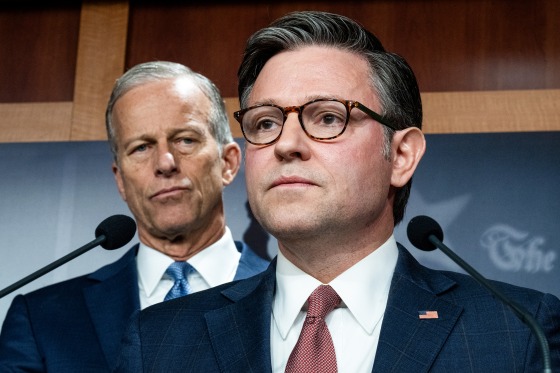
WASHINGTON — House and Senate Republican leaders jointly announced a plan Wednesday that they said would end the shutdown of the Department of Homeland Security that caused major airport delays.

“In the coming days, Republicans in the Senate and House will be following through on the President’s directive by fully funding the entire Department of Homeland Security on two parallel tracks: through the appropriations process and through the reconciliation process,” House Speaker Mike Johnson, R-La., and Senate Majority Leader John Thune, R-S.D., said in a statement.

The two leaders were vague about the exact plan, but it appears to closely resemble the Senate’s preferred path from Friday.

Johnson and Thune heavily implied that it would be for the Senate to, once again, pass a bill it approved unanimously last week, which it could try to do as early as Thursday.

It would fund all of DHS except ICE and Customs and Border Protection, which Democrats won’t agree to fund without reforms to immigration enforcement operations. Those two agencies already have separate funding.

House Republican leaders trashed that bill and rejected it Friday, but they now appear ready to back down and accept the Senate plan. They would have to vote to pass it through the House.

GOP leadership had no immediate comment on the timing for a vote. Both chambers are scheduled to be on recess until April 13.

Then Republicans would fund ICE and CBP in a separate party-line “budget reconciliation” bill that could bypass a filibuster and get approved without any Democratic votes. The timing for that is even less clear.

Johnson and Thune said the “two-track” plan would “fully reopen the Department, make sure all federal workers are paid, and specifically fund immigration enforcement and border security for the next three years so that those law-enforcement activities can continue uninhibited.”

A White House official told NBC News that the administration supports the Johnson-Thune plan.

Earlier Wednesday, President Donald Trump called on Republicans to pass the party-line bill “no later than June 1st.” He threw the earlier plans to reopen DHS into chaos last week when he declined to comment on the Senate bill, which led House Republicans to reject it.

DHS has been shut down for more than a month, with employees for the TSA, FEMA and other agencies going for weeks without pay. Trump signed an executive order last week to pay TSA employees, but the legality and length of that plan are murky. Thousands of civilian Coast Guard employees and other DHS workers are still not being paid.

Senate Minority Leader Chuck Schumer, D-N.Y., slammed Republicans for having “derailed a bipartisan agreement” for days, “making American families pay the price for their dysfunction.”

“Throughout this fight, Senate Democrats never wavered. We were clear from the start: fund critical security, protect Americans, and no blank check for reckless ICE and Border Patrol enforcement,” he said Wednesday. “We were united, held the line, and refused to let Republican chaos win.”

On Friday, House Minority Leader Hakeem Jeffries, D-N.Y., said, “House Democrats are prepared to support the bill to end the Trump-Republican shutdown of the Department of Homeland Security, make sure TSA agents are paid, stand up for FEMA and for the Coast Guard, for our cyber security professionals, and stop inconveniencing Americans.”

The grandson of the inventor of the Reese’s Peanut Butter Cups, who has publicly criticized The Hershey Company for tinkering with the classic formula in its spinoff products, appears to have gotten some sweet revenge.

The candy company has announced that it will return to using “classic milk and dark chocolate recipes” in all its Reese’s and Hershey’s products by 2027.

“If this is true, the people who deserve the credit are the loyal fans who were alarmed by what Hershey was doing,” Brad Reese told NBC News on Wednesday. “But I am seeing a lot of red flags here. I think what Hershey is trying to do here is change with PR narrative.”

Reese, whose demands that Hershey stop skimping on chocolate went viral in February, said he trusts his taste buds more than he trusts the company that produces iconic candies that bear his family name.

“If something like the Valentine’s Day Reese’s Mini Heart still doesn’t taste like real milk chocolate next year, I’ll know they’re lying,” he said.

Hershey CEO Kirk Tanner made the announcement on Tuesday in an interview with Bloomberg.

“We’re going to make some small investments to really align the portfolio to what the brand stands for,” Tanner said. “That consistency is important across the brand.”

Reese’s Peanut Butter Cups have been made with the same ingredients since 1928 — milk chocolate and peanut butter.

Starting next year, Tanner said candies inspired by the originals — like the “mini Reese’s cups and shapes,” as well as the Reese’s Fast Break candy bar — will also be made with real milk chocolate instead of a chocolate compound coating.

In addition, all the classic Hershey’s chocolate bars will also be made with “pure milk and dark chocolate,” he said. And Hershey is “enhancing” the Kit Kat candy bar “for a creamier taste and texture.”

In all, the company said the shift from chocolate compound coatings to the real thing will affect less than 3% of the Reese’s products and a tiny portion of Hershey’s products.

And Hershey is “on track” to remove all artificial colors from its products by the end of next year, the company said.

Tanner, in the Bloomberg interview, also insisted that the switch back to real chocolate was in the works long before Reese went public with his complaints.

“Right when I started with the company, we did a deep dive across our portfolio,” said Tanner, who joined the firm in August 2025.

Reese scoffed at that claim from Tanner.

“You know when this became an issue?” he asked. “Valentine’s Day. This has been going on since Valentine’s Day.”

Reese began taking Hershey to task after discovering that the company had replaced the milk chocolate with a chocolate-flavored coating on some of its Reese’s-inspired products, like the Valentine’s Day Reese’s Mini Hearts.

Infuriated, Reese posted a link to a letter of complaint he wrote to Todd Scott, who does the corporate branding for Hershey, on his LinkedIn page.

Reese invoked the name of his grandfather H.B. Reese, who created the iconic peanut butter cup in 1928 and started a candy company that produced them until 1963. Hershey has been making them ever since.

“My grandfather,” Reese wrote, “built REESE’S on a simple, enduring architecture: Milk Chocolate + Peanut Butter.”

But Hershey, he wrote, has replaced the original formula “with compound coatings and Peanut Butter with peanut-butter style cremes across multiple REESE’S products.”

That letter went viral.

Hershey insisted that the Reese’s Peanut Butter Cups were made the same way they had always been. But the company also conceded that, as it expanded its “Reese’s product line,” it had tinkered with the original recipe.

Right now, the Reese’s Mini Eggs that are a staple at Easter celebrations do not contain milk chocolate, according to their labels.

Neither do Reese’s Pieces, which were introduced in 1978 and became a sensation after they were featured in the 1982 movie “E.T. the Extra-Terrestrial.”

In response to an NBC News request for a full list of Reese’s and Hershey’s products that will return to using “classic milk and dark chocolate recipes,” the company released a statement that reiterated much of what Tanner said earlier.

“The core recipes for our Hershey’s chocolate bars and Reese’s peanut butter cups have not changed,” it said in part.

American flyers still smarting from interminable airport security lines are about to get another shock.

A looming global jet fuel shortage is expected to hike the cost of air travel and reduce flight schedules, as airlines look to offset rising prices.

On Monday, JetBlue announced it was raising baggage fees, citing “rising operating costs.”

“While we recognize that fee increases are never ideal, we take careful consideration to ensure these changes are implemented only when necessary,” the carrier said.

United Airlines CEO Scott Kirby said costs to passengers have already been increasing. Data from flight information group OAG shows average airfares in the past week reached $465, the highest price point for the same period since at least 2019.

“We have to raise prices to deal with higher fuel prices,” Kirby acknowledged at a company event last week in Los Angeles. In a subsequent memo, he added: “It may be a challenge to continue passing through much of the increased fuel price if oil stays higher for longer.”

The rising prices are the latest example of the economic fallout from the war with Iran. Analysts have started warning that the full toll has only begun to be accounted for as the global economy absorbs the loss of critical energy exports out of the region due to the closure of the Strait of Hormuz and damage to other key energy infrastructure sites in the region. On Tuesday, U.S. gasoline prices hit $4 a gallon for the first time since 2022 amid surging oil prices. Major stock indexes, meanwhile, have fallen by nearly 10% since the start of the war.

In the case of air travel, the industry is facing jet fuel prices that have surged 85% in the U.S. since the day before the war began in February, according to data from Argus published by the industry group Airlines for America. On Monday, they hit a record $4.62 a gallon.

Most U.S. carriers no longer hedge fuel costs, said Henry Harteveldt, president of Atmosphere Research Group. So they are forced to pass on some costs to passengers.

While U.S. carriers largely source jet fuel domestically, countries in Asia and Europe that are more reliant on Middle East stocks have begun signaling they are taking unprecedented measures to conserve jet fuel. In South Korea, carriers have requested that the government help redirect fuel stocks bound for export back to local markets.

The Financial Times reported Monday that the U.K. was also facing an acute shortage, with no Britain-bound cargoes visible on the water as transit through the Strait of Hormuz remains blocked. Some foreign carriers have begun charging fuel surcharges of as much as $150.

As overseas carriers begin looking to alternative supply bases, the cost for a global commodity like jet fuel rises across the board.

“It shocks the entire mechanism,” said Jaime Brito, an executive director at Oil Price Information Service consultancy.

President Donald Trump commented on the jet fuel shortages Tuesday morning, though he did not mention their impact on U.S. travelers.

“All of those countries that can’t get jet fuel because of the Strait of Hormuz, like the United Kingdom, which refused to get involved in the decapitation of Iran, I have a suggestion for you: Number 1, buy from the U.S., we have plenty, and Number 2, build up some delayed courage, go to the Strait, and just TAKE IT,” he wrote on Truth Social.

Airlines are also signaling capacity cuts to cope with rising costs. United will drop about 5% of planned flights in mostly “off-peak periods” — like red-eye and midweek routes — during the second and third quarters of 2026 to further mitigate the cost increases.

“We’re certainly going to be nimble in terms of capacity to make sure that supply and demand stay in balance,” American Airlines CEO Robert Isom said at a JPMorgan conference earlier this month.

Kyle Potter, executive editor of the Thrifty Traveler, said most carriers have quietly been raising airfares since the Iran war began. He said airlines typically move in droves when making pricing decisions, so it is likely that other carriers may also soon begin raising baggage fees or seek other forms of ancillary revenue. Potter noted that unlike airfares, revenues from these fees are not subject to federal excise taxes.

As a result, the fees — unlike airfares — are unlikely to come back down assuming jet fuel prices recover.

Representatives for five other major U.S. carriers did not respond to a request for comment.

The acute fuel price increase comes as air travel demand has remained steady, with January and February ticket sales at or near records. While investors have taken airline stocks down some 25% since the start of the Iran war, Kirby said that customers appear willing to keep booking thanks to healthy demand even if airfare rises.

“The number of wealthy Americans who are traveling is bigger and wealthier than ever, and that is what much of the airline industry is relying on right now,” Potter said. “And that means they’re more immune to higher fees, higher fares and just getting turned off by negative news about travel.”

For 47 days, Democrats have refused to fund Immigration and Customs Enforcement (ICE) and parts of U.S. Customs and Border Protection (CBP) without sweeping reforms. President Donald Trump is now considering a move that could make both agencies shutdown-proof for the rest of his second term. 

The president is asking top Republicans to draft a budget reconciliation package funding ICE and CBP that could pass both chambers without any Democratic support.

“We are going to work as fast, and as focused, as possible to replenish funding for our Border and ICE Agents, and the Radical Left Democrats won’t be able to stop us,” Trump wrote on Truth Social. “We will not allow them to hurt the families of these Great Patriots by defunding them.”

The president added that he wants the legislation on his desk by June 1.

HOUSE CONSERVATIVES ERUPT OVER SENATE GOP, WHITE HOUSE DEAL AMID SAVE ACT FIGHT

The budget reconciliation push comes as Republican efforts to fund ICE and the Border Patrol through regular order have stalled in the Senate due to widespread opposition from Democrats.

With the Senate’s 60-vote legislative threshold in place, Senate Minority Leader Chuck Schumer, D-N.Y., effectively has veto power over DHS appropriations if he keeps his caucus in line.

The budget reconciliation process would allow Republicans to steer around Democratic opposition and pass a DHS funding bill at a simple majority threshold. Republicans narrowly passed Trump’s One Big Beautiful Bill Act using reconciliation in June 2025 after months of intraparty squabbling.

House Speaker Mike Johnson, R-La., and Senate Majority Leader John Thune, R-S.D., quickly endorsed the proposal in a joint statement released Wednesday.

The GOP leaders said DHS would be funded along “two parallel tracks,” meaning that ICE and the Border Patrol would receive an influx of money through reconciliation while the rest of DHS would be funded through the normal appropriations process.

“We cannot allow Democrats to any longer put the safety of the American public at risk through their open border policies, so we are taking that off the table,” Johnson and Thune wrote.

The GOP leaders added that they will seek three years of immigration enforcement and border security funding, effectively preventing Democrats from using the appropriations process as leverage over the president’s immigration agenda for the remainder of his term.

Though ICE and the Border Patrol received an unprecedented infusion of money through Trump’s “big, beautiful” bill, certain support staff employed by both agencies have not been paid during the seven-week shutdown.

The U.S. Coast Guard, the Transportation Security Administration (TSA), the Federal Emergency Management Agency (FEMA) and the U.S. Secret Service have seen a more significant lapse in appropriations, though Trump took executive action to provide back pay to TSA agents reporting to work during the funding lapse.

HOUSE REPUBLICANS PASS RIVAL DHS PLAN, SETTING UP SENATE FIGHT AS SHUTDOWN SET TO BECOME LONGEST IN HISTORY

A Republican aide told Fox News Digital the Senate could pass a bill funding the non-immigration parts of DHS via unanimous consent as soon as Thursday morning during a planned pro forma session. The measure would then go to the House for consideration.

The anticipated vote comes after House GOP leadership rejected a Senate-passed deal on Friday including similar language, citing their objections to funding immigration enforcement outside the normal appropriations process.

Sen. John Hoeven, R-N.D., indicated to reporters Monday that Trump would ultimately get behind the Senate’s preferred approach. 

“The Democrats can’t create another shutdown like they did this time,” Hoeven said, if the DHS budget reconciliation bill were to be signed into law.

The North Dakota lawmaker also disputed that a reconciliation package would take several months to put together.

“We’ll get it done as quick as you can,” Hoeven said. “I hope it’s certainly not months.”

A second reconciliation package could prove more difficult in an election year when lawmakers will have to identify spending cuts to pay for the border security and immigration funding. The strategy could also extend the funding lapse for ICE and the Border Patrol for several more months.

Amid both chambers’ planned two-week recesses, Trump told the New York Post on Tuesday he is considering calling Congress back to Washington to find a solution to the DHS shutdown.

House Majority Whip Tom Emmer, R-Minn., told CNBC’s “Squawk Box” on Wednesday that a “skinny reconciliation bill” funding the department would pass both chambers once Congress resumes session in mid-April if a deal has not been reached.

House GOP leadership has previously voiced skepticism about funding immigration enforcement through a budget reconciliation package. Some conservatives have also complained about the precedent of letting Democrats decide which agencies receive funding through the normal appropriations process.

“The problem is that what they’re doing is they’re placing the burden on the Republican Party entirely to make sure that we have border security funding and Immigration and Customs Enforcement, because they’re going to try to force it into a reconciliation bill,” House Speaker Mike Johnson, R-La., told Fox News’ Brian Kilmeade on Friday. “That’s a very difficult task. It is a high risk gamble for us to assume that we could do that.”

President Donald Trump suggested Wednesday that Iran may be seeking a ceasefire, but analysts say real power lies with hardline figures inside the Islamic Revolutionary Guard Corps, including newly prominent Commander Ahmad Vahidi.

Trump did not name the Iranian figure he was referring to, but his comment likely pointed to President Masoud Pezeshkian, writing: “Iran’s New Regime President, much less Radicalized and far more intelligent than his predecessors, has just asked the United States of America for a CEASEFIRE! We will consider when Hormuz Strait is open, free, and clear. Until then, we are blasting Iran into oblivion or, as they say, back to the Stone Ages!!!”

Experts caution, however, that Iran’s president does not control decisions of war and peace.  

“He clearly does not have the authority to turn on or turn off a major military conflict with the United States,” Behnam Ben Taleblu, a senior fellow at the Foundation for Defense of Democracies, told Fox News Digital.

TRUMP’S IRAN STRATEGY SHOWCASES ‘DOCTRINE OF UNPREDICTABILITY’ AMID STRIKE THREATS AND SUDDEN PAUSE

Instead, analysts say real power lies with senior figures tied to the Islamic Revolutionary Guard Corps, including Vahidi, Parliamentary speaker Mohammad Bagher Ghalibaf, and security official Mohammad Zolghadr, all of whom operate within overlapping centers of influence.

Attention is turning to the new terror chief seen as an extremist pulling strings, Vahidi — a longtime Islamic Revolutionary Guard Corps commander whose reemergence highlights a broader shift underway inside Iran’s leadership.

Beni Sabti, an Iran expert at the Israeli Institute for National Security Studies, warned that even when Iran signals interest in a “ceasefire,” it may not reflect a Western understanding of the term. 

He pointed to the concept of “hudna,” describing it as “a ceasefire with deception — they stop when they are weak, rebuild their strength, and then attack again, whether against Israel or the United States.” 

Sabti added that such pauses can become “a cycle of violence that does not end,” driven by ideological motivations, and should not be interpreted as a genuine end to hostilities.

From covert operations to global attacks

At the center of that uncertainty is Vahidi, the new Islamic Revolutionary Guard Corps (IRGC) commander. 

“He is a very violent man and belongs to a generation that fought in guerrilla warfare,” Sabti told Fox News Digital.

Sabti described Vahidi as part of an early cadre of Iranian operatives who built ties with militant groups in Lebanon before and after the 1979 revolution, relationships that later became central to Iran’s regional strategy. Some accounts suggest Vahidi trained in camps linked to Palestinian and Lebanese factions in southern Lebanon, helping lay the groundwork for Iran’s long-standing alliance with Lebanon-based terror group Hezbollah. 

DESTROY THE REGIME’S POWER WITHOUT OCCUPYING IRAN: A SMARTER WAR PLAN

Vahidi rose through the ranks of the Islamic Revolutionary Guard Corps and went on to serve as commander of its elite Quds Force in the 1990s, a unit responsible for overseas operations.

He has been linked to some of the deadliest attacks attributed to Iranian-backed networks abroad, including the 1992 bombing of the Israeli Embassy in Argentina and the 1994 bombing of the AMIA Jewish community center in Buenos Aires.

Sabti said Vahidi was also accused of maintaining connections with al Qaeda figures following the Sept. 11 attacks, reflecting what he described as Iran’s willingness to cooperate with groups targeting Western and Israeli interests.

Despite later holding positions that appeared political or bureaucratic, Sabti said Vahidi never truly stepped away from the Revolutionary Guards, Iran’s powerful military and intelligence arm, meaning his role remained closely tied to the regime’s security and operational apparatus.

“He always remained part of the Revolutionary Guards — even wearing uniform,” he said. “That’s common in Iran. Even when they move into politics, they stay within the force.”

Sabti also pointed to Vahidi’s alleged role in suppressing Kurdish uprisings in northwestern Iran in the aftermath of the 1979 Islamic Revolution, underscoring his longstanding involvement in internal security operations. 

HEGSETH REVEALS COVERT VISIT TO TROOPS FIGHTING IN OPERATION EPIC FURY

A system driven by power, not position

Vahidi’s renewed prominence comes as Iran’s internal structure appears increasingly fragmented, with authority concentrated in overlapping and sometimes competing networks.

“It’s not clear how coordinated either the military or political actions of the government of the Islamic Republic is today,” Ben Taleblu said.

He described Iran as “a system of men, not a system of laws,” where personal ties and informal influence often outweigh formal titles.

That dynamic has intensified as the war continues. 

“We are seeing the IRGC ascendancy… across a host of Iranian political and security institutions,” he said.

“This IRGC ascendancy will mean a more crass Islamic Republic, but it comes at a time when this regime is militarily less capable than ever before,” he added.

More power, less restraint

Sabti said Vahidi may now be more influential than other prominent figures in Tehran, including parliamentary speaker Mohammad Bagher Ghalibaf and Supreme Leader Ali Khamenei’s son, Mojtaba Khamenei.

“In my view, he is more dominant right now, even if they are coordinated. This is not a time for internal competition,” Sabti said.

He warned that Vahidi’s rise could further harden Iran’s posture.

“He brings even more radicalization into the system and may not want to stop the war, because it serves the interests of the Revolutionary Guards to continue,” Sabti said.

“They could become masters of the region if the United States folds — and that is very much in his interest.”

Trump’s suggestion that Iran is seeking a ceasefire has raised hopes of a potential diplomatic opening, but experts caution that such signals may not reflect a unified position inside Iran. 

“The question is what was shared with President Trump genuine, or is it wheeling and dealing of just one ambitious person?” Ben Taleblu said.

“Pezeshkian clearly does not have the authority to turn on or turn off a major military conflict with the United States,” Ben Taleblu said.

That leaves open the possibility that any outreach could be tactical, fragmented, or even contradictory.

Fox News Digital reached out to the White House for comment but did not receive a response in time for publication.