Metro Mining (MMI:AU) has announced 2025 Half Year Results
Download the PDF here.
This post appeared first on investingnews.com


Metro Mining (MMI:AU) has announced 2025 Half Year Results
Download the PDF here.

Carbonxt Group (CG1:AU) has announced FY25 Results Announcement
Download the PDF here.

Cardiex Limited (CDX:AU) has announced Appendix 4E
Download the PDF here.

Cardiex Limited (CDX:AU) has announced FY25 Preliminary Results Summary and Company Update
Download the PDF here.

THE SANTA ROSA PLATEAU ECOLOGICAL RESERVE, Calif. — The scientist traipses to a pond wearing rubber boots but he doesn’t enter the water. Instead, Brad Hollingsworth squats next to its swampy edge and retrieves a recording device the size of a deck of cards. He then opens it up and removes a tiny memory card containing 18 hours of sound.
Back at his office at the San Diego Natural History Museum, the herpetologist — an expert in reptiles and amphibians — uses artificial intelligence to analyze the data on the card. Within three minutes, he knows a host of animals visit the pond — where native red-legged frogs were reintroduced after largely disappearing in Southern California. There were owl hoots, woodpecker pecks, coyote howls and tree frog ribbits. But no croaking from the invasive bullfrog, which has decimated the native red-legged frog population over the past century.
It was another good day in his efforts to increase the population of the red-legged frog and restore an ecosystem spanning the U.S.-Mexico border. The efforts come as the Trump administration builds more walls along the border, raising concerns about the impact on wildlife.
At 2 to 5 inches long, red-legged frogs are the largest native frogs in the West and once were found in abundance up and down the California coast and into Baja California in Mexico.
The species is widely believed to be the star of Mark Twain’s 1865 short story, “The Celebrated Jumping Frog of Calaveras County,” and their crimson hind legs were eaten during the Gold Rush. But as the red-legged frog declined in numbers, the bullfrog — with its even bigger hind legs — was introduced to menus during California’s booming growth in the late 19th and early 20th centuries.
AP correspondent Ed Donahue reports on an international effort to bring back a type of frog.
The red-legged frog population was decimated by the insatiable appetite of the bullfrogs and the disease the non-native species brought in, but also because it lost much of its habitat to drought and human development in the shape of homes, dams and more.
Hollingsworth couldn’t estimate the number of red-legged frogs that remain but said they have disappeared from 95% of their historical range in Southern California.
Robert Fisher of the U.S. Geological Survey’s Amphibian Research and Monitoring Initiative Program searched for the frog for decades across 250 miles from Los Angeles to the border. He found just one in 2001 and none after that.
Scientists using DNA from red-legged frogs captured in Southern California before their disappearance discovered they were more genetically similar to the population in Mexico than any still in California.
In 2006, Fisher, Hollingsworth and others visited Baja where they had heard of a small population of red-legged frogs. Anny Peralta, then a student of Hollingsworth at San Diego State University, joined them. They found about 20 frogs, and Peralta was inspired to dedicate her life to their recovery.
Peralta and her husband established the nonprofit Fauna del Noroeste in Ensenada, Mexico, which aims to promote the proper management of natural resources. In 2018, they started building ponds in Mexico to boost the frog population that would later provide eggs to repopulate the species across the border.
But just as they were preparing to relocate the egg masses, the COVID-19 pandemic hit. Peralta and the U.S. scientists scrambled to secure permits for the unusual cargo and a pilot to fly the two coolers of eggs closer to the border. The rest of their journey north was by road, after the eggs passed a U.S. border guard inspection.
Over the past five years, Hollingsworth and his team have searched for sounds to prove their efforts to repopulate ponds in Southern California worked.
On Jan. 30, he heard the quiet, distinct grunting of the red-legged frog’s breeding call in an audio flagged by AI.
“It felt like a big burden off my shoulder because we were thinking the project might be failing,” Hollingsworth said. “And then the next couple nights we started hearing more and more and more, and more, and more.”
Over the next two months, two males were heard belting it out on microphone 11 at one of the ponds. In March, right below the microphone, the first egg masse was found, showing they had not only hatched from the eggs brought from Mexico but had gone on to produce their own eggs in the United States.
Conservationists are increasingly turning to artificial intelligence to monitor animals on the brink of extinction, track the breeding of reintroduced species and collect data on the impact of climate change and other threats.
Herpetologists are building on the AI-powered tools already used to analyze datasets of bird sounds, hoping that it might help build audio landscapes to identify amphibians and track their behavior and breeding patterns, said Zachary Principe of The Nature Conservancy, which is working with the museum on the red-legged frog project. The tools could also help scientists analyze tens of thousands of audio files collected at universities, museums and other institutions.
Scientists working to restore the red-legged frog population in Southern California hope to soon be provided with satellite technology that will send audio recordings to their phones in real time, so they can act immediately if any predators — in particular bullfrogs — are detected.
It could also help track the movement of the frogs, which can be difficult to find in the wild, especially because cold-blooded creatures cannot be detected using thermal imagery.
The AI analysis of the pond audio has saved time for Hollingsworth and the others, who previously had to painstakingly listen to countless hours of audio files to detect the calls of the red-legged frog — which resembles the sound of a thumb being rubbed on a balloon — over the cacophony of other animals.
“There’s tree frogs calling, there’s cows mooing, a road nearby with a motorcycle zooming back and forth,” Hollingsworth said of the ponds’ audio landscape. “There’s owls, there’s ducks splashing, just all this noise”
The red-legged frog is the latest species to see success from binational cooperation along the near-2,000-mile border spanning California, Arizona, New Mexico and Texas. Over the years, Mexican gray wolves have returned to their historic range in the southwestern U.S. and in Mexico, while the California Condor now soars over skies from Baja to Northern California.
Based off the latest count, scientists estimate more than 100 adult red-legged frogs are in the Southern California ponds, and tadpoles were spotted at a new site.
The team plans to continue transporting egg masses from Baja, where the population has jumped from 20 to as many as 400 adult frogs, with the hope of building thriving populations on both sides of the border. Already the sites are seeing fewer mosquitos that can carry diseases like dengue and Zika.
A restoration pond in Baja that Peralta’s organization built recently teemed with froglets, their tiny eyes bobbing on its aquatic fern-covered surface. They could, one day, lay eggs for relocation to the U.S.
“They don’t know about borders or visas or passports,” Peralta said of the frogs. “This is just their habitat, and these populations need to reconnect. I think this shows that we can restore this ecosystem.”

The Trump administration’s latest allegations of mortgage fraud have raised questions about a long-standing housing issue known as owner-occupancy mortgage fraud. But that type of fraud can be difficult to prove, experts say.
President Donald Trump announced in a Truth Social post on Monday night that he was removing Federal Reserve Governor Lisa Cook. He cited allegations made by Federal Housing Finance Agency Director Bill Pulte that Cook committed mortgage fraud by claiming homes in two different states as her primary residence at the same time.
Cook’s attorney on Tuesday said Cook will file a lawsuit to challenge her removal.
“President Trump has no authority to remove Federal Reserve Governor Lisa Cook,” the lawyer, Abbe Lowell, said in a statement.
The Department of Justice has also recently targeted Sen. Adam Schiff, D-Calif., and New York Attorney General Letitia James with similar mortgage fraud allegations.
Here are the key things to know about owner-occupancy mortgage fraud, according to experts.
The main reason a borrower could be motivated to claim a primary residence on a mortgage application is to get a lower interest rate for that home.
Typically, mortgages for a primary residence have lower interest rates and homeowner’s insurance costs, said Keith Gumbinger, vice president of mortgage website HSH.
Mortgage interest rates are generally 0.5% to 1% higher for investment properties than for primary homes, according to Bankrate. Homeowners also typically pay about 25% more for insurance as a landlord compared with a standard homeowners policy, according to the Insurance Information Institute.
Owner-occupied means “you’re going to live there the majority of the time,” Gumbinger said. But there are limited exceptions, including for military service, parents providing housing for a disabled adult child or children providing housing for parents, according to Fannie Mae.
If a homeowner changes primary residences, they need to inform their mortgage lender that the original property is no longer owner-occupied, Gumbinger said.
There are also federal and state tax benefits for primary residences, according to Albert Campo, a certified public accountant and president of Campo Financial Group in Manalapan, New Jersey.
For example, when an owner sells a home and makes a profit, they can take a capital gains exemption worth up to $250,000 for single filers or $500,000 for married couples filing jointly, as long as they meet certain IRS rules, including owner occupancy for two of the past five years.
For tax purposes, a homeowner can have only one primary residence at a time.
When a taxpayer owns more than one home, proving which one is the primary residence is “always based on facts and circumstances,” Campo said. For example, a primary residence is typically where an owner spends most of their time, votes, files their tax returns and receives mail, he said.
A 2023 report from the Federal Reserve Bank of Philadelphia found that more than 22,000 “fraudulent borrowers” misrepresented their owner-occupancy status, out of 584,499 loans originated from 2005 to 2017. The data was based on a subsample from more than 15 million loans originated during this period.
Typically, the fraudulent borrowers took out larger loans and had higher mortgage default rates, the authors found.
However, this type of fraud may be “difficult to detect until long after the mortgage has been originated,” the authors wrote.
“There is a difference between the court of law and the court of public opinion,” Jonathan Kanter, a law professor at Washington University in St. Louis and a former assistant attorney general, told CNBC’s “Squawk Box” last week when asked about Cook. “In the court of law, this is small ball and very difficult to prove.”
“You’d have to establish not only that she filled out the form incorrectly, but she had the specific intent to deceive, to defraud banks, as opposed to just making a mistake,” he said.
During fiscal year 2024, 38 mortgage fraud offenders were sentenced in the federal system, according to the United States Sentencing Commission’s interactive data analyzer. That number is up slightly from 34 offenders in 2023, but down from 426 offenders in 2015, the earliest date in that tool’s dataset. The U.S. Sentencing Commission data does not break out the types of mortgage fraud.

The Trump administration’s latest allegations of mortgage fraud have raised questions about a long-standing housing issue known as owner-occupancy mortgage fraud. But that type of fraud can be difficult to prove, experts say.
President Donald Trump announced in a Truth Social post on Monday night that he was removing Federal Reserve governor Lisa Cook. He cited allegations made by Federal Housing Finance Agency Director Bill Pulte that Cook committed mortgage fraud by claiming homes in two different states as her primary residence at the same time.
Cook’s attorney on Tuesday said Cook will file a lawsuit to challenge her removal.
“President Trump has no authority to remove Federal Reserve Governor Lisa Cook,” the lawyer, Abbe Lowell, said in a statement.
The Justice Department has also recently targeted Sen. Adam Schiff, D-Calif., and New York Attorney General Letitia James with similar mortgage fraud allegations.
Here are the key things to know about owner-occupancy mortgage fraud, according to experts.
The main reason a borrower could be motivated to claim a primary residence on a mortgage application is to get a lower interest rate for that home.
Typically, mortgages for a primary residence have lower interest rates and homeowner’s insurance costs, said Keith Gumbinger, vice president of mortgage website HSH.
Mortgage interest rates are generally 0.5% to 1% higher for investment properties than for primary homes, according to Bankrate. Homeowners also typically pay about 25% more for insurance as a landlord compared with a standard homeowners policy, according to the Insurance Information Institute.
Owner-occupied means “you’re going to live there the majority of the time,” Gumbinger said. But there are limited exceptions, including for military service, parents providing housing for a disabled adult child or children providing housing for parents, according to Fannie Mae.
If a homeowner changes primary residences, they need to inform their mortgage lender that the original property is no longer owner-occupied, Gumbinger said.
There are also federal and state tax benefits for primary residences, according to Albert Campo, a certified public accountant and president of Campo Financial Group in Manalapan, New Jersey.
For example, when an owner sells a home and makes a profit, they can take a capital gains exemption worth up to $250,000 for single filers or $500,000 for married couples filing jointly, as long as they meet certain IRS rules, including owner occupancy for two of the past five years.
For tax purposes, a homeowner can have only one primary residence at a time.
When a taxpayer owns more than one home, proving which one is the primary residence is “always based on facts and circumstances,” Campo said. For example, a primary residence is typically where an owner spends most of their time, votes, files their tax returns and receives mail, he said.
A 2023 report from the Federal Reserve Bank of Philadelphia found that more than 22,000 “fraudulent borrowers” misrepresented their owner-occupancy status, out of 584,499 loans originated from 2005 to 2017. The data was based on a subsample from more than 15 million loans originated during this period.
Typically, the fraudulent borrowers took out larger loans and had higher mortgage default rates, the authors found.
However, this type of fraud may be “difficult to detect until long after the mortgage has been originated,” the authors wrote.
“There is a difference between the court of law and the court of public opinion,” Jonathan Kanter, a law professor at Washington University in St. Louis and a former assistant attorney general, told CNBC’s “Squawk Box” last week when asked about Cook. “In the court of law, this is small ball and very difficult to prove.”
“You’d have to establish not only that she filled out the form incorrectly, but she had the specific intent to deceive, to defraud banks, as opposed to just making a mistake,” he said.
During fiscal year 2024, 38 mortgage fraud offenders were sentenced in the federal system, according to the United States Sentencing Commission’s interactive data analyzer. That number is up slightly from 34 offenders in 2023, but down from 426 offenders in 2015, the earliest date in that tool’s dataset. The U.S. Sentencing Commission data does not break out the types of mortgage fraud.

Rescuers pulled six crew members alive from the Red Sea after Houthi militants attacked and sank a second ship this week, while the fate of another 15 was unknown after the Iran-aligned group said they held some of the seafarers.
The Houthis claimed responsibility for the assault that maritime officials say killed four of the 25 people aboard the Eternity C before the rest abandoned the cargo ship. Eternity C went down Wednesday morning after attacks on two previous days, sources at security companies involved in a rescue operation said.
The six rescued seafarers spent more than 24 hours in the water, those firms said.
The United States Mission in Yemen accused the Houthis of kidnapping many surviving crew members from Eternity C and called for their immediate and unconditional safe release.
“The Yemeni Navy responded to rescue a number of the ship’s crew, provide them with medical care, and transport them to a safe location,” the group’s military spokesperson said in a televised address.
The Houthis released a video they said depicted their attack on Eternity C. It included sound of a Yemen naval forces’ call for the crew to evacuate for rescue and showed explosions on the ship before it sank. Reuters could not independently verify the audio or the location of the ship, which it verified was the Eternity C.
The Houthis also have claimed responsibility for a similar assault on Sunday targeting another ship, the Magic Seas. All crew from the Magic Seas were rescued before it sank.
The strikes on the two ships revive a campaign by the Iran-aligned fighters who had attacked more than 100 ships from November 2023 to December 2024 in what they said was solidarity with the Palestinians. In May, the U.S. announced a surprise deal with the Houthis where it agreed to stop a bombing campaign against them in return for an end to shipping attacks, though the Houthis said the deal did not include sparing Israel.
Leading shipping industry associations, including the International Chamber of Shipping and BIMCO, denounced the deadly operation and called for robust maritime security in the region via a joint statement on Wednesday.
“These vessels have been attacked with callous disregard for the lives of innocent civilian seafarers,” they said.
“This tragedy illuminates the need for nations to maintain robust support in protecting shipping and vital sea lanes.”
The Eternity C and the Magic Seas both flew Liberia flags and were operated by Greek firms. Some of the sister vessels in each of their wider fleets had made calls to Israeli ports in the past year, shipping data analysis showed.
“We will continue to search for the remaining crew until the last light,” said an official at Greece-based maritime risk management firm Diaplous.
The EU’s Aspides naval mission, which protects Red Sea shipping, confirmed in a statement that six people had been pulled from the sea.
The Red Sea, which passes Yemen’s coast, has long been a critical waterway for the world’s oil and commodities but traffic has dropped sharply since the Houthi attacks began.
The number of daily sailings through the narrow Bab al-Mandab strait, at the southern tip of the Red Sea and a gateway to the Gulf of Aden, numbered 30 vessels on July 8, from 34 ships on July 6 and 43 on July 1, according to data from maritime data group Lloyd’s List Intelligence.
Oil prices rose on Wednesday, maintaining their highest levels since June 23, also due to the recent attacks on ships in the Red Sea.
Eternity C was first attacked on Monday afternoon with sea drones and rocket-propelled grenades fired from speed boats by suspected Houthi militants, maritime security sources said. Lifeboats were destroyed during the raid. By Tuesday morning the vessel was adrift and listing.
Two security sources told Reuters that the vessel was hit again with sea drones on Tuesday, forcing the crew and armed guards to abandon it. The Houthis stayed with the vessel until the early hours of Wednesday, one of the sources said.
Skiffs were in the area as rescue efforts were underway.
The crew comprised 21 Filipinos and one Russian. Three armed guards were also on board, including one Greek and one Indian, who was one of those rescued.
The vessel’s operator, Cosmoship Management, has not responded to requests for confirmation of casualties or injuries. If confirmed, the four reported deaths would be the first fatalities from attacks on shipping in the Red Sea since June 2024.
Greece has been in talks with Saudi Arabia, a key player in the region, over the latest incident, according to sources.
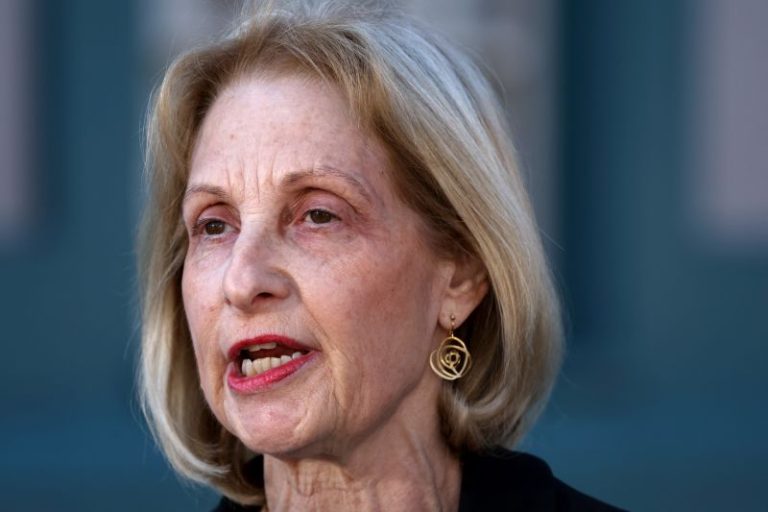
Australian universities may lose funding if they’re not judged to be doing enough to address anti-Jewish hate crimes, according to new measures proposed by the country’s first antisemitism envoy.
Jillian Segal was appointed to the role a year ago in response to a surge in reports of attacks against Jewish sites and property in Australia, following Israel’s invasion of Gaza, and was tasked with combating antisemitism in the country.
Standing alongside Prime Minister Anthony Albanese Thursday, Segal released a report nine months in the making proposing strong measures, including the university funding threats and the screening of visa applicants for extremist views.
“The plan is not about special treatment for one community; it is about restoring equal treatment,” Segal said. “It’s about ensuring that every Australian, regardless of their background or belief, can live, work, learn and prosper in this country.”
Like in the United States, Australian campuses were once the hub of pro-Palestinian protests led by students who pitched tents demanding action to stop Israel’s assault on Gaza.
The campus protests dwindled after restrictions were tightened and some protesters were threatened with expulsion, a move condemned by the activists as an infringement on free speech.
Segal’s report said antisemitism had become “ingrained and normalised” within academia and university courses, as well as on campuses, and recommended universities be made subject to annual report cards assessing their effectiveness in combating antisemitism.
Universities Australia chief executive Luke Sheehy said the organization had been working “constructively” with the special envoy and its members would “consider the recommendations.”
“Academic freedom and freedom of expression are core to the university mission, but they must be exercised with responsibility and never as a cover for hate or harassment,” he said in a statement.
Antisemitic attacks in Australia surged 300% in the year following Israel’s invasion of Gaza in October 2023.
In the past week alone, the door of a synagogue was set on fire in Melbourne, forcing 20 occupants to flee by a rear exit, as nearby protesters shouting “Death to the IDF” – using the initials of the Israeli military – stormed an Israeli-owned restaurant.
A man is facing arson charges over the synagogue attack, and three people were charged Tuesday with assault, affray, riotous behavior and criminal damage over the restaurant raid.
The Executive Council of Australian Jewry, which Segal once led and is the umbrella organization for hundreds of Jewish community groups, said the report’s release “could not be more timely given the recent appalling events in Melbourne.”
However, the Jewish Council of Australia, which opposes Israel’s war in Gaza, voiced concerns about Segal’s plan, saying it carried the overtones of US President Donald Trump’s attempts to use funding as a means of control over institutions.
In a statement, the council criticized the plan’s “emphasis on surveillance, censorship, and punitive control over the funding of cultural and educational institutions,” adding that they were “measures straight out of Trump’s authoritarian playbook.”
Max Kaiser, the group’s executive officer, said: “Any response that treats antisemitism as exceptional, while ignoring Islamophobia, anti-Palestinian racism, and other forms of hate, is doomed to fail.”
The envoy’s 20-page plan includes sweeping recommendations covering schools, immigration, media, policing and public awareness campaigns.
Segal wants Holocaust and antisemitism education baked into the national curriculum “as a major case study of where unchecked antisemitism can lead,” according to the report.
Arts organizations could be subject to the same restrictions as universities, with threats to pull public funding if they’re found to have engaged in, or facilitated, antisemitism.
“While freedom of expression, particularly artistic expression, is vital to cultural richness and should be protected, funding provided by Australian taxpayers should not be used to promote division or spread false/ distorted narratives,” the report said.
Under the recommendations, tougher immigration screening would weed out people with antisemitic views, and the Migration Act would enable authorities to cancel visas for antisemitic conduct.
Media would be monitored to “encourage accurate, fair and responsible reporting” and to “avoid accepting false or distorted narratives,” the report added.
During Thursday’s press conference, Albanese pointed to an interview on the country’s national broadcaster with a protester, saying the interviewee tried to justify the Melbourne restaurant attack.
“There is no justification for that whatsoever,” he said. “The idea that somehow the cause of justice for Palestinians is advanced by behavior like that is not only delusional, it is destructive, and it is not consistent with how you are able to put forward your views respectfully in a democracy,” he said.
Asked if the country had become less tolerant of different views and had, perhaps, lost the ability to have a debate, Albanese pointed to social media.
“I think there is an impact of social media, where algorithms work to reinforce people’s views,” he said. “They reinforce views, and they push people towards extremes, whether it be extreme left, extreme right. Australians want a country that is in the center.”
His comments came as Grok, X’s AI chatbot, was called out for spreading antisemitic tropes that the company said it was “actively working to remove.”
Albanese said, regarding antisemitic views, “social media has a social responsibility, and they need to be held to account.”
Asked whether anti-Israel protests were fueling the antisemitic attacks, the prime minister said people should be able to express their views without resorting to hate.
“In Israel itself, as a democracy, there is protest against actions of the government, and in a democracy, you should be able to express your view here in Australia about events overseas,” he said. “Where the line has been crossed is in blaming and identifying people because they happen to be Jewish.”
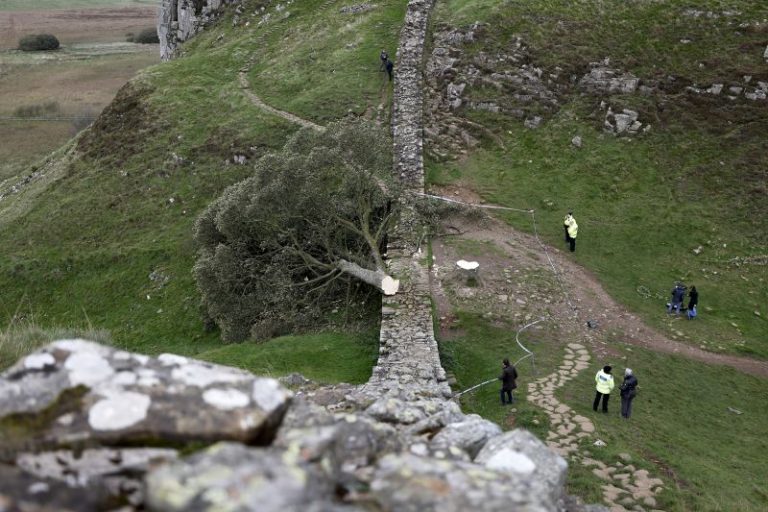
The remains of a famous sycamore tree, which stood on Britain’s Roman-built Hadrian’s Wall in northern England for more than 200 years, has found a new home nearly two years after it was illegally felled.
The removal of the tree from its spot known as “Sycamore Gap,” a pronounced dip in Hadrian’s Wall, in September 2023 sparked global outrage. Sycamore Gap was considered one of the most photographed trees in England and was made famous to millions when it appeared in Kevin Costner’s 1991 blockbuster film “Robin Hood: Prince Of Thieves.”
In May, two men were found guilty of criminal damage for felling the landmark tree.
Now, a section of it will be put on permanent display at The Sill: National Landscape Discovery Centre, about two miles (three kilometers) from where it once stood.
The UK’s National Trust gave the largest remaining piece of the salvaged trunk to the Northumberland National Park, where the tree was located.
“In the days and months after the tree was felled, The Sill became a place of celebration and memory. Visitors left post-it notes, letters, drawings and messages expressing grief, love, and hope,” the park said in a press release Thursday.
A public consultation was held in the aftermath of the felling on the future of the tree trunk. “The resulting exhibit honours the tree’s natural form while inviting people to engage with it in a deeply personal way,” The Sill said in a press release Thursday.
The trunk is positioned upright, as it once was, and is surrounded by tree oak benches and streams of wood bent to form a canopy in the shape of a huge leaf – recreating the shelter the tree once offered for people to sit and reflect.
Some tributes from the local community have been carved into the wood.
“The original tree may be gone in the form we knew it, but its legacy remains, and what has come since has been endlessly positive, affirming our belief that people nature and place cannot be separated and are interdependent,” said Tony Gates, chief executive of Northumberland National Park Authority, in the release.
“This commission has been the biggest honour of my career,” said Charlie Whinney, the artist behind the new exhibition, in the release.
“I really hope what we’ve done in some small way allows the people of Northumberland and those who held this tree close to their hearts to process the loss they still feel from that day in September 2023, when the tree was illegally cut down,” he added.
“The work looks forward with hope, the tree is regrowing, and Sycamore Gap will always be a magical place to visit,” Whinney continued.