Author

admin

Browsing

It’s been a historic week for precious metals, with gold nearly hitting the US$3,600 per ounce mark, and silver passing US$41 per ounce for the first time since 2011.

The gold price spent the summer in a consolidation phase, and part of what’s spurring its latest move is expectations that the US Federal Reserve will lower interest rates at its next meeting.

The central bank has held rates steady since December 2024, even as President Donald Trump places increasing pressure on Fed Chair Jerome Powell to cut.

Powell’s August 22 speech in Jackson Hole, Wyoming, began stoking anticipation of a cut, and August US jobs data, released on Friday (September 5), has all but guaranteed it will happen.

Non-farm payrolls were up by 22,000, significantly lower than the 75,000 expected by economists. Meanwhile, the country’s unemployment rate came in at 4.3 percent.

CME Group’s (NASDAQ:CME) FedWatch tool now shows a 90.2 percent probability of a 25 basis point rate cut in September, with a 9.8 percent probability of a 50 basis point reduction.

Bond market turmoil also helped move the gold price this week.

Yields for 30 year US bonds rose to nearly 5 percent midway through the period, their highest level since mid-July, on the back of a variety of concerns, including tariffs, inflation and Fed independence.

Globally the situation was even more tumultuous, with 30 year UK bond yields reaching their highest point since 1998; meanwhile, 30 year bond yields for German, French and Dutch bonds rose to levels not seen since 2011. In Japan, 30 year bond yields hit a record high.

Tariff developments have also created uncertainty this past week.

After an appeals court upheld a ruling that many of Trump’s tariffs are illegal, the president’s administration asked the Supreme Court to fast track its review of the decision.

Going back to gold and silver, their recent price activity is certainly raising questions about what’s next. The broad consensus among the experts focused on the sector is positive, but the metals are beginning to get more mainstream attention too.

Notably, investment bank Goldman Sachs (NYSE:GS) now has a gold price prediction of US$4,000 by mid-2026, although the firm notes that the yellow metal could rise to nearly US$5,000 if just 1 percent of private investors shift from treasuries to gold.

‘If 1 per cent of the privately owned US Treasury market were to flow to gold, the gold price would rise to nearly $5,000 per troy ounce’ — Daan Struyven, Goldman Sachs

Bullet briefing — Hoffman on gold, Hathaway on silver

It’s been a short week, at least in North America, so instead of the usual news stories this bullet briefing will highlight a couple of my favorite recent interviews.

Nothing in gold’s path

First is Ken Hoffman of Red Cloud Securities. It was my first time speaking with Hoffman, and he made a compelling case for how gold could get to US$10,000.

Watch the full interview with Hoffman above.

Silver a ‘smouldering volcano’

Next is John Hathaway of Sprott. He shared what he thinks will be the trigger for gold’s next move higher — a major decline in equities — but he also discussed his bullish outlook on silver, which moved past US$40 not long after our interview.

Watch the full interview with Hathaway above.

We’re definitely entering uncharted territory right now, and I want to make sure I bring you commentary from the experts you want to hear from — drop a comment below to let me know who you’d like me to talk to, and also what questions you have.

Securities Disclosure: I, Charlotte McLeod, hold no direct investment interest in any company mentioned in this article.

This post appeared first on investingnews.com

Lode Gold Resources Inc. (TSXV: LOD,OTC:LODFF) (OTCQB: LODFF) (‘Lode Gold’ or the ‘Company’) is pleased to announce that it has now closed its previously announced non-brokered private placement offering for $1.0 million (the ‘Offering’). In three tranches, the Company raised total gross proceeds of $1,513,768 through the issuance of 8,409,825 units of the Company (‘Unit’) at a price of $0.18 per Unit, (see related Company news first tranche, second tranche, and final tranche).

Each Unit consists of one common share of the Company (‘Common Share’) and one common share purchase warrant (‘Warrant’). Each Warrant shall entitle the holder to purchase one Common Share at an exercise price of $0.35 per share for a period of 36 months following the date of closing. The Company may accelerate the Warrant expiry date if the Company’s shares trade at $0.65 or more for a period of 10 days, including days where no trading occurs.

In conjunction with the private placement finder’s fees of $16,039 will be paid in cash and 89,100 Finders’ Warrants will be issued. Each Finders’ Warrant shall entitle the holder to purchase one Common Share of the Company at an exercise price of $0.35 per share for a period of 36 months following the date of closing.

Insiders of the Company subscribed to 1,022,111 Units of the private placement.

All securities issued pursuant to this private placement, including common shares underlying the Warrants, are subject to a statutory hold period which expires 4 months from the date of closing.

The completion of the private placement remains subject to the final acceptance of the TSX Venture Exchange.

The proceeds raised from the Offering will go toward execution of the business plans for Lode Gold and its subsidiary, Gold Orogen (1475039 B.C. Ltd.).

Management Changes
Winfield Ding has resigned as the CFO with immediate effect. The Company has initiated a search for a new CFO and has identified several potential candidates for the position. Wayne Moorhouse has agreed to act as the Company’s Acting CFO. Wayne has a wealth of senior company management experience including holding the position of CFO for Roxgold Inc. (TSXV), Midnight Sun Mining Corp. (TSXV), Genco Resources Inc. (TMX), Bluestar Gold (TSXV), and other private and public companies.

Construction Loan Extension
The Company has entered into an amending agreement with Romspen Investment Corporation (the ‘Lender’) to extend the maturity date of a construction loan agreement. The new maturity date of the loan is October 31, 2025. In consideration for extending the maturity date of the loan, the Company will pay the Lender $200,000 of interest owing consisting of $100,000 to be paid in cash and $100,000 to be paid in shares subject to final approval of the TSX Venture Exchange.

Legal Update
As part of the 2024 Restructuring and Growth Plans, a senior secured debt holder, aligned with the Company’s new strategic direction, converted to become one of the largest shareholders, exceeding 19.9%. The former CEO resigned, citing change of control as the reason and proceeded to make a severance compensation claim. The Company disagreed that compensation is due as this debt holder is an existing key shareholder and a Director of the Board. A claim was filed and the court ruled in favor of the claimant for a payment of $222,469. The outcome will have no material impact on the Company’s 2025 financial results as this amount had been accrued in the Company’s accounting records in a prior period.

About Lode Gold

Lode Gold (TSXV: LOD,OTC:LODFF) is an exploration and development company with projects in highly prospective and safe mining jurisdictions in Canada and the United States.

In Canada Lode Gold holds assets in the Yukon and New Brunswick. Lode Gold’s Yukon assets are located on the southern portion of the prolific Tombstone Belt and cover approximately 99.5 km2 across a 27 km strike. Over 4,500 m have been drilled on the Yukon assets with confirmed gold endowment and economic drill intercepts over 50 m. There are four reduced-intrusive targets (RIRGS), in addition to sedimentary-hosted orogenic exploration gold.

In New Brunswick, Lode Gold, through its subsidiary 1475039 B.C. Ltd., has created one of the largest land packages in the province with its Acadian Gold Joint Venture, consisting of an area that spans 445 km2 with a 44 km strike. It has confirmed gold endowment with mineralized rhyolites.

In the United States, the Company is focused on its advanced exploration and development asset, the Fremont Mine in Mariposa, California. It has a recent 2025 NI 43-101 report and compliant MRE that can be accessed here https://lode-gold.com/project/freemont-gold-usa/

Fremont was previously mined until gold mining prohibition in WWII, when its mining license was suspended. Only 8% of the resource identified in the 2025 MRE has been extracted. This asset has exploration upside and is open at depth (three step-out holes at 1,300 m hit structure and were mineralized) and on strike. This is a brownfield project with over 43,000 m drilled, 23 km of underground workings and 14 adits. The project has excellent infrastructure with close access to electricity, water, state highways, railhead and port.

The Company recently completed an internal scoping study evaluating the potential to resume operations at Fremont based on 100% underground mining. Previously, in March 2023, the Company completed a Preliminary Economic Assessment (‘PEA’) in accordance with NI 43-101 which evaluated a mix of open pit and underground mining. The PEA and other technical reports prepared on the Company’s properties are available on the Company’s profile on SEDAR+ (www.sedarplus.ca) and the Company’s website (www.lode-gold.com)

ON BEHALF OF THE COMPANY
Wendy T. Chan
CEO & Director

Information Contact:

Wendy T. Chan
CEO
info@lode-gold.com
+1-(604)-977-GOLD (4653)

Kevin Shum
Investor Relations
kevin@lode-gold.com
+1 (604) -977-GOLD (4653)

Cautionary Statement Regarding Forward-Looking Information

Neither the TSX Venture Exchange nor its Regulation Services Provider (as that term is defined in the policies of the TSX Venture Exchange) accepts responsibility for the adequacy or accuracy of this release.

This news release includes ‘forward-looking statements’ and ‘forward-looking information’ within the meaning of Canadian securities legislation. All statements included in this news release, other than statements of historical fact, are forward-looking statements including, without limitation, statements with respect to the use of proceeds, advancement and completion of resource calculation, feasibility studies, and exploration plans and targets. Forward-looking statements include predictions, projections and forecasts and are often, but not always, identified by the use of words such as ‘anticipate’, ‘believe’, ‘plan’, ‘estimate’, ‘expect’, ‘potential’, ‘target’, ‘budget’ and ‘intend’ and statements that an event or result ‘may’, ‘will’, ‘should’, ‘could’ or ‘might’ occur or be achieved and other similar expressions and includes the negatives thereof.

Forward-looking statements are based on a number of assumptions and estimates that, while considered reasonable by management based on the business and markets in which the Company operates, are inherently subject to significant operational, economic, and competitive uncertainties, risks and contingencies. These include assumptions regarding, among other things: the status of community relations and the security situation on site; general business and economic conditions; the availability of additional exploration and mineral project financing; the supply and demand for, inventories of, and the level and volatility of the prices of metals; relationships with strategic partners; the timing and receipt of governmental permits and approvals; the timing and receipt of community and landowner approvals; changes in regulations; political factors; the accuracy of the Company’s interpretation of drill results; the geology, grade and continuity of the Company’s mineral deposits; the availability of equipment, skilled labour and services needed for the exploration and development of mineral properties; currency fluctuations; and impact of the COVID-19 pandemic.

There can be no assurance that forward-looking statements will prove to be accurate and actual results, and future events could differ materially from those anticipated in such statements. Important factors that could cause actual results to differ materially from the Company’s expectations include a deterioration of security on site or actions by the local community that inhibits access and/or the ability to productively work on site, actual exploration results, interpretation of metallurgical characteristics of the mineralization, changes in project parameters as plans continue to be refined, future metal prices, availability of capital and financing on acceptable terms, general economic, market or business conditions, uninsured risks, regulatory changes, delays or inability to receive required approvals, unknown impact related to potential business disruptions stemming from the COVID-19 outbreak, or another infectious illness, and other exploration or other risks detailed herein and from time to time in the filings made by the Company with securities regulators, including those described under the heading ‘Risks and Uncertainties’ in the Company’s most recently filed MD&A. The Company does not undertake to update or revise any forward-looking statements, except in accordance with applicable law.

To view the source version of this press release, please visit https://www.newsfilecorp.com/release/265413

News Provided by Newsfile via QuoteMedia

This post appeared first on investingnews.com

The average rate on the 30-year fixed mortgage dropped 16 basis points to 6.29% Friday, according to Mortgage News Daily, following the release of a weaker-than-expected August employment report.

It’s the lowest rate since Oct. 3 and the biggest one-day drop since August 2024. Rates are finally breaking out of the high 6% range, where they’ve been stuck for months.

“This was a pretty straightforward reaction to a hotly anticipated jobs report,” said Mortgage News Daily Chief Operating Officer Matt Graham. “It’s a good reminder that the market gets to decide what matters in terms of economic data, and the bond market has a clear voting record that suggests the jobs report is always the biggest potential source of volatility for rates.”

Graham said in a post on X that many lenders are “priced better” than Oct. 3 and would be quoting in the high 5% range.

The drop is a major change from May, when the rate on the 30-year fixed peaked at 7.08%. It’s big for buyers out shopping for a home today, especially given high home prices.

Take, for example, someone purchasing a $450,000 home, which is just above August’s national median price, using a 30-year fixed mortgage with a 20% down payment. Not including taxes or insurance, the monthly payment at 7% would be $2,395. At 6.29%, that payment would be $2,226, a difference of $169 per month.

That might not sound like a lot to some, but it can mean the difference in not just affording a home, but qualifying for a mortgage.

Homebuilder stocks reacted favorably Friday, with names like Lennar, DR Horton and Pulte all up roughly 3% midday. Homebuilding ETF ITB has been running hot for the last month as rates slowly moved lower. It’s up close to 13% in the past month.

The big question is whether the drop in rates will be enough to get homebuyers back in the market.

Mortgage demand from homebuyers, an early indicator, have yet to respond to gradually improving rates. Applications for a mortgage to purchase a home last week were 6.6% lower from four weeks before, according to the Mortgage Bankers Association.

“Homebuyers grapple with a lack of affordability, sellers contend with more competition, and builders deal with lower buyer demand,” Danielle Hale, chief economist at Realtor.com, said Friday in a statement after the release of the August employment report. “These conditions haven’t spelled catastrophe, but have created a cruel summer for the housing market.”

Some analysts have argued that buyers need to see mortgage rates in the 5% range before it really makes a difference. Home prices remain stubbornly high, and while the gains have definitely cooled, they are not yet coming down on a national level. In addition, uncertainty about the state of the economy and the job market has left many would-be buyers on the sidelines.

This post appeared first on NBC NEWS

Israel has 40% control of Gaza City as the Israel Defense Forces are now preparing to seize the entire area, an Israeli military spokesperson confirmed Thursday. 

Brig. Gen. Effie Defrin told reporters at a news briefing that his forces had already secured large neighborhoods in its latest offensive.

‘We continue to damage Hamas’ infrastructure,’ he said before adding: ‘Today we hold 40% of the territory of Gaza City.’

‘We will continue to operate until all the war’s objectives are achieved. First and foremost, the return of the hostages and the dismantling of Hamas’ rule,’ he added.

Last week, Israel declared Gaza City in the north a combat zone, with some districts designated red zones, urging Palestinians to leave.

Senior officials warned that military rule may be imposed and Palestinians were told to evacuate to the south, with some of Prime Minister Benjamin Netanyahu’s coalition partners pushing for a permanent Israeli settlement in Gaza.

Meanwhile, Gaza health officials said at least 53 Palestinians were killed Thursday, most in Gaza City, as Israeli forces pressed deeper into eastern suburbs.

Residents reported heavy bombardments in Zeitoun, Sabra, Tuffah and Shejaia while tanks advanced into Sheikh Radwan, northwest of the city center, crushing homes and setting fires in encampments.

Mahmoud Bassal, spokesperson for Gaza’s civil emergency service, said the bombardment destroyed four buildings in what he described as a ‘fire belt’ targeting civilians.

‘Even if Israel issues warnings, there are no places that can accommodate the people,’ he said.

On the evacuations, Israeli officials say 70,000 people have fled Gaza City so far, though Palestinian authorities contend far fewer have left, with tens of thousands still in the path of advancing forces.

Israel launched its major Gaza City offensive on Aug. 10 under ‘Operation Gideon’s Chariots,’ deploying tens of thousands of reservists to fight together with its regular troops.

There are still 48 hostages believed to be held in Gaza.

Netanyahu initially said Israel would conquer all of Gaza after indirect talks with Hamas on a ceasefire and hostage release deal broke down in July.

This post appeared first on FOX NEWS

COLUMBUS, Ga. — During a trip to Fort Benning on Thursday, Defense Secretary Pete Hegseth said the department is working on re-establishing deterrence, ‘so that when the enemy sees an American, they don’t want to f— with us.’

The comments came after Hegseth spoke at an Officer Candidate School (OCS) graduation ceremony, where candidates were commissioned as second lieutenants in the Army or ensigns in the Navy.

Following the ceremony, he made remarks at the Infantry Basic Officer Leader Course luncheon — sharing stories about his children wanting Army Ranger shirts, and noting the proudest moment of his life would be saluting them if they earned it.

Hegseth also touched on military priorities under the Trump administration, noting the Department of Defense’s focus is rebuilding the military to ensure it has the best possible equipment from the warfighter perspective, across all services. 

‘And then reestablishing deterrence, so that when the enemy sees an American, they don’t want to f— with us,’ Hegseth said. ‘Because they know they’ll get the business end of the best warrior on the planet. We’re reestablishing that. Whether it’s midnight hammer, or freedom of navigation, or narco-traffickers that are poisoning the American people.’

He said the world knows that when President Donald Trump speaks, he means business, adding that the graduates are the faces of that deterrence. 

‘It’s you that we remember, and we think of, when we make decisions,’ Hegseth said. ‘It’s the job of policymakers and leaders in our positions to look down and say, ‘We’ve asked you to do tough things, we’re going to have your back when you do it.’ We’re going untie your hands and make sure you can unleash hell in Yemen. Absolute violence of action. 

‘We’re going to push decision-making authority down to you, the platoon level, the company level, the battalion unit level, as much as possible.’

During the trip, the secretary also teased that the Defense Department may have a new name on Friday, which Fox News Digital’s Diana Stancy and Emma Colton were first to confirm.

Trump will sign an executive order allowing the department to use the ‘Department of War’ as a secondary title, along with phrases like ‘secretary of war’ for Hegseth.

The order also directs Hegseth to propose legislative and executive actions to make the name change permanent.

Fox News Digital’s Diana Stancy and Emma Colton contributed to this report.

This post appeared first on FOX NEWS

The Trump administration asked the Supreme Court on Thursday to allow the president to fire a member of the Federal Trade Commission, after lower courts ruled he lacks the authority to remove members of independent agencies without cause.

President Donald Trump moved to fire Rebecca Slaughter earlier this year, but lower courts ruled she could keep her job because the law only allows commissioners to be removed for issues such as misconduct or neglect of duty.

Earlier this week, an appeals court said Trump unlawfully fired Slaughter and that her firing was squarely at odds with Supreme Court precedent.

The Justice Department contends that the FTC and other executive branch agencies are under Trump’s control and that the president has the power to remove commissioners without cause.

The testing of the president’s removal power could lead the nation’s highest court to consider overturning a 1935 Supreme Court decision known as Humphrey’s Executor, in which justices unanimously ruled that presidents cannot fire independent board members without cause.

The ruling brought in an era of powerful independent federal agencies charged with regulating labor relations, employment discrimination, the airwaves and other matters.

That case also centered around the FTC, which was highlighted by lower-court judges in the lawsuit filed by Slaughter, who has been fired and rehired multiple times this year as the case worked its way through the courts.

The FTC is a regulator created by Congress that enforces consumer protection measures and antitrust legislation. The agency’s seats are typically made up of three members of the president’s party and two from the opposing party.

Slaughter was first appointed by Trump in 2018, and then later reappointed by former President Joe Biden. She is the only remaining Democrat on the FTC.

The high court has already allowed the removal of several other board members from independent agencies. 

The justices have also suggested that Trump’s removal powers have limitations at the Federal Reserve, which could soon be tested as well in the case of Lisa Cook, a member of the Federal Reserve Board of Governors.

The Associated Press contributed to this report.

This post appeared first on FOX NEWS

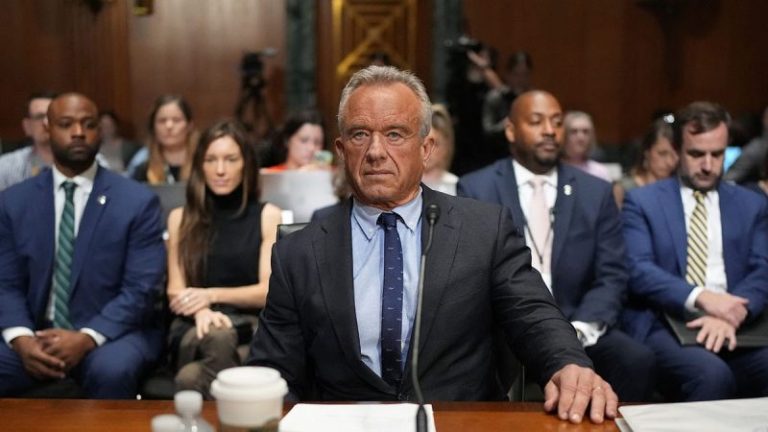
Senate Democrats found unlikely allies in Senate Republicans during a fiery hearing, where Health and Human Services (HHS) Secretary Robert F. Kennedy Jr. was grilled for his stance on vaccines.

Kennedy’s testimony before the Senate Finance Committee on Thursday was billed as a discussion on President Donald Trump’s healthcare agenda, but it quickly turned into a tongue-lashing from lawmakers, who accused the secretary of lying to the panel about how he would operate the HHS and Centers for Disease Control and Prevention (CDC).

While a barrage of heated exchanges between Kennedy and Democrats were expected, it was heat from Senate Republicans on the panel, including a pair of doctors turned legislators, who stood out.

‘I support vaccines. I’m a doctor. Vaccines work,’ Senate Majority Whip John Barrasso, R-Wyo., said. ‘Secretary Kennedy, in your confirmation hearings, you promised to uphold the highest standards for vaccines. Since then, I have grown deeply concerned.’

‘The public has seen measles outbreaks, leadership at the National Institutes of Health questioning the use of mRNA vaccines, the recently confirmed director of Center for Disease Control and Prevention fired,’ he continued. ‘Americans don’t know who to rely on.’  

When asked what he would do to ensure that vaccine guidance was clear, Kennedy said, ‘We’re going to make it clear, evidence-based and trustworthy for the first time in history.’

The hearing came on the heels of a week of turmoil at the CDC, where Kennedy fired former CDC Director Susan Monarez, which led to several senior officials resigning from the agency. Before that, the secretary had cleaned out the federal government’s vaccine recommendation panel and handpicked his own members to serve, and he also moved to cancel $500 million in mRNA vaccine contracts.

Sen. Bill Cassidy, R-La., also serves as the chair of the Senate’s health committee and was the decisive vote to confirm Kennedy. He argued that Kennedy’s actions on vaccines appeared to counter his support for Trump’s Operation Warp Speed, a sweeping executive program by the Trump administration at the onset of the COVID-19 pandemic that jump-started the production of vaccines.

He noted that both Trump and Kennedy have vowed ‘radical transparency’ when it came to the administration’s healthcare agenda, but countered that the secretary’s move to put new members on the Advisory Committee on Immunization Practices appeared to be a conflict of interest.

‘I am concerned though, because many of those that you have nominated for the [Advisory Committee on Immunization Practices] board… have received revenue as serving as expert witnesses as plaintiffs for attorneys suing vaccine makers,’ Cassidy said. ‘If we put people who are paid witnesses for people suing vaccines, that seems like a conflict of interest, real quickly do you agree with that?’

‘No I don’t,’ Kennedy said, arguing that while it may seem like a bias, it was not a conflict of interest.

Not every Republican doctor on the panel went after Kennedy. Sen. Roger Marshall, R-Kan., has long been an ally of the secretary’s and gave him room to address accusations that he was anti-vaccine.

‘Saying I’m anti-vaccine is like saying I’m anti-medicine,’ Kennedy said. ‘I’m pro-medicine, but I understand some medicines harm people, some of them have risks, some of them have benefits that outweigh those risks for certain populations, and that’s true with vaccines.’

Marshall agreed that he was not ‘anti-vax either,’ and he listed several vaccines that he believed were good but argued that it was the transparency and approach to vaccines under the HHS and CDC that he was after.

‘What I feel the difference is sometimes my friends across the aisle feel like there’s a one-size-fits-all, that they should be telling parents what to do,’ Marshall said. ‘And what you and I are fighting for is that we want to empower parents to make these decisions.’

This post appeared first on FOX NEWS

President Donald Trump has never played by the stale rules of Washington and Americans are grateful for it. His bold call for a 2026 pre-midterm convention is a political masterstroke that will cement America First policies, energize the Republican base, and ignite Generation Z voters. 

This convention is a seismic shift that sends a clear message to every politician: fight for the American people or step aside.

The GOP’s victories, from retaking the White House and strengthening congressional majorities to delivering real wins on border security, tax cuts, a stronger economy and energy independence, set the stage for Trump’s call for a pre-midterm national convention that breaks political tradition. 

While establishment Republicans cling to fundraising dinners, closed-door sessions and tired speeches that leave voters disengaged, Trump has mastered turning rallies into movements, from the electrifying 2016 campaign that flipped battleground states to the packed arenas of 2024 that reenergized the base. A pre-midterm convention would unite delegates from all 50 states to celebrate achievements, set a clear agenda and ignite voters. 

The contrast is clear. Conservative values of law and order through Trump’s National Guard blueprint to combat crime, economic freedom that fuels innovation, and family-first policies that honor tradition stand in sharp contrast to Democrat failures, including 9.1% inflation in 2022, open borders that allowed more than 11 million illegals, and foreign policy disasters that emboldened adversaries. 

By highlighting Republican successes like cutting gas prices through energy independence and appointing judges who defend constitutional rights, this convention would rebuke the Washington elite and prove Republicans deliver results while Democrats deliver excuses.

Unity is part of the strategy, but this is also a pivotal opportunity to mobilize Gen Z, the 68 million young Americans born between 1997 and 2012 who are increasingly open to conservative policies but need a reason to show up. A midterm convention can be that reason. 

Their frustration with the Left is clear: sky-high inflation, record crime and the relentless push of woke ideology. The 2025 Harvard Youth Poll found that 75% of young voters believe the country is headed in the wrong direction, with 62% citing a worsening economy under current policies and nearly half naming cost of living such as housing, food and gas as their top concern. A Yale Youth Poll revealed 35% now favor Republicans in the midterms, a notable increase from past cycles. 

Gen Z does not trust institutions and is disillusioned by political posturing. They crave authenticity while being bombarded by liberal propaganda in schools, on social media and from Hollywood. They see through empty promises of equity, knowing it means higher prices, fewer jobs and more division, with nearly 60% of Gen Z college graduates unemployed compared to just 25% of prior generations. 

President Trump understands this. A high-energy convention featuring conservative stars like Sen. Josh Hawley, R-Mo., and Rep. Anna Paulina Luna, R-Fla., along with influencers such as Charlie Kirk and Anthony Raimondi, known as Conservative Ant, can deliver messages tailored for TikTok and X. 

These voices can speak directly to Gen Z’s entrepreneurial spirit with policies that support small business tax cuts, energy independence to cut gas prices and unapologetic defenses of freedom. That spark could boost Gen Z turnout by 10% to 15% in the midterms, making them the GOP’s secret weapon. Failure to capture their energy risks apathy or a drift toward third parties.

This convention will energize the grassroots and unify the Republican Party. The GOP is already outpacing Democrats in record-breaking fundraising, but a unified front delivers more than dollars. It locks in a clear midterm agenda, quashes internal battles and promises a surge of support as Trump, Vice President JD Vance and other Republican stars deliver high-profile speeches that draw major contributions. 

By showcasing Republican successes in safety, job growth, lower gas prices and judicial appointments that protect constitutional rights, against Democrat failures like open borders and green energy disasters, the convention will mobilize voters. With the economy rebounding and Trump’s approval rising, it ensures Republicans avoid complacency and secure dominance.

A midterm convention also challenges GOP lawmakers to deliver results or leave Washington. Voters are demanding accountability, expecting politicians to prove their commitment to the America First agenda by securing the border, cutting red tape and prioritizing American workers, while elevating rising stars who represent the next wave of conservative leadership. This moment is an opportunity to purge establishment Republicans who align with elites and replace them with fighters for the American people, reshaping the future bench of Congress. 

Meanwhile, Democrats are leaderless and floundering in internal chaos and deeply unpopular policies. A 2025 CNN poll shows that while 72% of Democrats say they are motivated to vote, only 58% view their party favorably, compared to 76% for Republicans. Trump’s call for a midterm convention is another power move that highlights Democratic disarray, exposing their lack of leadership, failed policies and overall weakness.

Trump’s midterm convention is not just about exposing Democratic failure, it is about building the future of the movement and securing a foundation that lasts for generations. It is now or never for conservatives. 

A pre-midterm GOP convention led by Trump represents the next chapter in his revolution, timed to capture Gen Z’s openness to conservative ideas. By rallying young voters with authenticity and real solutions to their everyday struggles, amplifying momentum, and holding Republican leaders accountable, this convention can turn frustration into lasting America First policies. 

The GOP cannot afford to let woke politics or establishment complacency derail America’s future. Seizing this moment ensures 2026 delivers not just a victory but a generational turning point that will shape the direction of this country for decades to come.

This post appeared first on FOX NEWS

Despite the current low price environment, the long-term demand for battery metals is robust and offers opportunity for those interested in lithium stocks.

Seasoned metals investors who want to look beyond gold and silver are getting involved, while new investors are being drawn into the space by expanding battery market and lithium supply deals between auto makers and lithium producers.

Whatever the reason, it’s important to get familiar with the lithium market before investing in lithium stocks. Here’s a brief overview of some of the basics, including supply and demand, prices and companies.

In this article

    Where is lithium mined?

    Lithium is found globally in hard-rock deposits, evaporated brines and clay deposits. There’s some contention as to which type of deposit is superior, but generally there are challenges and upsides for both.

    The world’s largest hard-rock mine is the Greenbushes mine in Australia, and the bulk of the world’s lithium brine production comes from salars in Chile and Argentina. Most large lithium reserves are in Chile, and the prolific “Lithium Triangle” spans Chile, Argentina and Bolivia. Australia was once again the world’s largest lithium producer in 2024, followed by Chile and China.

    Canada and the United States, ranked as the seventh and ninth largest lithium producing countries, are increasingly becoming hotspots for lithium development and production as North American auto makers seek to secure domestic supply sources.

    What’s the difference between battery-grade and technical-grade lithium?

    Technical-grade lithium is used in ceramics, glass and other industrial applications, while battery-grade lithium carbonate and lithium hydroxide are used to make lithium-ion batteries. These lithium products can also be used for technical applications in a pinch, although battery-grade lithium fetches premium market prices over technical-grade. Those aren’t the only classifications, though. Pharmaceutical grade lithium carbonate is used in medicine.

    How is lithium priced?

    Getting a look at lithium prices isn’t easy, and that can make it difficult for investors who are looking to assess the viability of a given project. Pricing in the lithium industry has always been opaque due to the dominance of a few major producers, with investors having very little pricing information they can trust.

    Simon Moores of Benchmark Mineral Intelligence has emphasized that pricing can be a difficult concept for investors to grasp.

    “The biggest myth surrounding pricing is, ‘What is the price of lithium?’ Because there is no one price,” he said. “The newcomers want one lithium price, but the existing market has a wide range of lithium chemicals and then grades within a specification.’

    There are also distinct prices for lithium on markets in different regions, meaning lithium hydroxide in China will be priced slightly different than in Europe.

    For those looking to invest in lithium who want to learn about lithium prices, it’s best to read reports on lithium price trends from experts to help you understand what is happening in the market.

    What factors drive the lithium market?

    A major driver for the lithium market is its use in the lithium-ion batteries that power electric vehicles, energy-storage systems, smart phones and laptops.

    Global EV sales reached 17 million units in 2024, up 25 percent from the previous year, according to International Energy Agency (IEA) data. The figure represents more than 20 percent of all new cars sold worldwide. Looking forward, EV sales are expected to increase by another 25 percent to surpass 20 million in 2025, amounting to about one-quarter of total new car sales for the year.

    Tesla with its Nevada-based gigafactory was the first carmaker to stoke excitement in the lithium space. However, advancements in Chinese battery technologies, strategic pricing and government support led to Chinese EV maker BYD Company (HKEX:1211) overthrowing Tesla (NASDAQ:TSLA) as the global EV market leader in sales for 2024. That trend has continued into 2025, as Elon Musk’s involvement in US politics has also damaged Tesla’s brand for both sides of the political spectrum.

    The ascension of a Chinese automaker on the global EV stage doesn’t come as a surprise to most market insiders. The IEA is forecasting that China will see more than 14 million new EVs will be sold in 2025, representing 60 percent of all new cars sold in the country. Even more impressive, this figure is more than all EVs sold worldwide in 2023.

    When it comes to the lithium batteries that power electric vehicles, the US Energy Information Administration (EIA) data shows that in 2023, “China controlled nearly 85% of the world’s battery cell production capacity by monetary value.”

    In the US, the election of Donald Trump to a second term as president has cast a shadow over the North American EV market. On September 30, 2025, the Trump Administration is set to scrap the US$7,500 consumer tax credit for EVs offered under the Biden-era Inflation Reduction Act. Government incentives to purchase EVs has also evaporated in Canada, despite the mandate that by 2035, 100 percent of new vehicle sales must be zero-emission vehicles.

    “North America, and in particular Canada, is experiencing a slowdown of EV sales in 2025. With Trump’s latest cuts in his ‘Big Beautiful Bill,’ the USA could struggle to see any growth in the EV market overall in 2025,” said Rho Motion Data Manager Charles Lester.

    Data centers and artificial intelligence technologies represent another key demand trend for lithium as they require significant investments in battery energy storage systems.

    “Batteries are now essential — not just for EVs, but to balance power systems across sectors,” said Paul Lusty, head of battery raw materials at Fastmarkets, at Fastmarkets’ Lithium Supply & Battery Raw Materials conference in June.

    On the supply side, China has made a major push in recent years to expand its lithium mine production, leading to an oversupplied market. The resulting lithium price slump forced Australian lithium miners to stall development plans, curtail production and even place some operations on care and maintenance.

    Fastmarkets has reported that China is set to surpass Australia as the world’s largest lithium producing country by 2026.

    Lithium mine supply disruptions out of China are already having an oversized impact. In mid-August 2025, Chinese battery giant Contemporary Amperex Technology (CATL) (SZSE:300750,HKEX:3750) confirmed it had suspended operations at Jianxiawo, one of the world’s largest lithium mines, after the mine’s permit expired on August 9 and the company failed to obtain an extension.

    The news sent lithium spot prices higher as well as the stock values of ex-China lithium miners such as Lithium Americas (NYSE:LAC), Pilbara Minerals (ASX:PLS) and Mineral Resources (ASX:MIN).

    How to invest in lithium stocks

    So what’s the best way to invest in lithium? How should investors interested in lithium stocks begin? To start, it helps to understand the lithium production landscape.

    For a long time, most lithium was produced by an oligopoly of lithium producers often referred to as the “Big 3”: Albemarle (NYSE:ALB), Sociedad Quimica y Minera (SQM) (NYSE:SQM) and FMC. Rockwood Holdings was on that list too before it was acquired by Albemarle several years ago.

    However, the list of the world’s top lithium-mining companies has changed in recent years. The companies mentioned above still produce the majority of the world’s lithium, but China accounts for a large chunk of output as well. As already discussed, the Asian nation is on track to become the largest lithium-producing country by 2026.

    For now, the biggest producer continues to be Australia, which is home to many lithium mines, including up-and-comer Liontown Resources’ (ASX:LTR,OTC:LINRF) Kathleen Valley operations. The mine entered open-pit production during H2 2024, and the plant hit commercial production in January 2025. The company is currently transitioning Kathleen Valley from an open-pit to underground mining operation, making it the state of Western Australia’s first underground lithium mine.

    In other words, lithium investors need to be keeping an eye on lithium-mining companies in Australia and other jurisdictions in addition to the New York-listed chemical companies that produce the material.

    Of course, smaller lithium stocks are worth watching too — to find out which ones are currently thriving, check out our top global lithium stocks article. You can also check out our articles on the biggest lithium stocks globally, top performing Australian lithium stocks and top Canadian lithium stocks.

    Securities Disclosure: I, Melissa Pistilli, hold no direct investment interest in any company mentioned in this article.

    This post appeared first on investingnews.com