Author

admin

Browsing

(TheNewswire)

Vancouver, British Columbia TheNewswire – November 10, 2025 Juggernaut Exploration Ltd (JUGR.V) (OTCPK: JUGRF) (FSE: 4JE) ( the ‘Company’ or ‘Juggernaut’) is excited to announce that detailed mapping and sampling have confirmed that the gold-rich Big Mac Zone, Whopper Zone and Gold Dome Zone all form part of the 22 Km 2 district-scale Eldorado System that remains wide open where grab samples assayed up to 263.70 gt AuEq or 8.48 ozt AuEq and channel cuts assayed up to 4.89 gt AuEq over 5.21 m from >400 mineralized veins that are up to 10 m wide hosted in shear zones up to 50 m wide, and are exposed on surface for >1 km with >1 km of vertical relief, remains open and is drill ready on the Big One property (the ‘Property’), Golden Triangle, British Columbia. In addition, based on excellent assay results, the Company has acquired additional claims and expanded the Gold Swarm discovery area of strong gold potential from 1 km 2 to 3 km 2 and 700 m of vertical relief and remains open, effectively tripling this area of strong gold potential, where grab samples assayed up to 231.81 gt AuEq or 7.45 ozt AuEq and channel cuts assayed up to 4.51 gt AuEq over 4.36 m that remains open and is drill ready. The Big One discovery is located in an area of recent glacial and snowpack abatement adjacent to the Tier 1 gold-rich porphyry systems, the likes of Galore Creek. The 100% controlled Big One property covers 39,271 hectares of geological terrane with tremendous additional discovery potential.

Link to map with samples > 1 g/t AuEq

Big One Gold Rich District Scale System Highlights:

  • The district-scale Eldorado System covers an area ~half the size of the Island of Manhattan (22 km ) that remains wide open where grab samples assayed up to 263.70 g/t AuEq or 8.48 oz/t AuEq and channel cuts assayed up to 4.89 g/t AuEq over 5.21 m from 400 mineralized veins that remain open and are up to 10 m wide, the equivalent to ~3-story building, hosted in shear zones up to 50 m wide, comparable to a 15-story building, and are exposed on surface for 500 m, or 5 football fields, with 1 km of vertical relief, the height of 2.5 Empire State Buildings.

Link to Gold Dome Figure

Link to Whopper Zone Figure

  • The Gold Swarm Area of strong gold potential has been expanded from 1 km to 3 km , equivalent to more than the downtown core of Vancouver B.C, with 700 m of vertical relief and remains wide open, with 100 veins up to 4.5 m wide, the equivalent of a 1.5-story building, and exposed on surface for 200 m equivalent to 2 football fields and remain open containing grab samples that assayed up to 231.81 g/t AuEq or 7.45 oz/t AuEq a nd channel cuts that assayed up to 4.51 g/t AuEq over 4.36 m. The Gold Swarm Area is drill ready.

Link to Goldswarm Figure

  • 41% (219 samples out of 527) collected within the Eldorado System in 2024 and 2025 assayed 1 g/t AuEq; 65% (28 samples out of 43) collected withing the Gold Swarm Zone in 2024 and 2025 assayed 1 g/t AuEq.

Grade (AuEq)

>1 g/t

>3 g/t

>5 g/t

>10 g/t

>15 g/t

>20 g/t

>30 g/t

>60 g/t

>90 g/t

Samples

219

129

95

66

51

40

23

8

5

  • Gold samples up to 256.60 g/t or 8.25 oz/t, silver samples up 2810 g/t or 90.34 oz/t, and copper samples up to 14.40 % were collected on Big One.

  • Detailed mapping has confirmed common orientations as well as similar geochemical signatures and textures of the gold-mineralized veins along the 15 km Highway of Gold corridor surrounding the snowcap of Deeker Glacier, strongly indicating that the gold-rich mineralization found throughout is all part of one huge district-scale gold system that remains wide open.

  • The polymetallic veins, alteration signature, geochemical pathfinder element signature, and geophysical anomalies strongly indicate the presence of a large common buried gold-silver-copper rich porphyry feeder source or similar magmatic source or sources at depth responsible for the extensive high-grade veining confirmed on surface over 22 km

  • The company recently received a 5-year property-wide advanced exploration drill permit.

  • Detailed geological and structural mapping has been completed on the reported drill targets in order to define the full geometry of these high-grade gold-bearing shears and veins and will be instrumental in designing the drill plan for the upcoming maiden drill program.

  • A high-resolution UAV photogrammetry survey was completed over an area of 52 km2 on the Eldorado System and Gold Swarm Zone encompassing all of the maiden drill targets. The data will be used to support modelling and define targeting the high-grade gold mineralization recently discovered.

  • A property wide LiDAR survey covering an area of 385 km has been conducted and will be used to augment information obtained from the mapping as well as plan the upcoming inaugural drill campaign.

  • Multiple drill-ready targets have been confirmed and are planned to be tested in the fully funded inaugural drill program and include but are not limited to: the 22 km Eldorado System hosting the Gold Dome Zone where grab samples assayed up to 263.70 g/t AuEq or 8.48 oz/t AuEq; the Big Mac Zone where grab samples assayed up to 113.92 g/t AuEq or 3.66 oz/t AuEq; the Whopper Zone where grab samples assayed up to 43.94 g/t AuEq or 1.41 oz/t AuEq; and the Gold Swarm Area where grab samples assayed up to 231.81 g/t AuEq or 7.45 oz/t AuEq.

  • Juggernaut is working in consultation with the Tahltan First Nation and the local community and is committed to maintaining respectful and collaborative relationships. As we advance exploration on our project, we will continue working closely with the Tahltan First Nation and all the local stakeholders and regulatory agencies to ensure our activities create long-term value and reflect community priorities.

Dan Stuart, President and CEO of Juggernaut Exploration states: ‘With a district-scale discovery of this magnitude host to so many large gold-rich veins and shears exposed on surface that rise above the valley floor for >1 km we are likely only seeing the tip of the iceberg on this mountain of gold. We look forward to the fully funded maiden drill program on this remarkable gold discovery with much anticipation. The best is yet to come!’

Manuele Lazzarotto, PhD, Chief Geologist of Juggernaut Exploration, states: ‘With the advanced exploration permit in hand, we look forward to unlocking the full potential of the Big One gold discovery in the third dimension during the inaugural drill program. Once we receive, compile, and interpret all the deliverables from the detailed and regional mapping, UAV orthophotos survey, and LiDAR survey, the same team responsible for the Tier 1 Surebet gold discovery will design and execute the maiden drill program. Obvious opportunities with the scale and grades seen on Big One are extremely rare, and we have clearly barely begun to scratch the surface. The team looks forward to testing this remarkable discovery at depth.’

Table 1: Samples from 2024-2025 with assays >1 g/t AuEq

Sample ID

Year

Sample Type

Au (g/t)

Ag (g/t)

Cu (%)

Pb (%)

Zn (%)

AuEq (g/t)

M224886

2025

Float

256.60

546.00

0.43

0.41

0.01

263.70

M217656

2025

Float

226.94

335.00

0.00

4.99

0.01

231.81

D751423

2025

Grab

138.70

29.96

0.08

0.02

0.02

139.14

M220659

2025

Grab

111.35

159.00

0.02

3.88

0.01

113.92

M224956

2025

Grab

95.04

49.60

0.02

0.02

0.01

95.67

D751282

2024

Grab

79.01

58.90

0.13

0.43

0.80

80.08

D751407

2025

Grab

68.57

115.00

0.35

1.25

6.53

72.02

D751424

2025

Grab

60.08

9.57

0.01

0.00

0.01

60.21

D751966

2024

Grab

56.54

23.30

0.03

0.02

0.03

56.84

M220561

2025

Grab

55.50

38.62

0.09

2.02

0.44

56.47

M217807

2025

Channel

47.18

156.00

0.01

9.28

0.07

50.57

D750642

2025

Grab

43.99

102.00

0.00

9.19

0.44

46.79

M217601

2025

Channel

39.84

333.00

0.02

0.07

0.06

43.94

M217579

2025

Channel

34.96

415.00

0.02

21.13

0.06

43.38

D751216

2024

Grab

37.98

75.50

0.24

5.72

3.93

41.46

D751191

2024

Channel

12.12

2810.00

0.02

8.04

0.00

37.20

D751156

2024

Grab

33.72

177.00

0.27

2.71

0.27

36.11

D751357

2025

Grab

18.06

333.00

12.05

0.00

0.14

32.65

M217613

2025

Channel

31.68

9.40

0.16

0.00

0.10

31.96

M224961

2025

Grab

31.25

13.98

0.39

0.00

0.00

31.77

D750638

2025

Grab

14.46

621.00

0.11

54.39

0.44

30.79

D751375

2025

Grab

28.47

70.39

0.15

2.43

0.40

29.94

D751402

2025

Grab

29.23

11.44

0.17

0.01

0.00

29.52

D751373

2025

Grab

21.44

172.00

0.07

15.92

6.21

27.59

D751964

2024

Talus

23.47

110.00

1.37

0.01

0.00

26.07

D750389

2024

Grab

8.10

1420.00

1.11

0.15

2.70

26.01

D751163

2024

Float

23.97

116.00

0.02

2.16

0.13

24.53

D750639

2025

Grab

18.12

174.00

3.36

2.91

0.03

23.63

M217567

2025

Channel

17.00

461.00

0.04

0.87

0.31

22.86

D750624

2025

Grab

21.62

45.06

0.00

2.33

0.16

22.58

M217705

2025

Channel

20.78

48.45

0.62

2.37

1.05

22.53

M224905

2025

Talus

9.48

646.00

5.48

0.05

0.05

22.15

M224982

2025

Chip

21.17

20.30

0.02

0.92

0.03

21.58

M217655

2025

Grab

19.64

15.34

0.00

1.37

2.93

20.74

M224983

2025

Grab

14.06

191.00

0.15

17.27

4.50

20.31

D751365

2025

Grab

9.35

566.00

0.01

25.22

0.06

20.24

M217657

2025

Grab

18.11

88.95

0.00

2.08

0.01

19.53

D750621

2025

Grab

3.76

223.00

14.45

0.00

0.11

19.09

D750644

2025

Grab

18.47

12.54

0.00

0.89

0.01

18.77

D750625

2025

Grab

18.32

6.19

0.01

0.01

0.55

18.54

D751374

2025

Talus

16.60

66.43

0.38

1.82

0.60

18.17

D750641

2025

Grab

15.52

55.65

0.63

1.85

0.08

17.06

M224959

2025

Grab

15.94

16.54

0.00

0.01

0.01

16.15

D750394

2024

Grab

13.12

163.00

0.51

1.65

0.42

16.04

M217852

2025

Channel

15.39

20.95

0.04

1.02

0.37

15.93

M217649

2025

Channel

14.96

22.24

0.41

0.64

0.95

15.92

D751285

2024

Grab

3.74

91.20

7.96

0.01

0.01

13.18

D751975

2024

Grab

10.62

198.00

0.00

0.77

0.01

13.10

D750192

2024

Grab

3.44

220.00

6.61

0.00

0.01

12.91

M224932

2025

Grab

0.00

755.00

0.63

6.07

7.28

12.43

D750852

2025

Subcrop

1.07

860.00

0.01

2.12

1.32

12.20

M220602

2025

Grab

11.92

2.04

0.01

0.00

0.04

11.96

M224883

2025

Grab

11.07

20.98

0.03

0.01

0.00

11.36

D751943

2024

Grab

4.00

128.00

0.30

15.35

8.35

11.32

D750198

2024

Float

6.01

34.10

0.14

0.04

15.30

11.21

M217784

2025

Channel

10.83

1.88

0.00

0.00

0.04

10.87

D750704

2025

Grab

2.59

325.00

0.35

22.97

1.56

10.83

D750608

2024

Grab

10.62

3.20

0.00

0.01

0.01

10.67

M217785

2025

Channel

10.17

1.97

0.00

0.00

0.01

10.20

M224957

2025

Grab

9.65

15.14

0.03

0.18

0.48

10.00

D751154

2024

Grab

5.72

218.00

0.22

1.81

1.34

9.20

D751969

2024

Float

5.59

185.00

0.40

1.91

0.98

8.82

D751284

2024

Float

6.34

47.70

0.03

6.78

0.59

8.66

D751151

2024

Float

2.79

474.00

0.01

20.00

1.22

8.59

D751192

2024

Channel

3.39

366.00

0.01

0.11

0.00

7.68

D751372

2025

Grab

7.44

16.56

0.00

0.17

0.01

7.67

D751104

2024

Float

3.79

204.00

0.30

4.60

1.12

7.54

D750395

2024

Grab

6.01

105.00

0.01

0.06

0.09

7.42

D750643

2025

Grab

7.36

2.04

0.00

0.03

0.02

7.40

M217571

2025

Channel

6.06

89.91

0.04

0.01

0.67

7.35

M220559

2025

Grab

1.55

262.00

0.01

13.83

0.08

6.94

M220601

2025

Grab

6.77

5.19

0.08

0.00

0.01

6.91

M224865

2025

Grab

0.05

213.00

4.32

0.07

0.48

6.53

M217589

2025

Channel

5.81

19.08

0.35

0.37

0.28

6.48

D751403

2025

Float

6.13

14.47

0.00

0.02

0.01

6.31

D751368

2025

Talus

6.09

6.80

0.01

0.25

0.04

6.24

D751433

2025

Grab

0.03

139.00

2.99

4.42

4.65

6.13

D751369

2025

Grab

4.97

71.63

0.02

1.44

0.07

6.10

D751939

2024

Channel

5.06

96.30

0.00

0.05

0.03

6.10

M217566

2025

Channel

4.40

118.00

0.02

0.13

0.22

5.93

D751107

2024

Float

4.09

71.80

0.22

1.20

0.95

5.71

D751112

2024

Float

4.94

59.50

0.00

0.31

0.02

5.70

M217702

2025

Channel

4.30

38.77

0.58

2.16

0.10

5.64

M224981

2025

Grab

5.31

13.36

0.01

0.69

0.04

5.60

D751435

2025

Grab

5.19

10.98

0.00

0.54

0.20

5.46

D751158

2024

Grab

4.60

30.70

0.04

1.36

0.02

5.31

M220673

2025

Grab

0.00

345.00

0.03

0.45

4.17

5.29

M217648

2025

Channel

4.69

7.08

0.26

0.44

0.43

5.17

M217788

2025

Channel

5.15

1.29

0.01

0.01

0.00

5.17

D750657

2024

Grab

3.71

40.80

0.76

0.01

0.02

4.98

M220603

2025

Grab

0.39

313.00

0.26

1.50

1.07

4.92

D751215

2024

Grab

2.96

102.00

0.04

0.04

2.15

4.84

D750094

2024

Grab

0.02

108.00

1.01

0.06

8.60

4.83

D750632

2025

Float

4.44

20.01

0.02

0.74

0.01

4.83

D750656

2024

Grab

1.56

97.60

0.06

7.88

0.25

4.53

M217573

2025

Channel

4.27

16.46

0.00

0.00

0.00

4.48

M217643

2025

Channel

4.35

3.99

0.01

0.01

0.04

4.42

M217608

2025

Channel

4.35

1.50

0.00

0.00

0.01

4.38

D751406

2025

Grab

4.07

12.47

0.00

0.02

0.05

4.24

M224868

2025

Grab

0.38

68.48

3.42

0.01

0.15

4.23

M217805

2025

Channel

4.18

2.82

0.00

0.03

0.01

4.22

D750088

2024

Grab

0.16

143.00

0.04

7.63

1.50

4.18

M224938

2025

Grab

0.00

89.59

3.15

0.01

1.15

4.11

D751417

2025

Grab

3.38

46.67

0.00

0.41

0.00

4.02

M217637

2025

Channel

3.63

10.25

0.03

0.53

0.59

4.00

D750664

2024

Float

0.46

292.00

0.02

4.51

0.08

3.99

D750854

2025

Grab

0.00

186.00

0.07

7.28

1.99

3.95

M224935

2025

Grab

0.00

271.00

0.23

1.45

0.78

3.91

M224866

2025

Grab

0.20

146.00

1.78

0.04

1.31

3.85

M224851

2025

Chip

2.61

38.00

0.13

1.99

0.85

3.70

D751697

2024

Grab

0.09

105.00

2.35

0.01

0.07

3.65

M220553

2025

Grab

0.59

200.00

0.01

3.58

0.06

3.61

D751283

2024

Float

0.26

12.60

3.02

0.00

0.00

3.57

D751946

2024

Grab

0.02

136.00

0.72

0.18

4.35

3.54

D751699

2024

Grab

2.15

68.90

0.01

2.63

0.06

3.51

D750751

2025

Grab

1.16

82.41

0.03

4.01

2.80

3.48

M224904

2025

Grab

1.04

187.00

0.00

0.43

0.17

3.43

D751195

2024

Channel

1.61

38.20

0.82

1.27

0.71

3.37

D751398

2025

Grab

0.09

65.28

2.01

2.59

1.34

3.36

D751436

2025

Grab

0.14

80.25

0.09

13.18

0.20

3.32

D751394

2025

Grab

0.24

187.00

0.16

1.40

1.42

3.22

D750554

2024

Channel

0.05

81.50

0.35

1.05

5.34

3.17

D750199

2024

Grab

0.15

108.00

0.01

7.73

0.05

3.13

D751836

2024

Chip

0.22

114.00

0.00

5.21

1.59

2.95

D751845

2024

Chip

2.63

24.80

0.00

0.01

0.00

2.95

D751972

2024

Channel

1.42

47.30

0.03

3.43

0.68

2.90

D751846

2024

Grab

2.59

24.70

0.01

0.00

0.00

2.87

D751207

2024

Grab

0.04

256.00

0.01

12.65

0.01

2.85

M224963

2025

Grab

2.63

9.40

0.09

0.08

0.01

2.84

M224855

2025

Grab

2.23

30.34

0.03

0.95

0.20

2.83

M217727

2025

Channel

2.73

2.04

0.01

0.03

0.01

2.77

D751109

2024

Grab

1.65

89.50

0.10

0.01

0.03

2.73

D751962

2024

Grab

0.55

95.20

0.26

1.17

1.98

2.65

D751404

2025

Grab

2.61

1.26

0.00

0.00

0.00

2.63

M220555

2025

Grab

0.09

83.19

0.04

8.00

0.64

2.55

D751968

2024

Grab

1.49

53.50

0.01

1.68

0.13

2.55

D751153

2024

Grab

0.83

86.60

0.38

0.08

1.16

2.52

M220674

2025

Grab

0.00

175.00

0.01

0.62

0.74

2.42

D751213

2024

Float

1.65

51.40

0.02

0.31

0.02

2.41

M224927

2025

Grab

0.70

40.80

0.13

6.73

0.02

2.37

M217782

2025

Channel

0.02

88.40

0.84

0.78

1.59

2.32

M224902

2025

Subcrop

2.02

10.72

0.01

0.90

0.02

2.31

M220677

2025

Talus

0.00

29.29

0.29

0.29

6.78

2.26

D751992

2024

Grab

0.33

102.00

0.03

3.27

0.06

2.21

D750448

2024

Grab

0.42

71.70

0.03

4.57

0.09

2.20

D751391

2025

Grab

1.89

14.34

0.10

0.24

0.01

2.19

D751947

2024

Grab

0.01

74.70

0.48

0.09

2.81

2.16

D750086

2024

Channel

0.17

17.30

0.12

1.11

4.70

2.16

D751371

2025

Grab

1.56

39.69

0.00

0.20

0.00

2.08

M224852

2025

Grab

1.08

50.66

0.16

0.93

0.29

2.05

D750555

2024

Channel

0.05

73.10

0.17

1.03

2.65

2.03

M217618

2025

Channel

1.94

6.23

0.00

0.00

0.01

2.02

D750629

2025

Grab

1.23

39.89

0.15

0.00

0.58

1.99

D751165

2024

Grab

1.95

6.80

0.00

0.01

0.01

1.99

M217592

2025

Channel

1.69

10.63

0.17

0.02

0.01

1.97

D750393

2024

Grab

1.01

41.30

0.02

1.79

0.37

1.97

D750449

2024

Grab

0.24

32.60

0.01

6.38

0.02

1.96

D751426

2025

Grab

1.91

1.49

0.00

0.00

0.01

1.94

D751352

2025

Chip

0.22

41.10

1.34

0.01

0.07

1.91

D751422

2025

Grab

0.01

41.14

1.55

0.01

0.02

1.86

M217853

2025

Channel

1.75

2.88

0.00

0.02

0.06

1.81

M217665

2025

Channel

0.80

43.76

0.53

0.00

0.01

1.80

M224912

2025

Grab

1.00

64.20

0.00

0.01

0.00

1.78

D751194

2024

Grab

0.44

130.00

0.01

0.08

0.09

1.74

D750725

2025

Grab

0.00

62.49

0.07

4.77

0.60

1.71

M224903

2025

Grab

0.47

39.05

0.86

0.01

0.01

1.70

M217721

2025

Channel

0.03

53.49

0.88

0.46

0.76

1.70

M220604

2025

Grab

0.50

29.35

0.89

0.30

0.03

1.69

D751429

2025

Grab

0.06

73.61

0.02

2.36

1.37

1.67

M224901

2025

Grab

1.46

12.66

0.02

0.22

0.01

1.66

D750197

2024

Grab

0.10

95.80

0.02

1.43

0.53

1.66

D750195

2024

Grab

0.33

15.30

0.07

2.21

1.77

1.60

D750083

2024

Channel

0.81

32.70

0.01

1.63

0.12

1.57

M217565

2025

Channel

0.47

12.27

0.61

0.04

1.67

1.56

M217724

2025

Channel

1.50

2.88

0.01

0.06

0.01

1.55

D750616

2025

Grab

0.11

64.83

0.52

0.35

0.56

1.54

D751251

2024

Grab

1.27

11.10

0.11

0.02

0.02

1.53

M217636

2025

Channel

1.33

12.99

0.01

0.07

0.01

1.52

D750552

2024

Channel

0.02

33.00

0.24

0.04

2.82

1.51

D751948

2024

Grab

0.11

53.10

0.01

3.48

0.07

1.49

D751993

2024

Grab

1.20

11.90

0.03

0.35

0.17

1.48

M224885

2025

Grab

0.48

14.86

0.90

0.00

0.01

1.45

D751116

2024

Grab

1.27

13.20

0.00

0.01

0.01

1.44

D750553

2024

Channel

0.02

25.10

0.22

0.06

2.82

1.42

D751115

2024

Grab

0.05

45.10

0.02

0.95

2.03

1.40

D751397

2025

Grab

0.01

26.13

0.65

0.05

2.10

1.40

M224914

2025

Grab

0.02

49.81

0.32

1.61

0.85

1.36

D750607

2024

Grab

0.68

43.40

0.00

0.75

0.03

1.36

D751941

2024

Grab

0.35

26.00

0.06

0.64

1.54

1.34

D750095

2024

Channel

0.06

52.40

0.07

1.56

0.93

1.32

D750093

2024

Channel

0.02

43.70

0.15

0.65

1.65

1.31

D751159

2024

Grab

0.54

29.00

0.03

1.93

0.03

1.31

M217707

2025

Channel

0.03

35.15

0.46

1.41

0.94

1.30

M217591

2025

Channel

1.17

3.78

0.06

0.04

0.03

1.28

D751599

2024

Float

0.05

67.20

0.02

1.54

0.23

1.27

M217625

2025

Channel

0.35

20.84

0.55

0.02

0.61

1.22

M217673

2025

Channel

0.07

48.23

0.03

1.41

1.35

1.22

M217626

2025

Channel

0.84

17.58

0.18

0.00

0.02

1.22

M224854

2025

Grab

0.95

20.56

0.05

0.91

0.24

1.21

D750706

2025

Float

0.03

86.21

0.09

0.10

0.05

1.18

D750091

2024

Channel

0.02

56.00

0.13

0.07

1.40

1.18

D751193

2024

Grab

0.44

20.60

0.48

0.01

0.01

1.17

D750087

2024

Channel

0.14

37.00

0.00

1.49

0.91

1.15

D751945

2024

Grab

0.02

27.30

0.08

1.53

1.17

1.13

M217704

2025

Channel

1.07

1.61

0.02

0.01

0.02

1.11

M224856

2025

Grab

0.01

18.03

0.66

0.02

1.22

1.10

D750727

2025

Grab

0.00

28.20

0.83

0.00

0.02

1.07

D751835

2024

Chip

0.12

25.20

0.05

1.76

0.75

1.05

M224919

2025

Grab

0.86

8.94

0.03

0.17

0.01

1.03

M217602

2025

Channel

0.55

25.19

0.16

0.03

0.05

1.02

The Big One property is situated in a region that is well known for hosting Tier 1 precious metal and porphyry deposits, several of which occur near the property including the multiple porphyry systems at Galore Creek (12,159 million pounds of copper, 9.438 million ounces of gold, 174.086 million ounces of silver), the world’s largest known gold reserve at KSM (47.3 million ounces of gold, 160 million ounces of silver, 7.32 billion pounds of copper) and the polymetallic copper project at Shaft Creek (5 billion pounds of copper, 3.7 million ounces of gold, 16.4 million ounces of silver), as well as the Brucejack high-grade epithermal gold deposit (14 million ounces of gold, 91.8 million ounces of silver), and the structurally controlled high-grade hydrothermal gold-silver zones at Trophy and Sphal Creek. The property geology is favorable to host these types of deposits as confirmed by the presence of extensive areas of propylitic alteration, untested geophysical anomalies, strong silt, soil and rock geochemistry including path finder elements directly related to porphyry systems, key structures and textures, porphyry-style mineralization, and high-grade polymetallic veins, that have been discovered within the Big One claims.

The Big One property can be accessed year-round via helicopter from the Glenora/Telegraph Creek Road at the Barrington Mine (33 km to the north-northeast) as well as the Galore Creek Road (15 km to the southeast). The Canadian government committed $20 M to extend/improve the Galore Creek Road to within 15 km of the Big One property. The property is 2 km west of the Scud River airstrip used in the early days of Galore Creek.

The Big One property exploration qualifies for the Critical Mineral Exploration Tax Credit (CMETC).

The Company would like to extend a special thanks to the Tahltan First Nation, the local community, and service providers for supporting our efforts and contributing to the success of this year’s program. We look forward to continuing to work with the Tahltan First Nation and all local stakeholders and businesses while we move forward to unlocking the full potential of this amazing new discovery. WORKING TOGETHER WE SUCCEED!

About Juggernaut Exploration Ltd.

Juggernaut Exploration Ltd. is an explorer and generator of precious metals projects in the prolific Golden Triangle of northwestern British Columbia. Its projects are in world-class geological settings and geopolitical safe jurisdictions amenable to Tier 1 mining in Canada. Juggernaut is a member and active supporter of CASERM, an organization representing a collaborative venture between the Colorado School of Mines and Virginia Tech. Juggernaut’s key strategic cornerstone shareholder is Crescat Capital.

For more information, please contact:

Juggernaut Exploration Ltd.

Dan Stuart

President and Chief Executive Officer

Tel: (604)-559-8028

www.juggernautexploration.com

Follow us on LinkedIn: Click Here
Follow us on Facebook:
Click Here
Follow us on X / Twitter:
Click Here
Follow us on YouTube:
Click Here

Qualified Person

Rein Turna, P. Geo, is the qualified person as defined by National Instrument 43-101, for Juggernaut Exploration projects, and supervised the preparation of, and has reviewed and approved, the technical information in this release.

Other

The reader is cautioned that grab samples are spot samples which are typically, but not exclusively, constrained to mineralization. Grab samples are selective in nature and collected to determine the presence or absence of mineralization and are not intended to be representative of the material sampled.

Grab, channels, chip and talus samples were collected by foot with helicopter assistance. Prospective areas included, but were not limited to, proximity to MINFile locations, placer creek occurrences, regional soil anomalies, and potential gossans based on high-resolution satellite imagery. The rock grab and chip samples were extracted using a rock hammer, or hammer and chisel to expose fresh surfaces and to liberate a sample of anywhere between 0.5 to 5.0 kilograms. All sample sites were flagged with biodegradable flagging tape and marked with the sample number. All sample sites were recorded using hand-held GPS units (accuracy 3-10 meters) and sample ID, easting, northing, elevation, type of sample (outcrop, subcrop, float, talus, chip, grab, etc.) and a description of the rock were recorded on all-weather paper. Samples are then inserted in a clean plastic bag with a sample tag for transport and shipping to the geochemistry lab. QA/QC samples including blanks, certified reference materials, and duplicate samples are inserted regularly into the sample sequence at a rate of 10%.

All samples are transported in rice bags sealed with numbered security tags. The rice bags are transported from the core shacks to the MSALABS facilities in Terrace, BC. MSALABS is certified with both AC89-IAS and ISO/IEC Standard 17025:2017. The core samples undergo preparation via drying, crushing to ~70% of the material passing a 2 mm sieve and riffle splitting. The sample splits are weighed and transferred into three plastic jars, each containing between 300 g and 500 g of crushed sample material. A 250 g split is pulverized to ensure at least 85% of the material passes through a 75 µm sieve. The crushed samples are transported to the MSALABS PhotonAssayTM facility in Prince George, where gold concentrations are quantified via photon assay analysis (method CPA-Au1). Samples that result in gold concentrations ≥5 ppm are analyzed to extinction. Photon assay uses high-energy X-rays (photons) to excite atomic nuclei within the jarred samples, inducing the emission of secondary gamma rays, which are measured to quantify gold concentrations. The assays from all jars are combined on a weight-averaged basis. Multielement analyses are carried at the MSALABS facilities in Surrey, BC, where 250 g of pulverized splits are analyzed via ICF6xx and IMS-230 methods. The IMS-230 method uses 4-acid digestion (a combination of hydrochloric, nitric, perchloric and hydrofluoric acids) followed by inductively coupled plasma emission spectrometry to quantify concentrations of 48 elements. Samples with over-limit results for Ag, Cu, Pb and Zn undergo ore-grade analysis via the ICF-6xx method (where ‘xx’ denotes the target metal). This method employs 4-acid digestion followed by inductively coupled plasma emission spectrometry.

FORWARD LOOKING STATEMENT

Certain disclosures in this release may constitute forward-looking statements that are subject to numerous risks and uncertainties relating to Juggernaut’s operations that may cause future results to differ materially from those expressed or implied by those forward-looking statements, including its ability to complete the contemplated private placement. Readers are cautioned not to place undue reliance on these statements.

NOT FOR DISSEMINATION IN THE UNITED STATES OR TO U.S. PERSONS OR FOR DISTRIBUTION TO U.S. NEWSWIRE SERVICES. THIS PRESS RELEASE DOES NOT CONSTITUTE AN OFFER TO SELL OR AN INVITATION TO PURCHASE ANY SECURITIES DESCRIBED IN it.

NEITHER THE TSX VENTURE EXCHANGE NOR ITS REGULATION SERVICES PROVIDER (AS THAT TERM IS DEFINED IN THE POLICIES OF THE TSX VENTURE EXCHANGE) ACCEPTS RESPONSIBILITY FOR THE ADEQUACY OR ACCURACY OF THIS RELEASE.

Copyright (c) 2025 TheNewswire – All rights reserved.

News Provided by TheNewsWire via QuoteMedia

This post appeared first on investingnews.com

Here’s a quick recap of the crypto landscape for Friday (November 7) as of 9:00 p.m. UTC.

Get the latest insights on Bitcoin, Ether and altcoins, along with a round-up of key cryptocurrency market news.

Bitcoin and Ether price update

Bitcoin (BTC) was priced at US$103,760, a 3.8 percent decrease in 24 hours, and its highest valuation of the day. Its lowest was US$99,590.49.

Bitcoin price performance, November 7, 2025.

Chart via TradingView.

After a week that has seen the world’s largest cryptocurrency slip more than 20 percent from its early October record high, the crypto market began to show signs of recovery on Friday afternoon.

Speaking about Tether’s Bitcoin accumulation during the recent downturn, Bitget Wallet’s Lacie Zhang said the move underscores institutions’ view of Bitcoin as a strategic reserve asset rather than a speculative trade.

“However, institutional accumulation does not necessarily signal an immediate rebound — it’s a strategic positioning move grounded in the expectation that Bitcoin will outperform once global liquidity conditions improve.’

Zhang explained that Bitcoin’s recent selloff was driven more by broader liquidity stress rather than crypto-specific issues, with exchange-traded fund redemptions causing mechanical selling, and leverage unwinding amplifying volatility — a typical liquidity-drain cycle. She also offered her outlook on what’s to come:

“Looking ahead, recovery depends on how quickly liquidity returns: if unemployment climbs above 4.4 percent or economic data softens once the US shutdown ends, the (US Federal Reserve) may be pushed toward easing. Until then, conditions remain tight, and the January to February credit cycle could still test markets. Longer term, though, institutional accumulation and resilient on-chain activity suggest the foundation for the next phase of crypto recovery is quietly being built.”

Ether (ETH) was priced at US$3,463.13, a 4.8 percent increase in 24 hours to its highest valuation of the day. Its lowest was US$3,199.47.

Altcoin price update

  • Solana (SOL) was priced at US$163.40, up by 5.2 percent over the last 24 hours to its highest valuation of the day. Its lowest was US$150.79.
  • XRP was trading for US$2.36, up by 8 percent over the last 24 hours, also at its highest valuation of the day. Its lowest was US$2.17.

Crypto derivatives and market indicators

Crypto derivatives markets displayed notable liquidation activity on Friday afternoon amid cautious trader sentiment and volatile price action. Bitcoin liquidations hit US$35.8 billion, primarily from short positions unwinding, while Ether saw US$29.8 billion in short liquidations, reflecting significant adjustments in bearish bets.

Open interest in Bitcoin futures climbed modestly by 0.65 percent to US$71.24 billion, indicating persistent market engagement despite recent price pressures just below the key US$100,000 level. Ether’s open interest rose more sharply by 3 percent to US$40.24 billion, underscoring increasing participation ahead of critical expiration events.

Funding rates for both Bitcoin (0.005) and Ether (0.006) remain marginally positive, signaling a slight long bias among traders, but a generally cautious and balanced market stance.

Crucially, Bitcoin’s relative strength index (RSI) at 48.86 sits near neutral territory, suggesting neither overbought nor oversold conditions. This RSI level aligns with the view of an equilibrium phase with potential for either consolidation or a directional move, depending on forthcoming catalysts.

Today’s crypto news to know

Senate members still gridlocked

The US government shutdown entered day 38 on Friday, with the Senate voting down a House-passed funding bill designed to temporarily restore operations. The deadlock centers on the extension of Affordable Care Act subsidies, a key sticking point for Democrats who rejected the GOP-backed measure.

In response, Senate Democrats proposed a counteroffer to reopen the government with a one year extension of healthcare subsidies. However, bipartisan agreement has yet to be reached, and negotiations continue amid growing economic and social impacts, including flight cancelations and delayed pay for federal workers.

Tempo invests in Commonware

Crypto infrastructure startup Commonware has raised US$25 million in a funding round led by Tempo, a payments-focused blockchain network launched by Stripe and crypto venture firm Paradigm.

Commonware was founded in 2024. The company develops open-source tools that empower companies to launch and manage their own blockchains. Commonware’s CEO, Patrick O’Grady, reportedly told Fortune, which first reported the story, that strategic partnerships and network growth are more important than capital alone at this stage, highlighting the long-term value of collaboration over fundraising milestones.

Japan’s financial regulator backs bank-led stablecoin pilot

Japan’s Financial Services Agency has confirmed it will support a project by the country’s three largest banks — Mitsubishi UFJ Financial Group (TSE:8306), Sumitomo Mitsui Financial Group (TSE:8316) and Mizuho Financial Group (NYSE:MFG,TSE:8411) — to jointly issue stablecoins for cross-border payments.

In a Reuters report, Finance Minister Satsuki Katayama said the agency will oversee legal and operational compliance as the initiative moves into testing. The banks intend to issue yen-pegged tokens under Japan’s revised Payment Services Act, which requires full asset backing and enhanced consumer safeguards. Startup JPYC recently launched its first fully regulated yen-denominated stablecoin backed by domestic savings and government bonds.

UNDP to launch global blockchain training program for governments

The United Nations Development Programme (UNDP) is expanding its blockchain education initiatives to include government officials, aiming to accelerate digital infrastructure adoption in the public sector.

Robert Pasicko, who leads UNDP’s Alternative Finance Lab, said four countries will be selected for the initial rollout within weeks. The program will build on UNDP’s internal blockchain academy, and will include both training and hands-on project support. Research by UNDP has identified over 300 potential government applications for blockchain technology, from transparent fund tracking to public sector payments.

Twenty-five major blockchain organizations, including Polygon Labs, Stellar Foundation and the Ethereum Foundation, have discussed forming an advisory group under UNDP coordination.

Securities Disclosure: I, Giann Liguid, hold no direct investment interest in any company mentioned in this article.

Securities Disclosure: I, Meagen Seatter, hold no direct investment interest in any company mentioned in this article.

This post appeared first on investingnews.com

Nov. 8, 2025, marks the 50th anniversary of Chevy Chase’s comedic portrayal of U.S. President Gerald Ford as a bumbling klutz on ‘Saturday Night Live.’

Nowadays, we expect ‘SNL’ to mock the president. (There’s even speculation going into each administration about who will play the president.) 

But when Chase did it for the first time, it was groundbreaking. In fact, in the years before ‘SNL,’ mocking the president on what was still the relatively new mass medium of television often had to overcome resistance from network censors and presidential pressure.

In the early 1960s, NBC executives would not allow a comedy sketch about President John F. Kennedy to appear on its ‘Art Carney Show.’ As a network spokesperson explained, ‘We thought it would have been improper to have performers actually portraying the president and his wife,’ adding the ‘decision was based on a matter of good taste.’

The networks were similarly reluctant to mock Kennedy’s successor, Lyndon Johnson. In 1964, NBC imported the British parody show ‘That Was the Week That Was,’ which was specifically developed in England to ‘prick the pomposity of public figures.’ 

Although the show did get in an occasional poke at Johnson, NBC censors constantly battled the show’s producers over LBJ jokes. NBC also took the step of suspending all political humor on the show around the 1964 presidential election.

Another show that tried to make fun of the president was ‘The Smothers Brothers Comedy Hour.’ The show, which premiered on CBS in 1967, even got pushback from Johnson himself. One skit that mocked Johnson prompted Johnson to tell CBS Chairman William Paley in a late-night call, ‘get those b——- off my back.’ Paley asked the show to go easier on the president.

When Richard Nixon was elected in 1968, the brothers pledged to ‘lay off the jokes’ about the incoming president for a time. But that pledge did not stop them from having the comedian David Frye impersonate Nixon on the show. 

Still, the show was canceled in April 1969, over a host of controversies, including sex and religion jokes, as well as political ones.

On the final episode, the brothers read a letter from former President Johnson, claiming that he had been OK with being mocked.

‘It is part of the price of leadership to be the target of clever satirists. You have given the gift of laughter to us. May we never grow so somber or self-important that we fail to appreciate humor.’ 

Although the words were admirable, it was a little hard to take Johnson seriously given his earlier intervention with Paley.

As for Frye, with the show canceled, he continued to impersonate Nixon on comedy albums. But even here, the networks continued to obstruct. In 1973, the three major networks refused to accept advertising in New York for Frye’s Watergate-related album. According to a WABC-TV spokesman, ‘It’s such a serious matter we’ve decided not to accept advertising for any comedy material relating to Watergate.’

With this backdrop in mind, ‘SNL’ must have known that it was taking a risk when it had Chase send up the president on live TV. Chase’s portrayal went beyond light jokes at the president’s expense. Chase was pratfalling around the Oval Office, holding up a glass rather than a phone to his ear and pouring water from a pitcher onto the papers on his desk. Yet the show not only survived, it thrived.

That first ‘SNL’ presidential skit was a watershed moment that helped fundamentally change the relationship between the American people and the president. The 1960s and 1970s had brought the U.S. presidency down in the eyes of the American people. The Kennedy assassination shocked Americans who did not realize the president was so vulnerable. 

The Johnson years punctured the bubble of presidential honesty about foreign affairs. Nixon’s Watergate scandal punctured a similar bubble about domestic affairs. And then the unelected Ford came to power and almost immediately pardoned Nixon for Watergate. The decision is lauded in retrospect but was controversial at the time.

Chase’s opening the show as Ford on that day in 1975 brought mocking presidents out from the narrowcast world of Lenny Bruce and Mort Sahl comedy routines and more regularly into the mass media. That first ‘SNL’ sketch ushered in a period in which presidents became both closer to and further from the American people. 

Mockery can keep physically- removed politicians less distant from everyday citizens. As a result, presidents are now nearly ubiquitous in a world of TV and social media, with constant mockery taking them down a peg — or more. In this world, even a short presidential disappearance of a day or two can lead to unfounded rumors of a presidential demise.

At the same time, presidents are further from the American people in that the security bubble around them is so much tighter. The White House resembles an armed camp. Presidential motorcades are unapproachable, and presidents are hard-pressed to continue to communicate regularly with friends. George W. Bush gave up e-mail. Obama resisted pressure to give up his BlackBerry.

In our current Chevy Chase-enabled world, presidential mockery is a constant. While Stephen Colbert and Jimmy Kimmel learned that presidents and network suits can still target an individual comic or show, those are unfortunate exceptions rather than the rule, and even Kimmel’s exile lasted barely a week. 

The continuing mockery of the president on Kimmel, as well as South Park, Jon Stewart, social media and a host of other places, shows that the genie of mass market, largely uncensored, mockery of presidents unleashed by Chevy Chase on ‘SNL’ a half century ago is not going back in the bottle, and for that we should be grateful.

This post appeared first on FOX NEWS

A reckoning is coming.

Or shall we say, ‘reckonings.’

And they’re coming, whether the government re-opens soon or remains shuttered.

If the government stays closed, voters will likely torch both parties for not hammering out a deal. Air traffic delays are stacking up. Those problems only intensify as we near Thanksgiving and Christmas. That’s to say nothing of multiple missed paychecks for federal employees, stress, economic consequences and no SNAP benefits for the needy.

Some of those concerns will dissipate if lawmakers address the shutdown quickly. But there will be a reckoning if the shutdown drags deeper into November.

There are likely specific reckonings for both political parties.

For Republicans, it’s a resistance by GOP leaders to address spiking health care subsidies. Yes. The GOP is making a compelling argument that health care subsidies are only necessary because Obamacare is a problem and health care prices skyrocketed. So Republicans are back fighting against Obamacare.

In fact, the entire government shutdown is not about spending levels and appropriations. It’s a re-litigation of the touchstone law passed under President Obama in 2010. And Republicans — despite multiple campaign promises and dozens of efforts to kill the law over a six-year period, failed at nearly every turn.

Despite issues with Obamacare, Democrats annexed the public’s concern about health care costs and linked that to government funding. Democrats appear like the party trying to address the issue as premiums spike. And Republicans, despite promises that they’ll get to it, are inert on the subject. They’re even championing efforts to lambaste Obamacare — much the same as they did in 2010 when Congress passed the law.

Republicans are latched on to the concept that the subsidies are ‘pumping money to insurance companies,’ as Sen. James Lankford, R-Okla., put it on Fox. Lankford also characterized those who benefitted from Obamacare as a ‘select group.’ It works out to about 24 million people. That’s seven percent of the U.S. population. So maybe that burns the GOP politically. Maybe it doesn’t.

A major reckoning looms for the Democrats, too.

It’s possible that a coalition of Democratic senators may break with the Democratic Party and support a new GOP plan to re-open the government on a temporary basis. Nowhere is it written that Democrats — who made the shutdown about health care — are guaranteed an outcome on Obamacare subsidies. Yes, House Speaker Mike Johnson, R-La., and Senate Majority Leader John Thune, R-S.D., have said they’ll address the health care issue after the government is open. But that’s not necessarily a fix.

So Democrats are fuming.

Therefore, it’s a distinct possibility that Democrats will refuse to fund the government in an effort to extract a concession on Obamacare subsidies — and walk away empty-handed.

Such an outcome will spark an internecine firestorm inside the Democratic Party. Progressives felt that Senate Minority Leader Chuck Schumer, D-N.Y., rolled them back in March when he and a squadron of other Democrats helped the GOP crack a filibuster to avoid a shutdown.

It’s doubtful that Schumer will help this time. But Senate Republicans hope to coax just enough Democrats to overcome the filibuster on a pending test vote and then fund the government through late January.

That’s the reckoning for the Democrats. 

No outcome on health care. And getting the screws put to them by members of their own party.

Again.

Progressives will be apoplectic. And House Democrats will seethe — not so privately — at Senate Democrats.

The Senate’s test vote on the new GOP proposal could come as early as Sunday evening. The revised package would also fund the Department of Agriculture and Department of Veterans Affairs, plus, Congress until Sept. 30, 2026.

Fox is told Republicans believe they are in range of persuading Democrats who are sweating the shutdown to join them.

Fox is told that air traffic control and flight delays are contributing to the Democrats’ consternation.

That said, it is believed that the Senate GOP leadership is reluctant to force a vote related to the retooled, spending bill without a guarantee it could break a filibuster. The last thing the Senate needs is another failed procedural vote – after repeated failed test votes over the past six weeks.

Let’s game out the timing for a moment:

By the book, if the Senate breaks the filibuster late Sunday, it’s doubtful the chamber can take a final vote on the package until Monday or Tuesday.  But Fox is told there is a distinct possibility that Democrats could yield back time to expedite the process in the interest of quickly re-opening the government. By the same token, angry liberal senators could bleed out the parliamentary clocks and attempt to amend the bill to their liking — presumably with Obamacare provisions.

The Senate must break yet another filibuster to finish the bill. Then it’s on to final passage. That only needs a simple majority. And even if some Democrats voted to hurdle the filibuster, they might not support the underlying plan at the end. However, that’s not a problem if GOP senators provide the necessary votes.

Then it’s on to the House. The House’s disposition is unclear on this legislation. However, it’s hard to believe that most Republicans wouldn’t take this deal. Reps. Tom Suozzi, D-N.Y., Marie Gluesenkamp Perez, D-Wash. and Jared Golden, D-Maine, are among moderate Democrats who may be in play to vote yes if the GOP loses a few votes. Golden was the lone House Democrat who voted for the old interim spending bill on Friday, September 19. Golden has since announced his retirement.

Another big question: 

Would the House swear-in Rep.-elect Adelita Grijalva, D-Ariz., before or after the vote? Democrats will bray if Johnson fails to swear-in Grijalva before a possible House vote

And, as we say, it’s always about the math.

Swearing-in Grijalva puts the House at 433 members with two vacancies. The breakdown is 219 Republicans to 214 Democrats. That means the GOP can only lose two votes before needing help from the Democrats.

Regardless, the House would not come back until at least the middle of next week if not later. It hinges on how fast the Senate can move, if it has the votes to break a filibuster and what happens to the Obamacare question.

All of this is uncertain after 39 days of the government shutdown.

And the only thing which is certain is the political reckoning for both parties.

This post appeared first on FOX NEWS

The Senate could take a test vote as early as tomorrow afternoon on a revamped Republican bill to end the government shutdown and fund parts of the government for the rest of the fiscal year. 

We are still waiting on bill text on a measure which would fund the government through late January and provide money for the Agriculture Department (which funds SNAP), the Veterans Affairs Department and military construction projects and Congress through Sept. 30, 2026. 

But things will begin moving once text is posted tonight or tomorrow morning. 

This appears to be a pure spending bill with nothing separate for renewing Obamacare subsidies. 

The test vote needs 60 yeas. That entails Democratic buy-in. Fox is told to watch the following Democratic senators to see if they will vote to break a filibuster — although they might not be needed to vote for the final bill. Only a simple majority is needed there. 

Fox is told here is the universe of potential senators who caucus with the Democrats to watch as possible yeas to break a filibuster:

Senate Minority Whip Dick Durbin, D-Ill., Sens. Jeanne Shaheen, D-N.H., Jack Reed, D-R.I., Jon Ossoff, D-Ga., John Fetterman, D-Pa., Catherine Cortez Masto, D-Nev., Maggie Hassan, D-N.H., Gary Peters, D-Mo., Angus King, I-Maine, and Patty Murray, D-Wash. Murray is the top Democrat on the Senate Appropriations Committee. Fox is told that Murray scored some significant language in the tenuous spending pact. 

This is a fragile coalition and could fall apart. 

But if the Senate breaks the filibuster, it is just a matter of time before the senators vote to re-open the government. In fact, it’s possible that the Senate could vote Sunday night if senators can forge a time agreement. 

By the book, the Senate is afforded significant debate time once it breaks a filibuster. Fox is told that progressives, steamed that they scored nothing on health care — and were burned by their own party — could try to stretch things out as much as possible. That could mean the Senate doesn’t vote until Tuesday or beyond on final passage. 

But by the same token, Democrats are only preventing SNAP benefits from going out. So they could agree to an expedited process. 

The House is on 48 hours notice to come back. So the House may not return until midweek to align with the Senate and re-open the government. But it’s likely the House could be recalled as soon as possible. 

The House’s disposition is unclear on this legislation. However, it’s hard to believe that most Republicans wouldn’t take this deal. In additon, Reps. Tom Suozzi, D-N.Y., Marie Gluesenkamp Perez, D-Wash., and Jared Golden, D-Maine, are among moderate Democrats who may be in play to vote yes if the GOP loses a few votes. Golden was the lone House Democrat who voted for the old interim spending bill on Sept. 19. Golden has since announced his retirement.

Here’s another question:

Would the House swear-in Rep.-elect Adelita Grijalva, D-Ariz., before or after the vote? Democrats will bray if Johnson fails to swear-in Grijalva before a possible House vote.

And, as we say, it’s always about the math. 

Swearing-in Grijalva puts the House at 433 members with two vacancies. The breakdown is 219 Republicans to 214 Democrats. That means the GOP can only lose two votes before needing help from the Democrats.
 

In addition, brace for the internecine Democratic warfare which will start once Democrats break with their party. Big divisions will emerge between those Democrats who vote to break the filibuster and those holding out for Obamacare subsidies. 

Moreover, consider the emerging chasm between House and Senate Democrats once this is over. 

And, here’s the kicker: It’s entirely possible that a group of Senate Democrats threw their colleagues under the bus to end the shutdown — and the party scored no guarantees on health care money despite their risky political shutdown gambit. 

This post appeared first on FOX NEWS

The Senate is in for a rare weekend session as the chamber remains in limbo while lawmakers try to find a way out of the government shutdown.

Behind the scenes, appropriators are cooking up a trio of spending bills to attach to the House-passed continuing resolution (CR), along with an extension to the bill that would, if passed, reopen government until December or January.

But the package was not ready for primetime Saturday, and no votes were held. Instead, Senate Republicans spent hours railing against Obamacare and Senate Democrats’ desire to extend the expiring premium subsidies on the floor. 

When the package does hit the floor, Senate Democrats, as they’ve done 14 times previously, are likely to block it. It all comes as the upper chamber is scheduled for a week-long recess to coincide with Veterans Day.

Senate Majority Leader John Thune, R-S.D., now wants to keep lawmakers in town until the shutdown ends.

When asked if there would be a vote on the plan, Thune said it would be ideal to have the package on the floor, but ‘we’ve got to have votes to actually pass it.’ Republicans are reticent to put the CR out again just to see it fail.

‘I’ve been talking all morning with some of the folks that are involved with the meeting, and I think we’re getting close to having it ready,’ Thune said. ‘We just need to get the text out there.’

The spending package, however, is just one piece of the puzzle to reopening the government. 

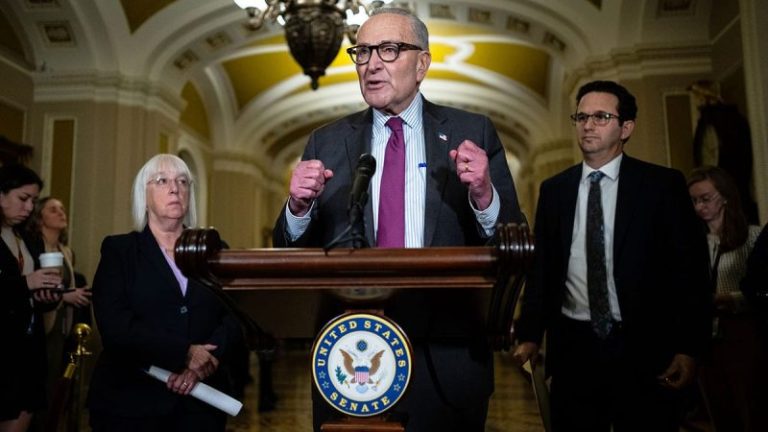
Senate Minority Leader Chuck Schumer, D-N.Y., and his caucus, freshly emboldened by sweeping Election Day victories earlier in the week, are sticking by their newly released plan that would extend the expiring Obamacare subsidies by one year and create a bipartisan working group to negotiate next steps after the government reopens.

But Senate Republicans immediately rejected the idea; Thune called it a ‘non-starter,’ while others in the GOP were angered by the proposal.

Sen. Eric Schmitt, R-Mo., said he would appeal to President Donald Trump and his administration to slash funding from ‘pet projects’ in blue states and cities to pay federal workers as the shutdown drags on.

‘The idea that you’ve got a bunch of kamikaze pilots trying to burn this whole place down because they’re emboldened by an election where Democrats won in Democrat areas is totally insane,’ he said.

Senate Democrats were largely unsurprised that Republicans rejected the offer, however.

‘I know many Republicans stormed out of the gate to dismiss this offer, but that’s a terrible mistake,’ Schumer said.

Thune and his conference have, throughout the course of the 39-day shutdown, said they would only deal with the subsidies after the government reopened and have offered Schumer and Senate Democrats a vote on a bill addressing the healthcare issue once the closure ends.

‘I’m not surprised,’ Sen. Mark Kelly, D-Ariz., said. ‘They don’t want to help people with their healthcare.’

But Republicans countered that a simple extension of the enhanced subsidies, which were modified under former President Joe Biden during the COVID-19 pandemic, would funnel money straight to insurers.

Sen. Katie Britt, R-Ala., has been in talks with Senate Democrats on a path forward, particularly through jump-starting government funding with the impending trio of spending bills.

After Schumer unveiled Democrats’ plan, she charged that ‘since Obamacare came into effect, look who’s gotten rich? It’s not the people.’

‘They’re talking about the people’s premiums and have … they have taken it to the companies that are actually making the money off of it? They’re not,’ Britt said. ‘So, I look forward to hearing why in the world they want to continue these profits and not actually help the people they serve.’

Senate Democrats, however, contend that their offer was fair.

Sen. Chris Murphy, D-Conn., argued that there were some in the caucus that wanted to do a multi-year extension, while others wanted to go beyond just the enhanced subsidies. He reiterated his frustration that the core of the issue, from his perspective, was that neither Schumer nor Thune would sit down and negotiate.

‘We made a really simple, really scaled-down offer that could get the government up and operating and [is] really good for them politically,’ he said. ‘I just still don’t understand why they won’t accept the offer.’

This post appeared first on FOX NEWS

Republican Rep. Riley Moore said the United States could take a range of actions — including sanctions and ‘even kinetic military action’ — in response to what he called the ‘genocide’ of Christians in Nigeria.

Trump designated Moore, a member of the Appropriations Committee from West Virginia, along with Chairman Tom Cole, R-Okla., to lead an investigation into the killing of Christians by Islamist militants in the African nation.

Frustrations with the matter boiled out into the open when Trump this week designated Nigeria as a country of particular concern and ordered the Pentagon to prepare to intervene militarily.

In a video on Truth Social this week, Trump threatened to ‘do things to Nigeria that Nigeria is not going to be happy about’ and ‘go into that now-disgraced country guns-a-blazing.’

Moore told Fox News Digital the designation unlocks ’15 different levers’ the administration can use against Nigeria, including halting arms sales, freezing aid and sanctioning officials or institutions accused of ignoring or enabling religious killings.

‘All options are on the table here for this, even kinetic military action,’ Moore said. ‘That could mean targeted, strategic counterterrorism strikes to get rid of some of the top leadership if that’s what it takes to stop the killing.’

‘We’ve been providing security assistance to this country since at least 2009 – billions of dollars worth of arm sales, training and equipment that they’ve received. And it’s a question of prioritization in what’s important to them. And clearly this has not been one of the most important things.’

The West Virginia Republican said he has been working with the House Appropriations Committee and the State Department to identify what he called ‘legislative levers’ that could support the administration’s response. Moore said he’s also consulting with NGOs and Christian organizations ‘on the ground’ in Nigeria to document the scale of the violence.

He described the attacks as a ‘genocide,’ claiming Christians are being killed at a rate of five to one compared with non-Christians. Moore accused Nigeria’s government of ‘looking the other way’ despite receiving billions in U.S. security aid since 2009.

‘They’re not taking this seriously,’ he said. ‘We had a pastor warn the government about an impending attack — they called it fake news. Within 24 hours, that pastor and 20 of his congregants were murdered.’

The Nigerian government denies a genocide is taking place. ‘Portraying Nigeria’s security challenges as a targeted campaign against a single religious group is a gross misrepresentation of reality. Terrorists attack all who reject their murderous ideology — Muslims, Christians, and those of no faith alike,’ the office of the presidency wrote on X. 

Moore said he and House Appropriations Chairman Tom Cole, R-Okla., plan to meet with Nigerian officials in Washington this month as part of the investigation, and may even send delegations to the nation. He added that the U.S. could still work with Nigeria’s government if it shows a willingness to confront extremist groups.

‘It’s not all sticks here — there are some carrots in this,’ Moore said. ‘If they’re willing to work with us, this could actually lead to a stronger relationship between our countries.’

The Nigerian government has denied that the killings amount to religious persecution, arguing that extremist and criminal groups target civilians of all faiths.

With a population of more than 230 million, Nigeria’s vibrant and often turbulent cities and villages are home to people of strikingly diverse backgrounds. The country’s more than 500 languages and mix of Islam, Christianity, and traditional indigenous faiths have long been marred by tension.

Nigeria’s faith communities remain sharply divided, with Muslims dominating the northern regions and Christians concentrated in the south.

Christianity took firm root in the 19th century, when freed slaves educated in Sierra Leone returned home as teachers and missionaries — establishing schools, churches, and early congregations that continue to shape southern Nigeria’s identity today.

Despite vast oil and mineral wealth, decades of corruption and mismanagement have left much of the nation impoverished.

Nigeria’s growing cache of lithium, cobalt, nickel, and other rare minerals has drawn quiet U.S. attention as Washington looks to counter China’s dominance in Africa’s critical-minerals market. The Commerce Department and U.S. International Development Finance Corp. have eyed investment opportunities in Nigeria’s nascent lithium industry, but persistent insecurity in mining regions threatens Western access and future development.

For over a decade, Nigeria’s Christians fleeing the nation’s northern half have been subject to the violence of Boko Haram, an Islamist militant group known for its terrorist spectacles. Churches and homes burned, communities vanishing in the group’s night raids.

Numbers are difficult to verify, but the International Society for Civil Liberties and Rule of Law reports at least 52,000 Christians have been killed, some 18,500 abducted and unlikely to have survived, and 20,000 churches and Christian schools attacked between 2009 and 2023.

In 2014, Boko Haram famously kidnapped and enslaved 276 teenage girls in a raid on a high school dormitory. The group regularly arms children as suicide bombers and holds slave markets in captured territories.

But a direct U.S. military campaign would prove difficult with current U.S. assets in the nation and is unlikely, one defense official told Fox News Digital.

The United States currently has no permanent military base in Nigeria, though small teams of U.S. advisors and special operations trainers work periodically with Nigerian forces under AFRICOM programs.

Washington approved about $600 million in security aid to Nigeria over the past decade, mostly focused on counterterrorism in the northeast.

This post appeared first on FOX NEWS

A federal appeals court on Friday denied a Trump administration request to temporarily block a lower court ruling requiring the government to fully fund the Supplemental Nutrition Assistance Program (SNAP) program amid the government shutdown. 

The U.S. Court of Appeals for the 1st Circuit ruling comes as the U.S. Department of Agriculture on Friday said it is working to comply with a judge’s order to fully fund the program for November. 

On Thursday, U.S. District Judge Jack McConnell rejected the administration’s effort to only partially fund the benefits program for some 42 million low-income Americans for November as the shutdown drags on, giving the government 24 hours to comply. 

‘People have gone without for too long,’  McConnell said in court.

After the appeals court ruling, the Trump administration filed an emergency appeal to the U.S. Supreme Court, hoping it will step in by 9:30 p.m. ET Friday evening. 

‘Given the imminent, irreparable harms posed by these orders, which require the government to transfer an estimated $4 billion by tonight, the Solicitor General respectfully requests an immediate administrative stay of the orders pending the resolution of this application by no later than 9:30pm this evening,’ an administration spokesperson told Fox News. 

In a letter sent to all regional directors of the SNAP program on Friday, Patrick Penn, deputy undersecretary for USDA’s Food, Nutrition and Consumer Services, said, ‘FNS is working towards implementing November 2025 full benefit issuances in compliance with the November 6, 2025, order from the District Court of Rhode Island.’

He added, ‘Later today, FNS will complete the processes necessary to make funds available to support your subsequent transmittal of full issuance files to your EBT processor.’

Penn said the department would keep regional directors ‘as up to date as possible on any future developments and appreciate your continued partnership to serve program beneficiaries across the country. State agencies with questions should contact their FNS Regional Office representative.’

He scolded the Trump administration for failing to comply with the order he issued last week, which required the U.S. Department of Agriculture to fund the SNAP benefits programs before its funds were slated to lapse on Nov. 1, marking the first time in the program’s 60-year history that its payments were halted. 

The judge also said Trump officials failed to address a known funding distribution problem that could cause SNAP payments to be delayed for weeks or months in some states. He ordered the USDA to tap other contingency funds as needed.

‘It’s likely that SNAP recipients are hungry as we sit here,’ McConnell said Thursday. 

Trump administration officials said in a court filing earlier this week that they would pay just 65% of the roughly $9 billion owed to fund the SNAP program for November, prompting the judge to update his order and give the administration just 24 hours to comply.

‘The evidence shows that people will go hungry, food pantries will be overburdened, and needless suffering will occur,’ McConnell said. ‘That’s what irreparable harm here means.’

Fox News’ Breanne Deppisch contributed to this report. 

This post appeared first on FOX NEWS

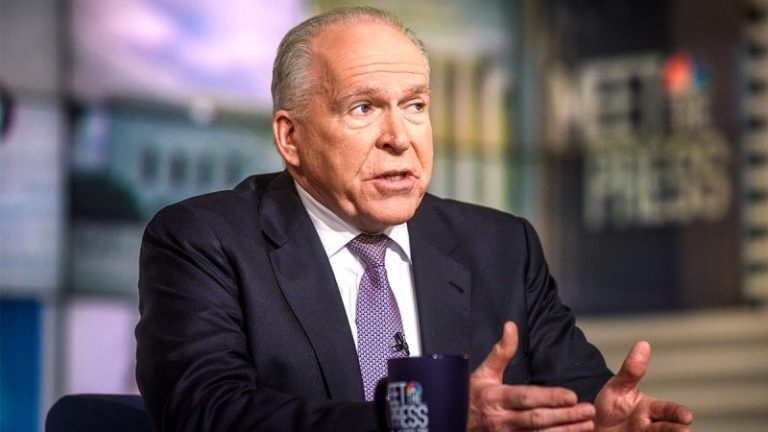
: A federal grand jury has subpoenaed former CIA Director John Brennan, former FBI officials Peter Strzok and Lisa Page, among others as part of the Justice Department’s investigation into the origins of the Trump-Russia probe, Fox News Digital has learned.

Sources told Fox News Digital Brennan; Strzok, the FBI’s former deputy assistant director of counterintelligence; and Page, a former FBI lawyer, were served with federal subpoenas on Friday.

Law enforcement sources told Fox News Digital that up to 30 subpoenas will be issued in the coming days relating to the investigation.

The grand jury is out of the Southern District of Florida. U.S. attorney for the Southern District of Florida Jason Reding Quiñones is supervising the probe.

Fox News Digital first reported this summer that Brennan was under criminal investigation. 

Strzok and Page first came under scrutiny in 2018 when Justice Department Inspector General Michael Horowitz uncovered a series of anti-Trump text messages between them. Both were assigned to work on Special Counsel Robert Mueller’s team in 2017.

Page served on Mueller’s team on a short detail, returning to the FBI’s Office of General Counsel in July 2017. Strzok, though, was removed from the team and was reassigned to the FBI’s Human Resources Division. Prior to serving in the special counsel’s office, Strzok was a top agent in the bureau’s counterintelligence division.

Strzok is the FBI agent who, in July 2016, opened the FBI’s initial Russia investigation, which was nicknamed ‘Crossfire Hurricane’ inside the bureau.

Page resigned from the bureau in May 2018, and Strzok eventually was fired in August 2018.

Strzok was fired from the bureau in August 2018 after months of scrutiny regarding the anti-Trump text messages exchanged between himself and Page.

During congressional testimony in 2018, Strzok confirmed that he and Page were involved in an extramarital affair.

As for the criminal investigation into Brennan, CIA Director John Ratcliffe referred evidence of wrongdoing by Brennan to FBI Director Kash Patel for potential prosecution, DOJ sources told Fox News Digital.

Sources, at the time, said that the referral was received and told Fox News Digital that a criminal investigation into Brennan was opened and is underway. DOJ sources declined to provide further details. It is unclear, at this point, if the investigation spans beyond his alleged false statements to Congress.

The Brennan investigation came after Ratcliffe, this summer, declassified a ‘lessons learned’ review of the creation of the 2017 Intelligence Community Assessment (ICA). The 2017 ICA alleged Russia sought to influence the 2016 presidential election to help then-candidate Donald Trump. But the review found that the process of the ICA’s creation was rushed with ‘procedural anomalies,’ and that officials diverted from intelligence standards. 

It also determined that the ‘decision by agency heads to include the Steele Dossier in the ICA ran counter to fundamental tradecraft principles and ultimately undermined the credibility of a key judgment.’ 

The dossier — an anti-Trump document filled with unverified and wholly inaccurate claims that was commissioned by Fusion GPS and paid for by Democrat presidential candidate Hillary Clinton’s campaign and the DNC — has been widely discredited. Last week’s review marks the first time career CIA officials have acknowledged politicization of the process by which the ICA was written, particularly by Obama-era political appointees. 

Records declassified as part of that review further revealed that Brennan did, in fact, push for the dossier to be included in the 2017 ICA.

Brennan testified to the House Judiciary Committee in May 2023, however, that he did not believe the dossier should be included in that intelligence product.

Ratcliffe was not surprised by the review’s findings, a source familiar told Fox News Digital, given the director’s long history of criticizing Brennan’s politicization of intelligence. But Ratcliffe was compelled to refer aspects of Brennan’s involvement to the FBI for review of possible criminality, the source said.

The source was unable to share the sensitive details of Ratcliffe’s criminal referral to the FBI with Fox News Digital, but said that Brennan ‘violated the public’s trust and should be held accountable for it.’

The false statements portion of the probe stems from a newly declassified email sent to Brennan by the former deputy CIA director in December 2016. That message said that including the dossier in the ICA in any capacity jeopardized ‘the credibility of the entire paper.’

‘Despite these objections, Brennan showed a preference for narrative consistency over analytical soundness,’ the new CIA review states. ‘When confronted with specific flaws in the Dossier by the two mission center leaders – one with extensive operational experience and the other with a strong analytic background – he appeared more swayed by the Dossier’s general conformity with existing theories than by legitimate tradecraft concerns.’

The review added: ‘Brennan ultimately formalized his position in writing, stating that ‘my bottomline is that I believe that the information warrants inclusion in the report.’’

But Brennan testified the opposite in front of Congress in May 2023.

‘The CIA was very much opposed to having any reference or inclusion of the Steele dossier in the Intelligence Community Assessment,’ Brennan testified before the House committee, according to the transcript of his deposition reviewed by Fox News Digital. ‘And so they sent over a copy of the dossier to say that this was going to be separate from the rest of that assessment.’

CIA officials at the time of its creation pushed back against the FBI, which sought to include the dossier, arguing that the dossier should not be included in the assessment, and casting it as simply ‘internet rumor.’ 

Ultimately, Steele’s reporting was not included in the body of the final ICA prepared for then-President Barack Obama, but instead detailed in this footnote, ‘largely at the insistence of FBI’s senior leadership,’ according to a review by the Justice Department inspector general, and later, the Senate Intelligence Committee.

But back in June 2020, Ratcliffe, while serving as director of national intelligence, declassified a footnote of the 2017 ICA, which revealed that the reporting of Trump dossier author Christopher Steele had only ‘limited corroboration’ regarding whether then-President-elect Trump ‘knowingly worked with Russian officials to bolster his chances of beating’ Hillary Clinton and other claims.

The footnote, also known as ‘Annex A’ of the 2017 ICA, exclusively obtained by Fox News Digital in June 2020, spanned less than two pages and detailed reporting by Steele, the former British spy who authored the unverified anti-Trump dossier — a document that helped serve as the basis for controversial Foreign Intelligence Surveillance Act (FISA) warrants obtained against former Trump campaign aide Carter Page.

Steele’s reporting, at the time, was commissioned by opposition research firm Fusion GPS and funded by the Clinton campaign and the Democratic National Committee (DNC) through law firm Perkins Coie.

The footnote made clear the internal concerns officials had over that document.

‘An FBI source (Steele) using both identified and unidentified subsources, volunteered highly politically sensitive information from the summer to the fall of 2016 on Russian influence efforts aimed at the US presidential election,’ the annex read. ‘We have only limited corroboration of the source’s reporting in this case and did not use it to reach the analytic conclusions of the CIA/FBI/NSA assessment.’

‘The source collected this information on behalf of private clients and was not compensated for it by the FBI,’ it continued.

But the annex notes that Steele’s reporting was ‘not developed by the layered subsource network.’

‘The FBI source caveated that, although similar to previously provided reporting in terms of content, the source was unable to vouch for the additional information’s sourcing and accuracy,’ the annex states. ‘Hence this information is not included in this product.’

Justice Department Inspector General Michael Horowitz also reviewed the inclusion of Steele’s reporting in the ICA during his review of alleged misconduct related to the Foreign Intelligence Surveillance Act, or FISA.

His report, released in late 2019, found that there were ‘significant inaccuracies and omissions’ in FISA warrants for former Trump campaign aide Page. Those warrants relied heavily on Steele’s reporting, despite the FBI not having had specific information corroborating allegations against Page that were included in Steele’s reporting.

Meanwhile, Fox News Digital exclusively reported in October 2020 that Brennan briefed former President Obama and administration officials on intelligence that then-Democrat nominee former Secretary of State Clinton was stirring up a plan to tie Trump to Russia.

Ratcliffe, as director of national intelligence, declassified Brennan’s handwritten notes memorializing that meeting, which were exclusively obtained by Fox News Digital in October 2020.

On July 28, 2016, Brennan briefed Obama on a plan from one of Clinton’s campaign foreign policy advisors ‘to vilify Donald Trump by stirring up a scandal claiming interference by the Russian security service.’ 

Comey, then-Vice President Joe Biden, former Attorney General Loretta Lynch and former Director of National Intelligence James Clapper were in the Brennan-Obama briefing.

After that briefing, the CIA properly forwarded that information through a Counterintelligence Operational Lead (CIOL) to Comey and then-Deputy Assistant Director of Counterintelligence Peter Strzok, with the subject line: ‘Crossfire Hurricane.’

Fox News Digital exclusively obtained and reported on the CIOL in October 2020, which stated: ‘The following information is provided for the exclusive use of your bureau for background investigative action or lead purposes as appropriate.’

‘Per FBI verbal request, CIA provides the below examples of information the CROSSFIRE HURRICANE fusion cell has gleaned to date,’ the memo continued. ‘An exchange (REDACTED) discussing US presidential candidate Hillary Clinton’s approval of a plan concerning US presidential candidate Donald Trump and Russian hackers hampering US elections as a means of distracting the public from her use of a private email server.’

The FBI on July 31, 2016, opened a counterintelligence investigation into whether candidate Trump and members of his campaign were colluding or coordinating with Russia to influence the 2016 campaign. That investigation was referred to inside the bureau as ‘Crossfire Hurricane.’

Former Special Counsel Robert Mueller was appointed to take over the FBI’s original ‘Crossfire Hurricane’ investigation. After nearly two years, Mueller’s investigation, which concluded in March 2019, yielded no evidence of criminal conspiracy or coordination between the Trump campaign and Russian officials during the 2016 presidential election.

Shortly after, John Durham was appointed as special counsel to investigate the origins of the ‘Crossfire Hurricane’ probe.

Durham found that the FBI ‘failed to act’ on a ‘clear warning sign’ that the bureau was the ‘target’ of a Clinton-led effort to ‘manipulate or influence the law enforcement process for political purposes’ ahead of the 2016 presidential election.

‘The aforementioned facts reflect a rather startling and inexplicable failure to adequately consider and incorporate the Clinton Plan intelligence into the FBI’s investigative decision-making in the Crossfire Hurricane investigation,’ Durham’s report states.

‘Indeed, had the FBI opened the Crossfire Hurricane investigation as an assessment and, in turn, gathered and analyzed data in concert with the information from the Clinton Plan intelligence, it is likely that the information received would have been examined, at a minimum, with a more critical eye,’ the report continued.

Durham, in his report, said the FBI ‘failed to act on what should have been—when combined with other incontrovertible facts— a clear warning sign that the FBI might then be the target of an effort to manipulate or influence the law enforcement process for political purposes during the 2016 presidential election.’

The Justice Department, earlier this year, formed a ‘strike force’ to assess evidence publicized by Director of National Intelligence Tulsi Gabbard relating to former President Barack Obama and his top national security and intelligence officials’ alleged involvement in the origins of the Trump–Russia collusion narrative.

Meanwhile, Fox News Digital also first reported that Comey was under criminal investigation. Comey has been charged with making false statements and obstruction of a congressional proceeding. 

Comey has pleaded not guilty. His trial is expected to begin in January.

This post appeared first on FOX NEWS

Senate Democrats again blocked a plan by Republicans to ensure that federal workers and the military would receive a paycheck as the shutdown back and forth revs into high gear.

Sen. Ron Johnson, R-Wis., again tried to advance a modified version of his ‘Shutdown Fairness Act’ bill that would see federal workers and the military paid now and during subsequent government shutdowns. However, the bill failed 53-43 with 3 Democrats defecting to support the bill. Georgia Sens. Raphael Warnock and Jon Ossoff, and Ben Ray Luján of New Mexico voted for the bill.

Last month, it was blocked over concerns from Senate Democrats that it did not include furloughed workers.

Johnson noted on the Senate floor that after discussions with Senate Democrats he changed the bill to include furloughed workers, and that his legislation had the backing of several federal employee unions.

‘They are sick and tired, being used as pawns in this political dysfunction here. They’re tired of it,’ Johnson said.

Still, after fireworks on the Senate floor where Senate Majority Leader John Thune, R-S.D., and Sen. Gary Peters, D-Mich., who initially blocked the bill over concerns that it allowed President Donald Trump to pick and choose who got paid, the bill was blocked largely along party lines.

‘It’s about leverage, isn’t it? Isn’t that what y’all have been saying? It’s about leverage,’ Thune said. ‘This isn’t leverage. This is the lives of the American people.’

Johnson’s bill appearing on the floor wasn’t the initial plan Senate Republicans had going into Friday. Thune wanted to put the House-passed continuing resolution (CR) up for a vote again, but newfound Democratic unity after a sweeping victory on Election Night earlier this week had derailed bipartisan attempts to build an off-ramp.

The GOP’s attempt to pay federal workers amid the ongoing, 38-day shutdown came as Senate Minority Leader Chuck Schumer, D-N.Y., and his caucus announced their counter-offer to Senate Republicans’ plan to reopen the government.

Schumer’s offer included attaching a one-year extension onto expiring Obamacare subsidies — the main sticking point of the shutdown — in exchange for the Democratic votes to reopen the government.

But the offer, which a source told Fox News Digital had been made in private to Senate Republicans last week and was summarily rejected, was again not going over well with Republicans.

The Senate is expected to return on Saturday to vote on the House-passed plan for a 15th time. Whether Schumer and his caucus block it once more remains to be seen.

This post appeared first on FOX NEWS