Author

admin

Browsing

President Donald Trump’s bold decision to capture, arrest, and bring Venezuelan strongman Nicolás Maduro to trial for drug-related offenses is far bigger than Operation Absolute Resolve itself. It resets the global chessboard. Here are ten reasons why.

First, the Venezuelan operation proves that American military and intelligence capabilities aren’t just better than anybody else’s — they operate in a wholly different dimension. 

Russian President Vladimir Putin has thrown his entire military at Ukraine in hopes of establishing Russian domination and killing President Volodymyr Zelenskyy. The bloody war has dragged on for three years, costing hundreds of thousands of lives and hundreds of billions of dollars, while draining both countries. And still, that war grinds on.

President Trump sent a small group of special forces into Caracas. Within three hours, they had captured President Maduro and his wife, transporting them to New York to face justice in a U.S. court. No Americans were killed.

Operation Absolute Resolve, like Operation Midnight Hammer, which destroyed Iran’s nuclear capabilities in a matter of hours, was carefully planned, flawlessly executed, and 100% successful. Nobody but America could do that — and leaders around the world know it.

Second, as President Trump says, if you kill Americans, you will be held accountable. Maduro and the drug cartels have killed tens of thousands of Americans with drugs. Not only have we now secured our borders and stopped the flow of fentanyl, but we are bringing drug cartel leaders — including the Maduro family — to face justice.

Third, President Trump has just reversed decades of failed American foreign policy. For years, American leaders of both parties ignored the importance of the Western Hemisphere. They dismissed the growing threats from the countries themselves and from anti-American powers seeking to establish footholds in our hemisphere. American leaders turned a blind eye to drug smuggling and human trafficking. The Biden administration, for its own political purposes, actively encouraged a mass invasion across our border by illegal aliens. 

Operation Absolute Resolve, like Operation Midnight Hammer, which destroyed Iran’s nuclear capabilities in a matter of hours, was carefully planned, flawlessly executed, and 100% successful. Nobody but America could do that — and leaders around the world know it.

While we were focused on the forever wars in the Middle East and the dogma of climate change, three groups were moving into South and Central America — the Chinese, the cartels, and the communists.

Trump’s new national security strategy puts the Western Hemisphere at the center of our foreign policy. Trump allies and reformers now govern Argentina, Chile, Paraguay, and El Salvador — and potentially Venezuela. His long-term vision is a North and South America united by similar economic and governance systems, working in harmony for peace and prosperity.

Fourth, President Trump has reestablished the Monroe Doctrine, which forbids foreign powers from operating in the Western Hemisphere. Two hundred years ago, President Monroe warned European powers against interfering in the Americas. Sixty years ago, President Kennedy used the Monroe Doctrine to keep Soviet missiles out of Cuba. Forty years ago, President Reagan used it to stop the Soviet Union from establishing military bases in the Caribbean. The Monroe Doctrine was a foundational principle of American foreign policy, establishing the Western Hemisphere as an American zone of influence.

The Obama administration abandoned the Monroe Doctrine. Secretary of State John Kerry unilaterally declared it dead. The Biden administration also abandoned the Monroe Doctrine by looking the other way while Russia, China, and Iran established footholds in several countries.

By sending the American armada into the Caribbean, President Trump reinstated the Monroe Doctrine and declared, ‘American dominance in the Western Hemisphere will never be questioned again.’

The new Monroe Doctrine is not an effort to keep our southern neighbors down; it is intended to keep malign powers out.

Fifth, President Trump uses not only military might but all aspects of American power — especially trade, finance, and technology — to influence world events. Before he dispatched special forces to capture Maduro, Trump put massive economic pressure on Venezuela. Maduro relied on a ghost fleet of unregistered tankers to illegally ship oil abroad, especially to China.

These transactions were sanctioned but never enforced. Oil sales brought Maduro about $200 million a week, which he used to bribe and blackmail Venezuelan kleptocrats and pay his military. President Trump enforced those sanctions and seized the oil tankers. By cutting off his main source of funding, it was only a matter of time before Maduro ran out of money.

Sixth, critics are quick to accuse Trump of the policies he once criticized — regime change, nation-building, and forever wars. They’re wrong. President Trump has learned from the failures of the past — he doesn’t want to repeat them. President George W. Bush overthrew the Iraqi and Afghan governments, fired government technocrats, and imposed U.S. occupations that were doomed from the beginning. He tried to impose Western-style democracies on countries that were neither suited for it nor wanted it. He got us tangled in decades of wars we couldn’t win, with massive losses in blood and treasure.

President Obama made the opposite mistake. He helped topple dictators during the Arab Spring but then walked away from the ensuing chaos, under the misguided assumption that these countries would immediately embrace democracy on their own.

President Bush tried to do too much. President Obama did too little. Both failed.

If critics had listened carefully to President Trump’s press conferences and statements, they would realize he aims to chart a different course. Trump said the U.S. would ‘run’ Venezuela until governance could be turned over to the Venezuelans. That’s a far cry from decades of occupation and nation-building.

Until Maduro and his predecessor, Hugo Chávez, seized power, Venezuela had a long tradition of democracy, with regular elections, a free press, and an independent judiciary. Trump isn’t trying to run Venezuela forever. He is already negotiating with remaining members of the Maduro government and political opposition groups for a smooth and quick transfer of power to the Venezuelan people, overseen by the U.S.

Seventh, the oil. The future, in both manufacturing and artificial intelligence, belongs to countries with technological superiority and inexpensive, abundant energy resources. Venezuela has the world’s largest known oil reserves but needs investment to modernize production. American companies have a long history of working with Venezuelan oil companies, and we can do so again. It will be a win-win for the U.S. and Venezuela.

But there is a secondary effect of increased Venezuelan oil production: over time, it will drive down global prices. Russia and Iran rely on oil sales to fund their governments. More oil worldwide means lower prices, which means less income for our enemies.

Eighth, corrupt, incompetent, America-hating dictators should take note. With American help, Maduro is now gone. If the United States and Venezuela, working together, succeed in establishing a new government that restores capitalism and democracy, it will succeed.

If so, could Venezuela be the spark that ignites other democratic reform movements? Cuba is kept alive by Maduro’s drug money. What happens when that money runs out? What happens to the pro-Maduro Colombian government once a new Venezuelan government is formed?

Ninth, the world will now see firsthand what the American legal system looks like. Maduro will be tried in the U.S., in a public courtroom, with the world watching. The Justice Department has worked for years to build a solid case against Maduro for narcoterrorism, drug trafficking, and money laundering. It will show Maduro’s personal connections to drug cartels and human trafficking. It may also shine a light on malign foreign involvement by Iran, Russia, and China.

Finally — and in some ways most importantly — President Trump has overcome the loser syndrome. For years, China has told the world that America is a nation in irreversible economic and moral decline. We fought and lost forever wars in the Middle East. Biden’s Afghanistan withdrawal was shambolic. We have been pushed around by our enemies and disrespected by our allies. Our own leaders have been corrupt, incompetent, and unresponsive.

That has now changed. Our economy is at the starting gate of significant growth. Trillions are being invested in American manufacturing. Our technology and energy sectors are unleashed. We have the most powerful and capable military in the world. Our leaders — especially President Trump — are decisive, confident, and unafraid. More and more people at home and abroad no longer see an America in decline but an America perhaps poised for a new Golden Age.
This post appeared first on FOX NEWS

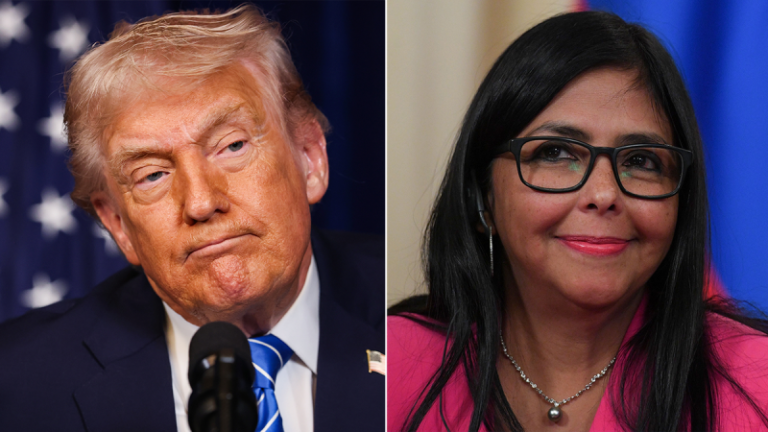
President Donald Trump issued a pointed warning to Venezuela’s new leader on Sunday, suggesting severe consequences if she continues to resist U.S. demands following the American-led operation that resulted in the capture of Venezuelan President Nicolás Maduro.

In an interview with The Atlantic, Trump said Delcy Rodríguez would ‘pay a very big price, probably bigger than Maduro’ if she fails to ‘do what’s right,’ adding that his administration would not tolerate what he described as her defiant rejection of the U.S. intervention.

Defending that approach, Trump said, ‘Rebuilding there and regime change, anything you want to call it, is better than what you have right now. Can’t get any worse,’ he added.

The White House did not immediately respond to Fox News Digital’s request for comment. 

Trump’s remarks followed a stunning predawn announcement Saturday that U.S. operators had carried out a mission to capture Venezuelan President Nicolás Maduro and his wife.

Speaking at a news conference at Mar-a-Lago, Trump said a U.S.-appointed team would ‘run Venezuela’ until the country’s political leadership was stabilized.

He also pledged a return of U.S. energy investment to the cash-strapped Latin American country which sits atop the world’s largest oil reserves. 

Trump framed his foreign policy approach, according to The Atlantic, through what he described as a modernized version of the Monroe Doctrine, the 19th-century policy opposing European colonial influence in the Western Hemisphere. 

Trump referred to his approach as the ‘Donroe Doctrine.’

Trump also hinted that Venezuela would not be the last nation to face U.S. pressure, raising the prospect of additional interventions beyond Latin America.

As an example, he reiterated his long-standing interest in Greenland, a semiautonomous territory of Denmark, a NATO ally.

‘We do need Greenland, absolutely,’ Trump told the magazine, citing U.S. national security interests and strategic location.

This post appeared first on FOX NEWS

For three years, the Washington foreign policy establishment has insisted that there is only one acceptable outcome in Ukraine: total victory over Russia achieved through relentless military aid, indefinite financial support and escalation readiness regardless of the risks. But strategy and morality are not always the same thing — and real leadership demands confronting reality as it exists, not as we wish it to be.

I write this not as an academic or pundit, but as someone who worked at the center of this conflict. As U.S. ambassador to the European Union during the first Trump administration, President Donald Trump tasked me with bringing Europe into alignment — truly into alignment — behind Ukraine. 

That meant ending the EU’s habitual double-game: proclaiming solidarity with Kyiv while enriching Moscow through energy purchases and dragging its feet on serious sanctions. I saw firsthand how Europe’s hesitation and transactional approach sent Moscow exactly the wrong message. It told President Vladimir Putin the West was divided, unserious and ultimately unwilling to sacrifice comfort for principle. That perception was part of his calculus.

The uncomfortable truth is that the United States is closer to strategic exhaustion than our rhetoric admits. Europe’s defense industries remain underbuilt. American stockpiles are finite. And while Russia has paid a staggering price, it has not collapsed, surrendered or reversed course. Worse, every escalation increases the probability of something unthinkable: a desperate Kremlin resorting to tactical nuclear weapons. That would not be ‘just another step’ on the escalatory ladder; it would fundamentally shatter global stability.

Against that background, the Trump administration’s instinct to seek a quasi-business resolution is not weakness. It is classic realpolitik — recognition that the job of American leadership is to maximize U.S. security, economic leverage and strategic flexibility while minimizing existential risk.

Business leaders know what Washington too often does not: the perfect deal rarely exists. The question is not whether we can achieve a morally pure resolution; it is whether we can lock in outcomes that are measurably better for American interests — and for Ukraine — than a perpetual, bleeding stalemate.

A negotiated settlement, backed by enforceable conditions and leverage, could do precisely that.

First, a settlement can provide Ukraine with a bespoke security guarantee — credible enough to deter renewed aggression but structured to avoid NATO Article 5 entanglement. This isn’t a vague promise; it is a contract with clear performance terms. The U.S. guarantee would stand as long as Russia adheres to its commitments. But if Russia violates the agreement, the snapback provisions would trigger instantly — not months later, not after diplomatic waffling — immediately unlocking full-scale U.S. and NATO support for Ukraine, including offensive weapons, advanced air defense, training and intelligence integration.

Just as important, the consequences of Russian cheating would be explicit, not theoretical.

If Moscow breaks the deal, the United States would reserve the option to openly back Ukraine in retaking every inch of territory — up to and including restoration to its pre-2014 borders. Moscow would know this going in. Deterrence works best when penalties are unmistakable.

And crucially, this would all be public. No more pretending, hedging or quiet back-channel shipments. The world — and Russia — would know that renewed aggression automatically and lawfully unleashes overwhelming Western support, with the U.S. leading confidently and unapologetically. That clarity is a deterrent in itself.

Equally important, this structure protects U.S. sovereignty in the agreement. If Ukraine violates its obligations, the American guarantee becomes void at our sole discretion. Not a bureaucratic process. Not a committee vote. The United States decides. That means Ukraine has every incentive to maintain discipline and treat the arrangement not as a blank check, but as a powerful partnership grounded in responsibility.

Second, a negotiated deal can generate tangible U.S. economic advantage. Ukraine holds minerals and rare earths essential to American industry, national security and technological supremacy. China knows this. Russia knows this. Only Washington’s old guard pretends resource control is not strategic policy. A structured agreement ensuring privileged U.S. access strengthens manufacturing, energy resilience, and economic security.

Third, a settlement can wedge open the relationship between Moscow and Beijing. Right now, the war has pushed Russia completely into China’s arms. That alignment is bad for the United States and for global balance. A disciplined settlement begins unwinding that dependency. America doesn’t need friendship with Moscow; it needs leverage over it. Realpolitik is about advantage, not affection.

Fourth, a deal can compartmentalize strategic theaters. If Russia insists on regional influence, the U.S. can demand reciprocal space in our hemisphere — particularly in Venezuela, narcotics interdiction, and energy-linked criminal networks — reducing adversarial reach in the Americas.

Critics will scream ‘Munich.’ They always do. But Adolf Hitler was leading a rising ideological empire bent on global conquest. Russia is a demographically and economically declining power seeking regional positioning. Brutal, yes — but not irrational. Mature powers negotiate with rivals when negotiations produce superior outcomes.

Others claim any deal rewards aggression. That assumes deterrence is binary — victory or failure. In reality, deterrence is layered.

A settlement that leaves Russia bloodied, sanctioned, strategically constrained and facing automatic, overwhelming Western military escalation — potentially including U.S. support for Ukraine restoring its 2013 borders — if it cheats is not a reward. It is a warning carved into treaty stone.

Meanwhile, the humanitarian and financial realities matter. Endless war means endless dead Ukrainians, shattered cities and endless U.S. taxpayer exposure with no defined victory condition. That may thrill think tanks that never fight wars, but it is not serious governance.

Most importantly, a business-style settlement introduces accountability — currently absent from Washington’s ‘as long as it takes’ mantra. Under a structured deal, compliance is measurable. Triggers are automatic. Support is not improvised — it is guaranteed. Enforcement is not theoretical — it is built in. And unlike today, America would no longer need to whisper its involvement. It would act openly, decisively and with treaty authority.

The alternative? A forever war with rising nuclear risk, continued strategic drift, and deepening alignment between Russia and China. That is not strategy. It is inertia dressed as courage.

Realpolitik does not abandon values. It protects them intelligently. A disciplined, enforceable settlement — with clear snapback provisions benefiting both the U.S. and Ukraine; explicit authority to openly arm Ukraine and potentially support full territorial restoration if Russia cheats; and a guarantee revocable at America’s sole discretion if Ukraine violates terms — is not capitulation.

It is strategic control.

In geopolitics, as in business, the strongest player is not the one who insists on endless confrontation. It is the one who knows when to fight — and when to close the deal.

This post appeared first on FOX NEWS

Tensions between Israel and Turkey are rising amid competing visions for Gaza’s reconstruction and widening strategic friction in Syria, even as both countries remain embedded in a U.S.-led diplomatic framework following the ceasefire with Hamas.

Israel has made clear it will not allow Turkish armed forces to operate inside Gaza, viewing Ankara as a destabilizing actor despite its public efforts to present itself as a reconstruction partner. Turkish sources told Fox News Digital that Ankara does not seek to deploy troops in Gaza, instead focusing on humanitarian aid, infrastructure projects and political influence. 

Dan Diker, president of the Jerusalem Center for Security and Foreign Affairs, said Israel views Turkey as a strategic threat rather than a neutral actor. 

‘From Israel’s point of view, Turkey is the arsonist behaving like the firefighter in Gaza,’ Diker told Fox News Digital. ‘If Turkey is allowed to enter Gaza with several thousand armed men, you can guarantee that this Muslim Brotherhood country will destabilize Gaza and dismantle the very 20-point plan that President Trump has bet the farm on.’

Diker said President Recep Tayyip Erdogan’s ambitions extend beyond Gaza, pointing to Turkey’s military presence in northwestern Syria and what he described as Ankara’s long-standing role enabling radical Islamist groups inside the country.

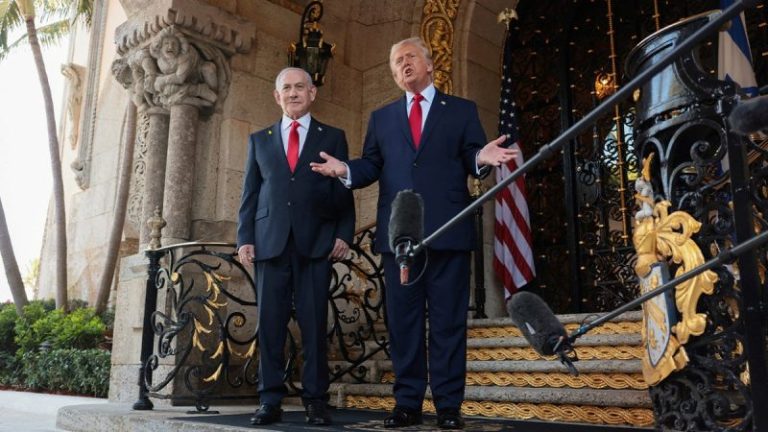
In Trump’s remarks at Mar-a-Lago on Monday at his press conference with Prime Minister Benjamin Netanyahu, he repeatedly praised Erdogan and downplayed concerns about a possible Israel-Turkey confrontation.

‘I know President Erdogan very well… he’s a very good friend of mine,’ Trump said. ‘Bibi respects him… They’re not going to have a problem. Nothing’s going to happen.’ Netanyahu smiled and didn’t comment.

At the same time, Trump aligned himself publicly with Netanyahu on Gaza’s future, issuing his strongest statement yet that Hamas must disarm.

‘They made an agreement that they were going to disarm,’ Trump said. ‘If they’re not going to disarm, those same countries will go and wipe out Hamas.’

According to Diker, the president is deliberately managing tensions with Ankara by keeping Erdogan inside the diplomatic framework rather than confronting him publicly.

‘President Trump is very, very good at keeping adversaries close, together with allies,’ Diker said. ‘That’s why he keeps saying that he likes Erdogan. He wants to keep Erdogan in the party. He wants to keep him close.’

Diker said Trump understands his own leverage in the region and believes he can coalesce Arab and Muslim states when it serves U.S. and Israeli interests, citing coordination during the first phase of the hostage deal.

Diker said Netanyahu is now walking a narrow line, trying not to undermine the framework Trump has built while ensuring Israel’s security red lines are maintained.

‘Israel will not allow Turkish Armed Forces in Gaza. It’s not going to happen,’ Diker said, adding that Israel may still be forced into limited compromises to preserve Trump’s broader support, particularly on Iran.

Beyond Gaza, Israel sees Turkey’s role in Syria as a growing point of friction. Ankara maintains influence across large swaths of northern Syria, while Israel has continued air operations aimed at Iranian targets.

Sinan Ciddi, a senior fellow at the Foundation for Defense of Democracies, warned in an analysis that Turkey views Israel-aligned regional cooperation as a direct challenge to its ambitions.

Ciddi cited a trilateral summit between Israel, Greece and Cyprus in Jerusalem as a flashpoint, arguing it signaled resistance to Turkey’s ‘Blue Homeland’ doctrine and broader maritime claims in the Eastern Mediterranean.

Following the summit, pro-Erdogan media outlets described Israel as a major threat, while Turkey increased military activity that alarmed U.S. allies, including airspace violations near Greece and reported efforts to expand radar coverage in Syria that could hinder Israeli operations against Iran.

Diker said Israel’s recognition of Somaliland adds another layer to the rivalry, particularly in the Red Sea region. ‘The Turks are working in Somalia. They are also working to control and influence what happens in the Red Sea region,’ Diker said. ‘Which is why Somaliland’s development is very, very important.’

He argued that the move gives Israel a strategic foothold along a vital maritime corridor.

‘Israel then has a strategic base, a forward base in Somaliland on the Red Sea,’ Diker said. ‘Very, very important, because it checkmates Turkey.’

Diker said the move was viewed in Ankara as a direct challenge to Turkish ambitions in the Horn of Africa, adding that the Trump administration had ‘expressed its understanding’ of Israel’s decision.

Despite Erdogan’s harsh rhetoric toward Israel and vocal support for the Palestinian cause, Turkish diplomatic sources say Ankara is acting pragmatically. While Turkey sees financial and political opportunity in Gaza’s reconstruction, those sources say Erdogan is aware there is little domestic appetite for sending Turkish troops into the enclave.

That gap between rhetoric and policy, analysts say, is likely to persist. As Diker put it, Trump is trying to keep the diplomatic structure intact while Israel works to contain what it sees as Turkey’s expanding regional footprint. ‘Trump does not want to topple the apple cart,’ Diker said. ‘He wants to try to keep everyone together so that they can move to stage two of the 20-point plan in Gaza.’

This post appeared first on FOX NEWS

The lithium market heads into 2026 after one of its most punishing years in recent memory, shaped by deep oversupply, weaker-than-expected electric vehicle (EV) demand and sustained price pressure.

In 2025, lithium carbonate prices in North Asia sank to four year lows, forcing production cuts and project delays as the industry grappled with the consequences of years of aggressive supply growth.

The second half of the year saw a rebound as lithium carbonate began a slow ascent. By December 29, prices had risen 56 percent from their January start position of US$10,798.54 per metric ton to US$16,882.63.

While volatility and brief price rallies highlighted the market’s sensitivity to sentiment and policy signals, analysts increasingly see the sector’s first-half downturn as an inflection point. With high-cost supply under strain and inventories gradually tightening, expectations are building that 2026 could mark the start of a rebalancing phase, supported by long-term demand tied to electrification, energy storage and the broader energy transition.

Battery energy storage systems to drive lithium growth

Energy storage is emerging as the fastest-growing pillar of battery demand, with major implications for the lithium market heading into 2026. Indeed, according to Benchmark Mineral Intelligence’s Iola Hughes, growth in this segment is accelerating well ahead of the broader battery market.

“We’re expecting about 44 percent growth (in 2025),” she said. That’s compared with roughly 25 percent growth across total battery demand. As a result, energy storage is set to account for about a quarter of total global battery demand in 2025, a share that is rising rapidly. The shift is even more pronounced in the US, where Hughes expects storage to make up a significant “35 to 40 percent of battery demand in the next few years.”

That growth is being driven by falling costs and the growing role of lithium iron phosphate (LFP) chemistry, which Hughes described as the dominant technology in stationary storage.

“It very much is the story of LFP right now,” she said, pointing to recent innovation and lower costs, which have helped to make LFP “the best chemistry” for most storage applications.

Globally, deployment remains highly concentrated. China and the US account for roughly 87 percent of cumulative grid-scale storage installations, but new markets are emerging quickly.

Saudi Arabia, Hughes noted, has surged from effectively zero to the world’s third largest market in a matter of months, deploying around 11 gigawatt-hours in the first quarter alone. “That really goes to show just how early this market is in its story,” she said; it also indicates how quickly new sources of battery demand can materialize.

Cost declines sit at the core of the expansion. Fully integrated storage systems in China are now approaching, and in some cases falling below, US$100 per kilowatt-hour. Hughes said this has fundamentally changed the economics of storage, making deployments viable even as policy support tightens. “The prices are so much cheaper, the economics are a lot stronger, even in a normal, unsubsidized environment,” she said.

In the US, growth remains concentrated in a handful of states — led by California and Texas — but Hughes stressed how early stage the market still is. New Mexico, now the fifth largest storage market, is built on just a few projects.

At the same time, the scale of energy storage projects is increasing rapidly. Giga-scale installations, defined as projects larger than 1 gigawatt-hour, are moving from novelty to norm.

Hughes said nine such projects are expected to come online this year, accounting for about 20 percent of battery demand, with more than 20 in the pipeline for next year, representing close to 40 percent.

Policy remains a key variable. While investment tax credits for storage remain in place in the US, Hughes warned that tighter sourcing and eligibility rules are reshaping supply chains, particularly for LFP. The pipeline of announced LFP gigafactories has grown sharply this year — up more than 60 percent — led largely by Korean manufacturers.

“We’re in a much better position when it comes to sourcing of cells for energy storage than we were even three months ago,” she said, though challenges remain around production tax credits and heavy reliance on Chinese cathode supply.

Underlying the storage boom is a broader shift in electricity demand.

After more than a decade of stagnation, US power demand is rising again, driven by data centers, AI, electrification and reshoring of manufacturing. Hughes said estimates now point to electricity demand rising 20 to 30 percent by 2030, placing energy storage at the center of energy security planning. “Storage has become a central topic in the energy security conversation,” she said, adding that its role will only grow.

Looking ahead, Hughes said LFP is likely to dominate shorter-duration storage, while sodium-ion and other battery technologies compete in longer-duration segments.

For the lithium market, the message is clear: as storage scales up in size, geography and strategic importance, it is becoming one of the most powerful demand drivers shaping the sector’s outlook for 2026 and beyond.

Lower costs driving LFP adoption

Howard Klein, RK Equity co-founder and partner, argued that falling costs remain a central driver of LFP battery adoption, reflecting a familiar economic dynamic: as prices decline, demand accelerates.

While lithium is a key input, he suggested that ongoing manufacturing efficiencies and economies of scale are likely to continue pushing LFP battery costs lower over time, potentially offsetting upward pressure from higher lithium prices.

Klein emphasized that even if LFP costs rise modestly, battery storage will remain highly competitive as a source of grid power. Compared with conventional generation options such as gas or coal, storage already offers a compelling cost and performance proposition, he said, and does not rely solely on subsidies to remain economically viable.

Geopolitical instability on the rise

Critical minerals are increasingly at the center of US foreign policy, and that shift is set to reshape the lithium value chain through 2026, according to Klein. He noted that geopolitics now underpins many of Washington’s strategic priorities, from Eastern Europe to Africa and the Arctic.

“The entire foreign policy agenda is largely being driven by critical minerals,” Klein said, citing regions including Ukraine, Russia, the Democratic Republic of Congo, Greenland and Canada.

China’s willingness to weaponize its dominance in key supply chains has sharpened that focus.

On that note, Klein pointed to Beijing’s renewed rare earths export restrictions in October, noting that these measures were applied globally, not just against the US.

“They showed that they wield a significant negotiating stick, and they’re willing to use it,” he said.

In Klein’s view, that move has triggered a forceful response from western governments. “I think they’ve overplayed their hand to some degree, because now you’ve had this very big reaction from the US.”

That reaction is translating into a renewed push to localize and reshore critical mineral supply chains — an effort that has gained rare bipartisan backing in Washington.

“Unlike so many other things in America, which are hyper-partisan, both sides agree we need to resolve this,” Klein said, adding that the policy momentum will continue to shape the lithium industry.

While rare earths remain the immediate pressure point, Klein said the policy lens is widening. The US recently added 10 minerals to its critical minerals list, which now stands at a total of 60. Lithium, he said, sits high on that agenda, not out of enthusiasm for the metal itself, but because of its role in batteries.

“It’s an understanding by the government that batteries and battery technology are very, very important, and the entire battery supply chain needs to be supported,” Klein said. That support extends beyond lithium to graphite, manganese, nickel, cobalt and battery components such as anodes and cathodes.

The approach is increasingly coordinated across western economies. Klein described it as “a G7 effort,” with the EU and Canada aligned alongside the US through a mix of bilateral and multilateral initiatives.

That coordination is already translating into capital flows. He pointed to US-backed progress at Thacker Pass, EU funding for Vulcan Energy Resources (ASX:VUL,OTC Pink:VULNF) and a 360 million euro grant for European Metals Holdings (LSE:EMH,ASX:EMH,OTCQB:EMHLF) as early examples. Canada, he added, is also ramping up support.

“Canada announced C$6 billion over 26 investments,” Klein said, adding that more announcements are likely by the time the Prospectors & Developers Association of Canada convention rolls around in March.

Klein sees geopolitics, industrial policy and supply chain security converging into powerful lithium tailwinds. “This is a super hot topic,” he said, and one that is likely to drive increased lithium-related activity well into 2026.

Should the US build a strategic lithium reserve?

To dilute China’s grip on the sector, Klein is advocating for a strategic lithium reserve in the US as a more effective and market-neutral alternative to company-specific subsidies. He argues that the industry’s core challenge is not demand, but extreme price volatility caused by global oversupply and what he describes as non-market behavior, which has driven prices below sustainable levels and distorted investment signals across the sector.

“The problem in lithium is volatile prices — prices below the marginal cost, catastrophically low prices that put companies out of business,” he said, pointing to persistent oversupply as the primary distortion.

In Klein’s view, a reserve would act as a counterweight by creating steady, large-scale demand that stabilizes prices within a sustainable range. “The main focus is to stabilize price … not at a super high level, but at a level where companies can make an economic return,” he said. That stability, he added, is essential to incentivize investment in mines, processing and conversion facilities across the US, Canada and allied jurisdictions.

Unlike targeted government support, Klein said a reserve would allow the market to determine which projects succeed.

“I want the market to decide which projects and companies are the best, not necessarily the government,” he said, noting the diversity of competing lithium resources, from US clay and brine projects to Canadian hard-rock deposits.

A more predictable price environment with fewer large swings would lower the cost of capital and give private investors greater confidence to finance viable projects.

Klein stressed that a lithium reserve should not be confused with a stockpile.

“People use ‘stockpile’ and ‘reserve’ like they’re the same thing, and they’re not,” he said. While a stockpile focuses on availability for emergencies, a reserve is designed as a market-stabilizing mechanism that can buy and sell material to smooth volatility. Availability, he said, is a secondary benefit.

He sees the concept as most relevant for mid-sized, fast-growing markets like lithium, graphite and other battery materials that lack deep futures markets and long-term hedging tools.

“Those are the markets that could be amenable to a reserve,” he said, contrasting them with large, liquid commodities like copper or very small, niche minerals tied mainly to military use.

Looking longer term, Klein said a lithium reserve aligns closely with the growth of EVs, energy storage, data centers and grid electrification, as well as geopolitical efforts to diversify supply chains away from China.

“This is no longer just a renewables or EV thing — this is national security, clean energy and building an electro-state,” he said, arguing that reducing volatility would make it easier for automakers, utilities and manufacturers to commit capital without fear of being caught on the wrong side of wild price swings.

North American cooperation key for lithium

Gerardo Del Real, publisher at Digest Publishing, also highlighted the impact of geopolitics on the lithium value chain, emphasizing the need for North American coordination to reduce reliance on dominant producers like China.

“I think this is the path towards that. It has to happen,” he said, noting that collaboration between the US, Canada and potentially Mexico could strengthen regional supply security and reduce vulnerability to global disruptions.

Del Real framed the issue in broader energy terms, pointing to the strategic value of domestic resources: “If we are serious as a country and as a region in being somewhat independent from China and from the Russians … we have a luxury of resources in the US, in Canada … there could be a very powerful path forward.”

On market dynamics, he suggested investors are focused on timing and catalysts, with policy shifts, demand surprises or supply disruptions likely to drive sentiment in 2026.

He also warned that the market may be underestimating the importance of coordinated regional supply initiatives as a factor shaping pricing and project economics.

Securities Disclosure: I, Georgia Williams, hold no direct investment interest in any company mentioned in this article.

This post appeared first on investingnews.com

Venezuelan opposition leader María Corina Machado issued an open call for a transfer of power Saturday, urging the military to abandon Nicolás Maduro’s government and recognize opposition-backed candidate Edmundo González as president after the U.S. said Maduro had been captured.

Machado’s statement came hours after President Donald Trump announced that U.S. forces had captured Maduro following what he described as ‘large-scale’ military strikes targeting the Venezuelan government. Trump said Maduro and his wife were flown out of the country, a move that would mark the most direct U.S. military action against a Latin American head of state in decades.

‘The hour of freedom has arrived,’ wrote in a post on X. ‘This is the hour of the citizens. Those of us who risked everything for democracy on July 28th. Those of us who elected Edmundo González Urrutia as the legitimate President of Venezuela, who must immediately assume his constitutional mandate and be recognized as Commander-in-Chief of the National Armed Forces by all the officers and soldiers who comprise it.’

It remained unclear Saturday whether senior commanders have shifted allegiance or whether the opposition has secured control of state institutions.

Machado also called on Venezuelans inside the country to remain ‘vigilant, active and organized,’ signaling that further instructions would be communicated through official opposition channels. To Venezuelans abroad, she urged immediate mobilization to pressure foreign governments to recognize a new leadership in Caracas.

The U.S. conducted strikes on Caracas early Saturday morning and took Maduro and his wife into custody and flew them to New York to face drug trafficking charges.

Machado and González have repeatedly argued that the July 28 presidential election was stolen, pointing to an opposition-run parallel vote count that they say shows González won by a wide margin.

Venezuela’s electoral authorities, which are controlled by Maduro allies, declared him the winner with just under 52% of the vote, compared with roughly 43% for González. The government has rejected allegations of fraud.

The opposition, however, says it collected and published tally sheets from polling stations nationwide showing González received about two-thirds of the vote, compared with roughly 30% for Maduro — a claim cited by several foreign governments that declined to recognize the official results.

Maduro’s government has refused to release detailed precinct-level data to independently verify the outcome, further fueling accusations that the election did not reflect the will of voters.

While González is the opposition-backed presidential candidate, Machado has remained the dominant figure in Venezuela’s opposition movement. Machado won the opposition’s primary by a landslide before being barred from running by Maduro’s government, forcing the coalition to rally behind González as a substitute candidate.

Throughout the campaign, González publicly acknowledged Machado as the movement’s leader, with Machado continuing to direct strategy, messaging and voter mobilization efforts. Machado has remained the public face of the opposition, while González has largely played a formal, constitutional role tied to the presidency.

This post appeared first on FOX NEWS

President Donald Trump’s House GOP critics are ripping the administration’s operation in Venezuela that resulted in the capture of the country’s president, Nicolás Maduro.

Rep. Thomas Massie, R-Ky., was the first to criticize the Trump administration’s operation in Venezuela, again breaking from the majority of his party and butting heads with the commander-in-chief.

Massie, a longtime critic of U.S. foreign intervention, appeared to question the legality of the federal government’s Venezuela strikes.

‘If this action were constitutionally sound, the Attorney General wouldn’t be tweeting that they’ve arrested the President of a sovereign country and his wife for possessing guns in violation of a 1934 U.S. firearm law,’ Massie posted to X on Saturday morning.

The Department of Justice (DOJ) unsealed a four-count indictment against Maduro after Trump confirmed the U.S. took custody of the Venezuelan leader and his wife following strikes in the capital of Caracas.

Attorney General Pam Bondi said in a statement those charges were ‘Narco-Terrorism Conspiracy, Cocaine Importation Conspiracy, Possession of Machineguns and Destructive Devices, and Conspiracy to Possess Machineguns and Destructive Devices against the United States.’

It’s not immediately clear what Maduro’s wife, Celia Flores, has been charged with.

In a follow-up posted on the charges, Massie said, ’25-page indictment but no mention of fentanyl or stolen oil. Search it for yourself.’

Trump said on Fox News that Maduro and Flores were being flown to the U.S.S. Iwo Jima, which will bring them to the U.S. where they will face criminal proceedings led by the Southern District of New York.

Massie’s criticism was followed by scathing comments by Rep. Marjorie Taylor Greene, R-Ga., another Trump critic who is retiring from Congress early next week before finishing her term.

‘If U.S. military action and regime change in Venezuela was really about saving American lives from deadly drugs, then why hasn’t the Trump admin taken action against Mexican cartels? And if prosecuting narco terrorists is a high priority, then why did President Trump pardon the former Honduran President Juan Orlando Hernández, who was convicted and sentenced for 45 years for trafficking hundreds of tons of cocaine into America?’ part of Greene’s statement read.

‘The next obvious observation is that by removing Maduro this is a clear move for control over Venezuelan oil supplies that will ensure stability for the next obvious regime change war in Iran. And of course, why is it ok for America to militarily invade, bomb, and arrest a foreign leader, but Russia is evil for invading Ukraine and China is bad for aggression against Taiwan? Is it only ok if we do it? (I’m not endorsing Russia or China).’

Meanwhile, Rep. Don Bacon, R-Neb., praised the operation itself but expressed concerns about what precedent is being set.

‘My main concern now is that Russia will use this to justify their illegal and barbaric military actions against Ukraine, or China to justify an invasion of Taiwan,’ Bacon said in a statement. ‘Freedom and rule of law were defended last night, but dictators will try to exploit this to rationalize their selfish objectives.’

Bacon is also retiring from Congress, but unlike Greene, he is serving out his full term.

The vast majority of Republican lawmakers unequivocally backed the operation, as expected. 

Senate Majority Leader John Thune, R-S.D., and House Speaker Mike Johnson, R-La., both said they expected congressional briefings from the Trump administration in the coming days when lawmakers return from a two-week recess. 

This post appeared first on FOX NEWS

Vice President JD Vance was not physically present at President Donald Trump’s news conference announcing the capture of Venezuelan leader Nicolás Maduro because of heightened security and secrecy concerns, according to a spokesperson, despite being closely involved in the planning and execution of the operation.

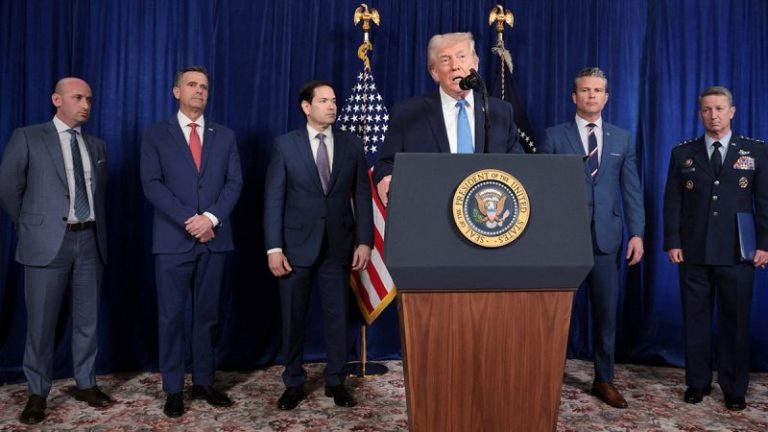
Trump briefed the press on the mission hours after Maduro was taken into U.S. custody, flanked by Secretary of State Marco Rubio, War Secretary Pete Hegseth and chairman of the joint chiefs, Gen. Dan Caine. 

Vance publicly praised the operation on X but did not attend the briefing. Vance did meet with Trump at Mar-a-Lago on Friday to discuss the strikes, but was not at Trump’s golf club Friday night where senior Trump officials monitored the mission because the national security team ‘was concerned a late-night motorcade movement by the Vice President while the operation was getting underway may tip off the Venezuelans.’ 

‘The Vice President joined by secure video conference throughout the night to monitor the operation. He returned to Cincinnati after the operation concluded.’

Due to ‘increased security concerns,’ Trump and Vance are limiting the ‘frequency and duration’ of time they spend together outside of the White House, the Vance spokesperson told Fox News Digital. 

‘Maduro is the newest person to find out that President Trump means what he says,’ Vance wrote on X after the operation was made public. 

‘And PSA for everyone saying this was ‘illegal’: Maduro has multiple indictments in the United States for narco-terrorism. You don’t get to avoid justice for drug trafficking in the United States because you live in a palace in Caracas,’ he wrote in a separate post. 

Trump, during his news conference, revealed that the U.S. will ‘run’ Venezuela until a ‘safe, orderly’ transition of power can take place. 

Pressed on whether U.S. forces would remain inside the country, Trump did not rule out a sustained troop presence. ‘They always say boots on the ground – so we’re not afraid of boots on the ground if we have to,’ he said, confirming U.S. troops were already involved ‘at a very high level’ during the operation. 

Trump noted Venezuela’s vice president had been ‘picked by Maduro,’ but said U.S. officials were already engaging with her. ‘She’s essentially willing to do what we think is necessary to make Venezuela great,’ Trump said, adding that the issue was being handled directly by his team.

Venezuelan Vice President Delcy Rodriguez has been sworn in as Maduro’s successor, and Trump did not say whether the U.S. will move to install opposition leaders Maria Corina Machado and Edmundo Urutia-Gonzalez. 

Vance, in the past, has voiced skepticism of U.S. interventions. 

In a Signal chat leaked after the Houthi strikes last March, Vance told a group of Trump Cabinet officials, ‘I think we are making a mistake.’

‘[Three] percent of U.S. trade runs through the Suez Canal. Forty percent of European trade does. There is a real risk that the public doesn’t understand this or why it’s necessary,’ Vance said. 

‘I am not sure the president is aware how inconsistent this is with his message on Europe right now.’

This post appeared first on FOX NEWS