American Uranium (AMU:AU) has announced Lo Herma Resource Expansion Drilling Approved
Download the PDF here.
This post appeared first on investingnews.com


American Uranium (AMU:AU) has announced Lo Herma Resource Expansion Drilling Approved
Download the PDF here.

It can be tempting for investors to focus on specific assets or strategies when building an investment portfolio, but those taking a long-term approach will want to diversify in order to balance out potential portfolio instability.
Gold has a reputation for being a reliable diversifier because it can act as a hedge against various risks.
For those unfamiliar with the term, put simply, a hedge is an investment position whose main purpose is to offset potential losses or gains related to another asset. But how does that work, and what’s the best way to get exposure to gold as a hedge?
Read on for a look at how this strategy works and why it’s worth considering.
Gold is looked at as a hedge investment in many different situations. The first and most popular use of gold as a source of protection is as a hedge against the decline of a currency, typically the US dollar. When the dollar slips, the yellow metal not only becomes less expensive to hold, but also tends to rise in value.
“Gold’s relationship with the dollar is determined by US-based gold supply and demand, as well as by the status of the dollar as the reserve currency globally,” states the World Gold Council. “Historically, a weak dollar tends to provide a stronger boost to gold’s performance than the drag created by a strong dollar.”
By holding the precious metal as a diversification tool when the economy negatively affects currencies, investors can incur gains from the metal’s increased value.
The second reason why gold makes a good hedge is that it can act as a defense against inflation. When the cost of living begins to rise, the stock market often falls. In those cases, investors with assets that are negatively affected by a volatile market need something to balance that out — that’s where gold comes in.
Over the past 50 years, investors have seen gold make huge gains when the stock market is crumbling. As Investopedia points out, “This is because, when fiat currency loses its purchasing power to inflation, gold tends to be priced in those currency units and thus tends to arise along with everything else.”
Interestingly, the yellow metal has also been used as a hedge against deflation, which happens when prices drop, the economy is in a downturn and excessive debt looms. This situation has not occurred since the Great Depression of the 1930s, and to a much smaller degree after the 2008 financial crisis.
Market participants may decide to hoard cash in this type of scenario, and the safest place to hold cash is in gold. Again, while this situation is not commonplace, many investors keep the yellow metal in their portfolios on the off chance that another massive period of deflation will take place.
Finally, gold can be used as a general portfolio hedge when market participants hold investments that are not related to one another. Since the precious metal generally has a negative correlation to stocks, bonds and other financial instruments, investors often diversify by creating a portfolio that combines gold with stocks and bonds in order to reduce both volatility and risk.
While it is true that the yellow metal goes through times of volatility, it has always maintained its value over the long term, making it a steady addition to investors’ portfolios.
Those who have decided to add gold to their portfolio as a hedge have a variety of options. Here’s an overview of three of the most popular ways of getting exposure to gold.
Investors can get the most direct exposure to gold by buying physical gold, and holding the physical metal also adds diversification from digital assets. Physical gold can be purchased through government mints, private mints, precious metals dealers and even jewelry stores.
Physical gold investors should generally focus on 0.999 fine items, as these will also be the easiest to sell. The majority of gold bullion products fit this description.
One of the most common choices for investors are gold bullion coins, such as the South African Krugerrand or the Canadian Gold Maple Leaf, which are 0.999 fine. The American Gold Eagle is reputable and popular as well, but has a lower purity at 91.67 percent. Another option is gold rounds, which are similar to coins, but are not legal tender, making them often slightly cheaper.
Gold bars are another popular option, and because they come in a variety of sizes, they can accommodate a range of investors. Large investments may best be made in bars since bigger sizes are available. Further, it is often easier to manage several large products than it is to manage an array of smaller gold items.
When deciding on what to purchase, gold buyers will want to keep their plans for selling in mind. For example, large products may be more difficult and thus slower to sell, meaning it could be harder to take advantage of gold price movements or convert it to cash in an emergency. Individuals making ongoing or significant investments may therefore want to consider purchasing gold in various weights to give them versatility.
Click here to learn more about physical gold as an investment.
Click here to learn what moves the gold price and the highest price for gold is.
One of the common ways investors add gold as a hedge is through investing in a gold exchange-traded fund (ETF), which trade on a stock exchange just like equities. There are several kinds of gold ETFs, offering exposure to different aspects of the gold market. Gold ETFs can offer investors access to gold price movements by holding physical gold or the gold futures market through holding futures contracts. There are also gold ETFs focused on gold mining stocks, providing a more stable alternative to investing in individual gold stocks.
It is important to keep in mind that investors who own gold ETFs do not own any physical gold — even gold ETFs that track physical gold generally cannot be redeemed for it, with the exception of the Vaneck Merk Gold ETF (ARCA:OUNZ). Nonetheless, gold ETFs are a good option for getting exposure to the precious metal without personally trading physical gold, gold futures or gold stocks.
Click here for a list of five biggest gold ETFs and more information on gold ETFs.
Click here for a list of top ASX-listed gold ETFs.
A futures contract is an agreement to buy or sell gold on a date in the future for a price determined when the contract is initiated. In a gold futures transaction, two parties agree on a price, the amount of gold being purchased and the future delivery month.
The futures market is often referred to as an arena for paper trading. The bulk of the activity is just that, as metal is not actually exchanged and settlements are made in cash. It allows investors to buy or sell gold as they want without management fees, and taxes are split between short-term and long-term capital gains.
In some cases, the futures market can be an arena for purchasing physical gold. However, obtaining gold through the futures market requires a large investment and involves a list of additional costs. The process can be complicated, cumbersome and lengthy, which is why actually buying physical gold through futures is considered best for highly experienced market participants.
Click here to learn more about gold futures.
Securities Disclosure: I, Lauren Kelly, hold no direct investment interest in any company mentioned in this article.
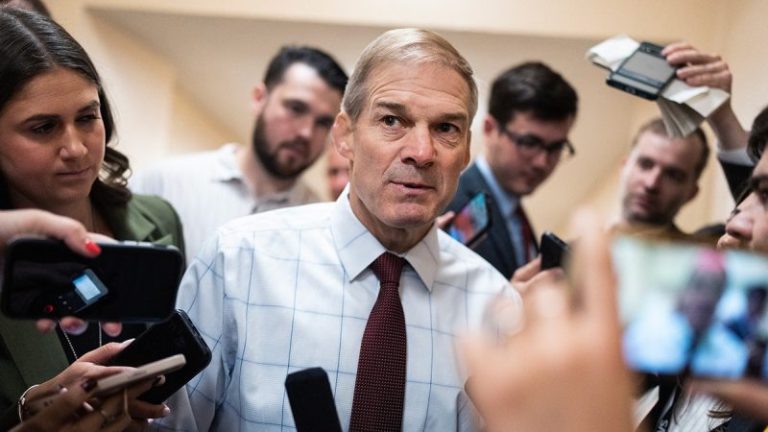
A conservative climate policy group is urging House Judiciary Committee Chairman Rep. Jim Jordan, R-Ohio, to subpoena records from the Environmental Law Institute’s Climate Judiciary Project as part of an ongoing probe into the influence of climate advocacy groups in climate policy litigation.
Jason Isaac, CEO of the American Energy Institute, a conservative pro-U.S. energy production policy group, wrote a letter to Jordan last week pointing to evidence from a Sept. 12 Multnomah County v. ExxonMobil et al. court filing that he says suggests ‘covert coordination and judicial manipulation.’
‘This new evidence raises serious red flags about the credibility of both the so-called science being used in climate lawsuits and the judicial training programs behind the bench,’ Isaac told Fox News Digital.
According to Isaac’s letter to Jordan, the court filing submitted by Chevron Corporation earlier this month reveals that ‘one of the plaintiffs’ lead attorneys, Roger Worthington, had undisclosed involvement in at least two so-called scientific studies that the county is presenting as independent, peer-reviewed evidence.’
One of those studies ‘acknowledged funding from the Climate Judiciary Project in a draft version, but that disclosure was inexplicably removed from the final publication,’ Isaac said in the letter.
Earlier drafts of the study, labeled ‘DO NOT DISTRIBUTE,’ were found on Worthington’s law firm website, the letter revealed.
According to the American Energy Institute, the study seeks to ‘attribute global economic losses from climate change to specific oil companies.’ The website also included a ‘pre-publication draft of a CJP judicial training module’ with internal editorial comments, according to the letter.
Isaac told Jordan this mark-up raises ‘serious questions about how and why a plaintiffs’ attorney had early access to, and possibly editorial influence over, materials being presented to state and federal judges as ‘neutral’ science.’
Another module was designed to ‘educate’ participant judges on how to apply ‘attribution science’ in the courtroom, according to Isaac.
Attribution science seeks to measure how much human-caused climate change is responsible for certain extreme weather events, per Science News Explores’ definition.
‘The Environmental Law Institute has claimed neutrality, yet documents suggest coordination with plaintiffs’ counsel who stand to profit from the outcomes,’ Isaac told Fox News Digital. ‘If the same lawyers suing energy companies are shaping the studies and educating the judges, that is not justice; it is manipulation. Congress is right to dig deeper, and the American Energy Institute is proud to support that effort.’
Isaac is requesting that Jordan formally request ‘communications, draft documents, funding agreements, and internal editorial notes related to the scientific studies and CJP curriculum.’
While commending Jordan’s leadership, Isaac said, ‘Judges and the public deserve to know whether the courtroom is being quietly shaped by coordinated climate advocacy posing as neutral expertise.’
Isaac said the Environmental Law Institute and Worthington should answer several questions about their involvement in the studies, including the ‘judicial education module on attribution science.’
‘Does ELI regularly seek input from plaintiffs’ attorneys on its judicial education modules?’ Isaac questioned.
‘ELI did not fund the Nature study, and the Climate Judiciary Project has not coordinated with Mr. Worthington,’ Environmental Law Institute spokesman Nick Collins told Fox News Digital in a statement.
‘CJP does not participate in or provide support for litigation,’ Collins added. ‘Rather, CJP provides evidence-based continuing education to judges about climate science and how it arises in the law. Our curriculum is fact-based and science-first, grounded in consensus reports and developed with a robust peer review process that meets the highest scholarly standards.’
When 23 Republican state attorneys general sent a letter last month to Environmental Protection Agency chief Lee Zeldin calling on him to cancel funding to the Environmental Law Institute, Collins told Fox News Digital that the Climate Judiciary Project’s projects are far from ‘radical.’
‘The programs in which the Climate Judiciary Project (CJP) participates are no different than other judicial education programs, providing evidence-based training on legal and scientific topics that judges voluntarily choose to attend,’ Collins said.
Fox News Digital has reached out to Jordan and Worthington for comment on the letter but did not immediately hear back.
Fox News Digital’s Emma Colton contributed to this story.
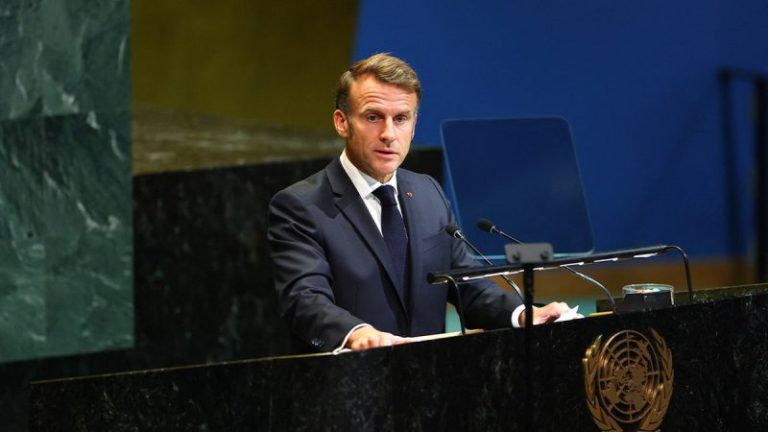
French President Emmanuel Macron’s push for Palestinian statehood at the United Nations clashed sharply with Donald Trump’s message — but the two leaders’ rivalry also played out in the streets of New York in an unexpected way.
At the UN General Assembly, Macron formally announced France’s recognition of a Palestinian state, insisting the move was ‘essential to peace.’ Trump, speaking today, blasted the recognition as a ‘reward’ for Hamas’s ‘horrible atrocities, including October 7,’ that would only prolong conflict.
But away from the UN stage, the two presidents collided in an unusual moment when Macron was stopped at a crosswalk by New York police as Trump’s motorcade rolled through Manhattan. ‘Sorry President, everything is frozen, the motorcade moving now,’ one officer told him. Macron, visibly frustrated, replied, ‘If you don’t see it, let me cross.’
With the road blocked, Macron picked up his phone and called President Trump directly. According to a video circulating online, the French president said: ‘Guess what, I’m waiting in the street because everything is frozen for you.’ Only after the call was the road eventually cleared.
Macron then walked through the city for nearly half an hour, trailed by passersby who stopped him for selfies. One person planted a kiss on his head. Macron laughed off the encounter, saying, ‘It’s just a kiss, makes no harm.’
France’s embassy in the U.S official X account leaned into the moment with humor: ‘It’s a good thing our presidents have each other on speed dial… If you’ve ever had to walk through NYC during UNGA, this is 110% relatable content.’
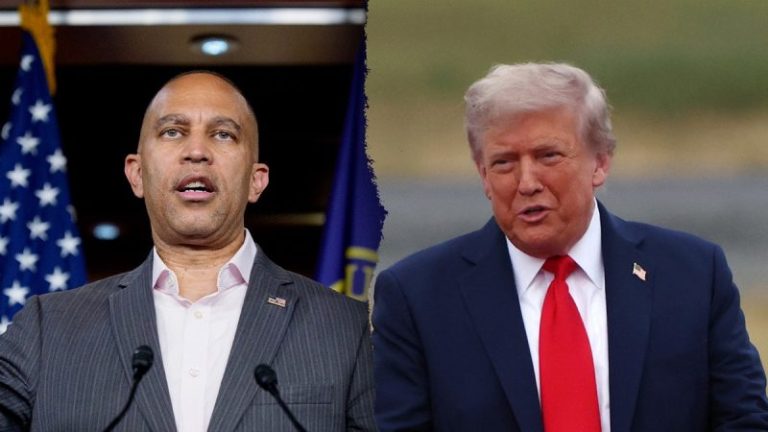
House Minority Leader Hakeem Jeffries, D-N.Y., criticized recent remarks by President Donald Trump as ‘unhinged’ during a press conference on Tuesday, as the federal government lurches toward a potential shutdown at the end of this month.
Jeffries held a media availability in his Brooklyn, New York district after Trump canceled a planned meeting with congressional Democrat leaders on the issue of government funding.
Trump accused Democrats of making ‘unserious and ridiculous demands’ in their push for a compromise deal to avert a shutdown.
‘The statement that Donald Trump issued today was unhinged, and it related to issues that have nothing to do with the spending bill that is before the Congress, and the need to try to avoid a government shutdown,’ Jeffries said in response.
He said at an earlier point, ‘Leader Schumer and I are ready to meet with anyone, anytime, at any place, to discuss the issues that matter to the American people and avoid a painful, Republican-caused government shutdown.’
‘Democrats do not support the partisan Republican spending bill because it continues to gut the healthcare of the American people,’ he added.
Schumer held his own press conference later in the afternoon, where he charged ‘Today seems to be tantrum day for Donald Trump.’
‘Mr. President, do your job,’ he said. ‘Stop ranting, stop these long diatribes that mean nothing to anyone. Get people in a room and let’s hammer out a deal.’
The House passed a short-term extension of fiscal year (FY) 2025’s government funding levels intended to keep federal agencies running through Nov. 21, in order to give Senate and House appropriators more time to reach a deal on FY 2026.
If not passed by the Senate by the end of Sept. 30, Congress risks plunging the government into a partial shutdown.
Democrats, infuriated by being sidelined in discussions on the bill, have been pushing for the inclusion of enhanced Affordable Care Act (ACA) subsidies that are set to expire at the end of 2025 without congressional action.
During his press conference, Jeffries also appeared to reference Republicans’ ‘One Big, Beautiful Bill,’ conservative policy legislation that imposed new restrictions and work requirements on Medicaid coverage for certain able-bodied Americans.
‘Our top priority is to make sure that we cancel the cuts, lower the costs and save healthcare for the American people. That’s eight words – not difficult for Donald Trump to process. Cancel the cuts, lower the cost, save healthcare. Eight words,’ Jeffries said.
‘And we’ve been very clear that if Republicans want to go it alone, then go it alone and continue to do damage to the American people. But as House Democrats, partnered in lockstep with [Senate Minority Leader Chuck Schumer] and Senate Democrats, we are not going to participate in the Republican effort to continue to gut the healthcare of the American people. That’s immoral, and we want no part of it.’
Jeffries and Schumer were set to meet with Trump on Thursday to discuss a path forward to avert a partial government shutdown.
But Trump nixed the meeting in a lengthy post on his social media platform Truth Social, where he blasted the duo for pushing ‘radical Left policies that nobody voted for.’
‘I have decided that no meeting with their Congressional Leaders could possibly be productive,’ Trump said.
‘They must do their job! Otherwise, it will just be another long and brutal slog through their radicalized quicksand. To the Leaders of the Democrat Party, the ball is in your court. I look forward to meeting with you when you become realistic about the things that our Country stands for. DO THE RIGHT THING!’ the president continued.
The Senate already voted against moving forward with the House GOP stopgap bill on Friday.
With 60 votes needed to proceed on the measure, at least some Democratic support will be needed to avert a shutdown.
Fox News Digital reached out to the White House for a response to Jeffries’ comments.
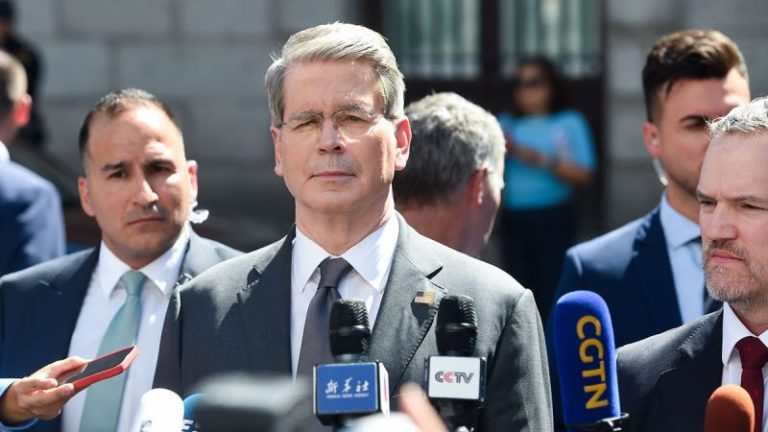
Treasury Secretary Scott Bessent and U.S. Trade Representative Jamieson Greer met with Chinese Vice Premier He Lifeng and Commerce Minister Li Chenggang in Madrid last week. They announced a ‘framework agreement’ over TikTok, the Chinese-owned app used by millions of Americans.
But the story isn’t only about TikTok. It’s also about how America uses TikTok as a lever – and why that lever is more necessary than ever.
TikTok is an important issue in and of itself: control over data, algorithmic influence, foreign ownership – all of which are critical for national security. In addition, however, TikTok is a tool the U.S. can and should use in ongoing trade engagement, as well as to counter China’s growing leverage in rare earths, critical minerals and semiconductors.
When I served in President Donald Trump’s first administration (‘Trump 45’), the core issues we confronted included a massive trade imbalance, intellectual property theft, cyber-theft and China’s Belt and Road infrastructure expansion. These were predatory practices in trade, tech and finance. Today, in ‘Trump 47,’ the battlefront has broadened – but one thing that hasn’t changed is the psychological warfare the Chinese employ any time negotiations are underway.
I was at the center of one of the most dramatic examples of this during Trump 45…
After an exhausting month of prep work, I boarded my flight to Beijing in March 2018 with wary optimism. I had worked intensively leading up to this trip, drafting a comprehensive framework document outlining a new trade deal with China, a proposal that would overhaul virtually every aspect of the U.S.-China economic relationship.
We’d sent the proposal to our Chinese counterparts several days earlier, and now our high-level trade delegation was en route to Beijing to negotiate the largest change to trade relations in at least 10 years. The cast of characters illustrates just how significant this trade deal could be. It included Secretary Steven Mnuchin (head of the delegation), Under Secretary David Malpass and me (Treasury), Secretary Wilbur Ross (Commerce), U.S. Trade Representative Robert Lighthizer and several of his deputies, NEC Director Larry Kudlow, Under Secretary Ted McKinney (Agriculture), and Peter Navarro (special assistant to the president and director of trade and manufacturing policy).
We arrived at the U.S. Embassy in Beijing with about an hour to review our plans one more time before we had to depart for Diaoyutai – the state guest house where Mao and every leader since has entertained foreign dignitaries. But there was a surprise waiting for us at our embassy:a brand-new proposal, drafted by the Chinese, which they were putting forth at the eleventh hour, and which we had never seen. It was about 15 pages long – and completely in Chinese!
I was one of the few people in the room who could read it. After a quick scan, I told the group: ‘This is wholly unacceptable. This document doesn’t say anything – they’re just messing with us.’ A heated debate ensued over how to respond, and how the Chinese were likely to react. But there was no time to reach a consensus; it was time to leave for Diaoyutai.
There was a mass exit from the secure room where we met at the embassy, and, almost like a well-choreographed ballet with a hundred moving parts, we all shuffled to our designated cars. As Secretary Mnuchin stepped into the limousine to take us to the meeting, Malpass insisted that I ride with the secretary and pushed me into the seat next to Mnuchin, saying, ‘We need to know exactly what this says – can you translate it on the way?’
As we sped through the streets of Beijing, I sat in the back seat, literally shvitzing as a technical term in Chinese got the better of me, and furiously translated as I read out loud, in English, what the Chinese had dropped in our laps.
Even as we climbed the stairs into the building and entered the meeting room, none of us was quite sure how Mnuchin was going to handle this hot potato. After Vice Premier Liu He’s flowing stream of diplomatic pleasantries welcoming us to China, the secretary calmly stated in response, ‘We received your draft. Thanks for sending it over – but we’re going to use our draft for today.’ It wasn’t the preamble they expected. But it was entirely consistent with the new tone that President Trump had set from the day he took office.
Today, China has moved from using tariffs and IP theft to controlling choke points – especially in rare earth elements, critical minerals, semiconductors and advanced manufacturing capacity. The numbers are clear indicators of China’s leverage.
China accounts for about 70 % of global rare earth mining and about 90 % of the world’s rare earth refining and separation capacity. In 2023, China controlled 61 % of global mining of rare earth magnet elements and 92 % of refining capacity for those magnets.
On semiconductors: while U.S. companies remain strong in chip design and advanced R&D, China’s share of the semiconductor industry’s value-added has surged (from about 8 % in 2001 to over 30 % by 2016), and China is pushing aggressively to become self-sufficient in mature node production.
These are not passive metrics. They are active levers China already uses in the trade negotiations through export restrictions, licensing controls or by threatening disruptions. For example, in April 2025 China – clearly in response to President Trump’s bold tariff moves – added export licenses and restrictions for seven heavy rare earth elements, including dysprosium, terbium, samarium, plus rare earth magnets—materials critical to EV motors, wind turbines, electronics and defense systems.
The challenges faced in Trump’s first term have only evolved – not eased. The trade deficit is large, IP and tech theft are growing more dangerous, predatory development finance practices continue and China’s leverage in rare earths, semiconductors and control over supply chains threatens global development and American autonomy.
TikTok is a headline issue impacting critical issues of data, influence and national security. But it is also an essential lever to counter the new pressure points China is pressing. Madrid and Friday’s Trump–Xi call offer a chance to reshape this broader contest.
As I demonstrate in ‘A Seat at the Table,’ President Trump’s strategy and policies during his first administration allowed us to exert maximum pressure on our counterparts and to stay the course with firm negotiating positions and clear red lines. Last week’s dialogues demonstrate that Trump will continue to insist on substance over symbolism, an approach critical to our national interest.

President Trump just fired a top federal prosecutor because he failed to bring charges against two despised opponents, New York Attorney General Letitia James and ex-FBI chief James Comey.
The ouster of Erik Siebert, U.S. attorney for Virginia’s Eastern District — and Trump’s own appointee — came after he couldn’t find sufficient evidence to charge James with mortgage fraud.
The president blamed the firing on Siebert having been put forward by two Democratic senators – hardly a secret – under the archaic ‘blue slip’ requirement that should be abolished.
‘Yeah, I want him out,’ Trump said after ABC broke the story. Tish James is ‘very guilty of something.’
What’s more, ‘he didn’t quit, I fired him!’
It’s a blip of a story, compared to Trump and his team naming a special prosecutor to again investigate Russiagate allegations from 2016; dropping corruption charges against New York’s Mayor Eric Adams, and suspending security clearances for the law firm that Robert Mueller left four years ago (later blocked by a judge).
The larger point is that perhaps we’ve become inured to the serious spectacle of a president not just interfering with the Justice Department but literally dictating who should be charged and who should be protected.
Trump told Pam Bondi over the weekend, ‘They impeached me twice, and indicted me (five times!), OVER NOTHING. JUSTICE MUST BE SERVED, NOW!!!’
He said he believes James, Comey and Democratic Sen. Adam Schiff are ‘all guilty as hell’ but that nothing is being done.
As someone who used to roam the halls of the Justice Department — and covered three independent counsels involving Ronald Reagan’s AG, Ed Meese — I am acutely aware of the ethical boundaries.
After the Watergate scandal, which included Attorney General John Mitchell going to prison, led to reforms, the idea of a wall between the White House and DOJ was further cemented.
Joe Biden saw any involvement in criminal probes as radioactive, and no evidence of his tampering has surfaced (though he did pardon a bunch of allies, including his son).
There was a huge uproar back when Bill Clinton had a chance tarmac meeting with his AG, Loretta Lynch, while his wife was under investigation over her private email server. She said they talked about grandchildren and travel. A CBS reporter called the meeting ‘absolutely shocking.’
But you don’t have to rely on unnamed sources to learn about Trump giving his attorney general marching orders. He broadcasts it, even boasts about it.
Of course, Trump stretching his executive powers goes well beyond DOJ. There are his funding freezes against universities, dispatching of the National Guard in D.C. and elsewhere, and attempting to fire members of supposedly independent agencies such as the Federal Reserve.
The escalation against the media has been nothing short of stunning. Trump cheered ABC’s suspension of Jimmy Kimmel against the backdrop of FCC Chairman Brendan Carr threatening to take action against its local licenses. ‘We can do this the easy way or the hard way,’ he said, prompting some conservatives to say he sounded like a mafioso.
Trump won a $16 million settlement from ABC over George Stephanopoulos saying Trump had been held liable for ‘rape,’ not sexual abuse. He also won $16 million from CBS over the biased editing of a ’60 Minutes’ interview with Kamala Harris.
It just so happens that Nexstar, which preempted Kimmel and owns many CBS affiliates, needs administration approval to take over Tegna, another media conglomerate.
Trump filed suit against the Wall Street Journal for reporting he’d sent a birthday message to Jeffrey Epstein with a silhouette of a naked woman–and when that surfaced with what closely resembled his signature, continued to deny he had done it.
And then there is his $15 billion suit against the New York Times, which a judge threw out after just four days for its ‘inexcusable’ breaking of the rules in a filing filled with ‘vituperation.’ It’s a strange suit because it wasn’t triggered by any particular story, just a general charge that the Times campaign coverage was illegal, including a Harris endorsement that ran on the front page.
Even the largest corporations have to spend big bucks to defend such suits, which is sort of the point.
But nothing is as sensitive and powerful as law enforcement, whose officials can shield allies and prosecute opponents.
The president’s position is that DOJ was weaponized against him during the Biden administration, and therefore he’s entitled to payback.
The latest news just broke. The Justice Department was investigating border czar Tom Homan for allegedly offering to help win federal contracts to businessmen — who were actually undercover FBI agents — in exchange for $50,000.
But as MSNBC reports, Trump’s DOJ dropped the case after he took office.
Since the hidden-camera encounter took place before Trump was elected, when Homan was a private citizen, I could argue he was just doing what hundreds of lobbyists do. Except for one nagging detail — Homan took the 50K in cash, in a Cava fast-food bag. No paper trail.
And yet Pam Bondi’s department gave him a pass.
Prosecutors in every administration must make difficult judgment calls about whether they have enough evidence to convict, especially against government officials or high-profile figures.
And next time there’s a Democrat in the White House, what’s to stop that person from playing the same kind of hardball, saying their party was entitled to payback? The cycles could be endless.
As for now, it would be easier to have confidence in these prosecution decisions if the president wasn’t openly calling the shots.

Gareth Soloway of VerifiedInvesting.com shares price targets for gold, silver and Bitcoin.
He also discusses the health of the US economy and shares concerns about the stock market.
Securities Disclosure: I, Charlotte McLeod, hold no direct investment interest in any company mentioned in this article.

Bitcoin may soon share space with gold on central bank balance sheets, according to a new report from Deutsche Bank (NYSE:DB) that frames the cryptocurrency as an emerging reserve asset.
“There is room for both gold and Bitcoin to coexist on central bank balance sheets by 2030,” Marion Laboure and Camilla Siazon, both analysts at the firm, wrote in a note published on Monday (September 22).
Deutsche Bank’s report points to recent diversification trends in global central bank reserves.
The US dollar is still the dominant reserve currency, but it accounted for only 43 percent of holdings in 2024, down from 60 percent at the start of the century. Meanwhile, China reduced its US treasury holdings by US$57 billion last year.
Against this backdrop, both gold and Bitcoin are being positioned by market participants as hedges against inflation, geopolitical risk and questions about monetary sovereignty.
Gold has been a standout performer in 2025. The precious metal surged to a record of US$3,788.33 per ounce on Tuesday (September 23), capping a year-to-date rally of more than 40 percent and its largest gain in over four decades.
Central banks have been a driving force behind the rally, with a recent World Gold Council survey showing that 43 percent of monetary authorities plan to increase their gold reserves in the next 12 months.
Nearly all respondents, tallying 95 percent, expect global central bank gold reserves overall to continue rising.
Bitcoin, meanwhile, has faced short-term pullbacks, but has shown longer-term resilience. After topping US$123,500 in August, the cryptocurrency slipped below US$113,000 at the start of the week.
Yet analysts at Deutsche Bank highlight that its 30 day volatility hit historic lows even during record-breaking price runs, a sign that Bitcoin may be decoupling from its speculative reputation.
That adoption is evident in corporate balance sheets as well.
More than 180 companies have added Bitcoin or other crypto assets to their holdings, often modeling their strategy on Strategy’s (NASDAQ:MSTR) high-profile accumulation, led by Executive Chairman Michael Saylor.
Prominent public figures have also lent support. Eric Trump told Yahoo Finance ahead of last week’s interest rate cut from the US Federal Reserve that a reduction could help crypto “skyrocket,” framing digital assets as a key hedge.
While Deutsche Bank’s analysts acknowledge the risks tied to Bitcoin’s sudden swings, they said regulation and shifting macroeconomic conditions could accelerate its path to legitimacy.
The bank draws parallels between Bitcoin’s trajectory today and gold’s rise in the 20th century, suggesting that skepticism could eventually give way to acceptance. While the writers admit that neither asset is likely to dethrone the dollar, gold and Bitcoin could serve as complementary tools for monetary authorities seeking diversification.
Overall 2025 has been “excellent” for both gold and Bitcoin even if their price movements diverge.
“So long as we are human, Bitcoin and other alternative assets will likely continue to compete for our attention,” the Deutsche Bank note concludes.
Securities Disclosure: I, Giann Liguid, hold no direct investment interest in any company mentioned in this article.

United States Antimony (NYSEAMERICAN:UAMY) has secured a US$245 million sole-source contract from the US Defense Logistics Agency to supply antimony ingots.
The five year ‘indefinite delivery indefinite quantity’ agreement was finalized after months of negotiations and makes US Antimony the exclusive supplier of antimony ingots to the National Defense Stockpile.
The company confirmed that first deliveries are expected this week. News of the award sent its shares up 17.8 percent in New York trading, boosting its market value to about US$975 million.
“This is the kind of knowledge that is only gained through decades of execution and know-how,” Chairman and CEO Gary C. Evans said in the Tuesday (September 23) announcement. “USAC has some of the most experienced antimony chemists, metallurgists and other professionals on its team in the global landscape.”
Evans added that the expertise of Gus Gustavsen, the company’s antimony division president, was central to the award. Gustavsen has more than 50 years in the field.
Washington is moving to strengthen supply chains for materials considered essential to defense and energy security. China dominates global antimony production, leaving the US reliant on imports in recent years. By securing a sole-source deal, the Pentagon has effectively locked in a domestic pipeline for a mineral it deems strategically important.
US Antimony said it is working to broaden its ore supply beyond imports.
Mining began this month on its acreage in Alaska, where early results indicate high-grade deposits that could support efficient processing and eventually supply military-grade products, including antimony trisulfide.
The Alaska development marks a shift for US Antimony, which for decades has depended heavily on foreign ore. The company emphasized that many competing sources, both in the US and abroad, are unlikely to meet military standards and remain years away from commercial production.
“We don’t believe the low quality of those antimony ores controlled by others will meet the stringent requirements of our U.S. Military,” the company reaffirmed.
The US Geological Survey lists antimony as one of 50 minerals critical to national security and economic stability.
The Defense Logistics Agency has been tasked with replenishing the National Defense Stockpile, which in recent years has drawn down to its lowest levels since the Cold War.
Securities Disclosure: I, Giann Liguid, hold no direct investment interest in any company mentioned in this article.