
Author

admin

Browsing

President Donald Trump’s global roller coaster of peace moves — led by him and his team to end wars around the world — is now picking up speed in Sudan, where a 30-month war has left tens of thousands dead, and some 14 million displaced from their homes.

‘Ending wars is a priority for President Trump, and the United States remains focused on working with our partners and other stakeholders to resolve the crisis in Sudan,’ a State Department spokesperson told Fox News Digital on Wednesday, adding, ‘Engagement with all relevant stakeholders is essential to achieving this goal. Given the immediate urgency of de-escalating the violence, we will continue to engage with the belligerents to end the conflict.’

Talks to end the fighting between the Rapid Support Forces (RSF) militia, led by Gen. Muhammad Hamdan Dagalo Musa, known as Hemedti, and the Khartoum government’s Sudan Armed Forces (SAF), under the control of Gen. Abdel Fattah al-Burhan, began during the Biden administration but failed to make headway. They have since gained momentum under President Trump, with the U.S. forming a so-called international Quad in September with Egypt, Saudi Arabia and the United Arab Emirates.

Since the weekend, the pace of peace talks has become positively frenetic. The White House’s senior advisor for Arab and African Affairs, Massad Boulos, fresh from brokering a ceasefire in the 30-year war between the Democratic Republic of the Congo and Rwanda, held talks with Egypt’s Foreign Minister Badr Abdelatty in Cairo on Sunday.

On Monday, Boulos met with the Arab League, with the League stating that Trump’s envoy had briefed them on U.S. efforts to ‘halt the war, expedite aid delivery, and initiate a political process.’

The Sudan Tribune then quoted Boulos as saying later on Monday, ‘Both parties have agreed in principle, and we have not recorded any initial objection from either side. We are now focusing on the fine details.’

But the two sides are still fighting. On Tuesday, Sudan’s Defense Minister Hassan Kabroun talked to the country’s state television network, following a government council meeting in Khartoum, saying, ‘We thank the Trump administration for its efforts and proposals to achieve peace,’ but added: ‘Preparations for the Sudanese people’s battle are ongoing. Our preparations for war are a legitimate national right.’

Also on Tuesday, White House Press Secretary Karoline Leavitt weighed in, telling reporters, ‘The United States is actively engaged in efforts to bring about a peaceful resolution to the terrible conflict in Sudan. We remain committed to working with our international partners, including Quad members — Egypt, Saudi Arabia and the UAE — as well as others to lead a negotiated peace process that addresses both the immediate humanitarian crisis and the longer-term political challenges.’

Leavitt continued, ‘I actually spoke with Secretary Rubio about this, this morning, as, of course, there’s been, you know, kind of an uptick in recent reporting on the matter. And he assured me that the administration is very much engaged. We’re in pretty frequent communication with those Arab partners that I just mentioned. And we want to see this conflict come to a peaceful end, just as we have with so many others. But it’s — the reality is — it’s a very complicated situation on the ground right now.’

Analysts say last week’s fall of the Sudanese city of El-Fasher, and with it the Darfur region to RSF fighters, effectively cutting the country in two, may have spurred all parties into action. ‘The RSF’s full control of the Darfur region could have dangerous and worrying consequences in the future in terms of partition,’ Boulos told Al Jazeera.

On Tuesday U.N. Secretary General Antonio Guterres called for an immediate ceasefire in Sudan. Speaking on the sidelines of a conference in Qatar, Guterres said the war was ‘spiraling out of control.’

‘The fall of El-Fasher to the RSF is a defining moment in Sudan’s brutal civil war’, Mariam Wahba, research analyst at the Foundation for Defense of Democracies (FDD), told Fox News Digital. Wahba continued: ‘It marks the militia’s full control of the Darfur region and leaves Sudan effectively split in two.’

The human cost is staggering. On Monday, the U.N. reported that ‘over 21 million people across Sudan are facing high levels of acute food insecurity — the largest such crisis in the world.’ The latest Integrated Food Security Phase Classification (IPC) found that famine is ongoing in the now-captured El-Fasher and in Kadugli, South Kordofan, with families trapped and surviving on leaves, animal feed and grass.

The Yale School of Public Health’s Humanitarian Research Lab released satellite images taken over El-Fasher over the last week, stating Tuesday, ‘Evidence of body disposal activities include at least two earth disturbances consistent with mass graves at a mosque and the former Children’s Hospital; there is one new instance of removal of objects consistent with bodies. This activity appears consistent with RSF conducting cleanup of their alleged mass atrocities.’

Sources say intense negotiations led by the U.S. team are continuing. Details of what’s on offer have not been revealed, but it’s understood an agreement would start with a three-month humanitarian truce, to allow aid delivery in, followed by a permanent ceasefire and a civilian-led transition.

‘For Washington, the stakes in Sudan are rising by the day,’ the FDD’s Wahba told Fox News Digital, adding, ‘The more time the RSF has to cement its control over Darfur and push toward Khartoum again, the harder it will become to prevent the country’s permanent collapse. What happens next in Sudan will shape the balance of power across the Horn of Africa and signal to America’s adversaries whether the United States still has the will to confront instability before it spreads in this critical region of the world.’


This post appeared first on FOX NEWS

The UN Climate Change Conference, COP30, starts Nov. 6 with a world leader summit and runs to Nov. 21. It will emphasize ‘the urgency of the climate crisis and the need for accelerated and collective climate actions.’ However, Microsoft founder Bill Gates just issued a memo aimed at COP30 attendees proposing a fundamental shift in priorities: focus on poverty reduction rather than climate modification.

Gates, who previously gave primary importance to measures to reduce near-term emissions, has drawn criticism for arguing that ‘a metric that should count even more than emissions and temperature change [is] improving lives. Our chief goal should be to prevent suffering, particularly for those in the toughest conditions who live in the world’s poorest countries.’

His argument rests on three key premises: climate change poses serious challenges but does not represent an existential threat to civilization; temperature metrics alone inadequately measure climate-related progress; and improved health and economic prosperity provide the most effective defense against climate change.

Gates provides data to show that achieving net-zero emissions would result in a 1.9-degree Celsius temperature increase from 1990 levels, while inaction would produce a 2.9-degree increase. This one-degree differential, he argues, suggests that resources allocated toward net-zero goals might yield greater humanitarian benefits if redirected toward energy access and disease prevention.

The correlation between energy consumption and economic prosperity is striking. Nations with annual per capita incomes below $1,145 consume approximately 1,100 kilowatts per person annually, while those exceeding $14,005 in per capita income utilize 55,000 kilowatts per person annually, according to data cited by Gates.

The genuine inequity, Gates contends, lies in human development disparities. A child born in South Sudan faces mortality risks 39 times higher before age five compared to a Swedish child. These vulnerable populations require enhanced access to energy, nutrition and healthcare infrastructure.

The relationship between economic development and energy consumption is unequivocal: no nation has achieved high per capita income with low per capita energy usage, and conversely, no country maintains high energy consumption alongside persistent poverty.

Increased energy access facilitates improved living standards through enhanced productivity, agricultural advancement and household consumption, thereby reducing dependence on subsistence farming. Energy availability either provides farmers with modern agricultural technologies or enables economic mobility to pursue alternative livelihoods.

High-energy nations benefit from superior healthcare infrastructure and water sanitation systems, resulting in reduced maternal and child mortality rates and greater capacity for environmental protection measures.

Hurricane Melissa’s destruction in Jamaica illustrates how natural disasters inflict disproportionate damage on developing nations compared to wealthy countries, due to disparities in energy infrastructure, resilient construction and recovery capabilities. Affordable energy access is essential to addressing these inequalities.

Energy poverty in many African and Latin American nations drives migration pressures, as residents seek higher living standards in fossil fuel-rich regions, particularly Europe and North America.

To support emerging economies and alleviate migration pressures, President Donald Trump has reversed restrictions on loans to developing countries for fossil fuel energy projects. Financial institutions are no longer compelled to finance exclusively renewable energy initiatives.

The 140 private banks from 44 countries that participated in the United Nations Net Zero Banking Alliance — including Barclays, JP Morgan Chase and Sumitomo — have suspended their commitments to restrict fossil fuel financing. The World Bank, which has historically discouraged fossil fuel and nuclear power lending while prioritizing renewables, may reassess its position.

This policy shift enables developing nations to secure financing for conventional power plants, transmission infrastructure, distribution networks and household connections. Importantly, this change diminishes China’s strategic advantage in lending to African and Latin American nations — often securing ports and other assets as collateral.

Gates’s reversal in the climate debate challenges the international community to confront an uncomfortable reality. While climate conferences convene in developed nations with reliable electricity and healthcare systems, billions lack access to the energy that makes such gatherings possible.

His argument suggests that the most effective climate strategy may be ensuring that vulnerable populations have the resources to adapt and thrive, rather than pursuing emissions targets that may perpetuate the very poverty that exacerbates climate vulnerability. Whether policymakers at COP30 will heed this message remains uncertain, but Gates has succeeded in reframing the conversation around what climate action should ultimately serve: economic progress, not merely atmospheric targets.

This post appeared first on FOX NEWS

Brien Lundin, editor of Gold Newsletter and New Orleans Investment Conference host, shares his outlook for gold and silver as prices continue to consolidate.

‘At the end of this cycle, I’ve long predicted that we’re going to get to a US$6,000 to US$8,000 (per ounce) price range, whenever that may happen — I hope it takes years from now,’ he said about gold.

Securities Disclosure: I, Charlotte McLeod, hold no direct investment interest in any company mentioned in this article.

This post appeared first on investingnews.com

Rio Silver Inc. (the ‘Company’ or ‘Rio Silver’) (TSX.V: RYO,OTC:RYOOD) (OTC: RYOOF) is pleased to announce that, subject to the approval of the TSX Venture Exchange, the Company intends to settle (the ‘Transaction’) an aggregate of $293,250 of indebtedness (the ‘Debt’) owed to certain arm’s length and non-arm’s length creditors through the issuance of an aggregate of 1,396,428 common shares, at a deemed price of $0.21 per common share, and 420,238 common share purchase warrants (the ‘Warrants’) of the Company. 976,190 of the common shares (and no Warrants) will be issued to non-arm’s length creditors.

Each Warrant is exercisable into a common share at the price of $0.28 per common share, for a period of three years from the date of issue.

All common shares and Warrants issued to settle the Debt will be subject to a hold period of four months and one day from the date of issuance. The Transaction is subject to TSX Venture Exchange approval. Completion of the Transaction will allow the Company to improve its current working capital deficiency position.

ON BEHALF OF THE BOARD OF DIRECTORS OF Rio Silver INC.

Chris Verrico

Director, President and Chief Executive Officer

Neither the TSX Venture Exchange nor its Regulation Services Provider accepts responsibility for the adequacy or accuracy of this release.

For further information,

Christopher Verrico, President, CEO

Tel: (604) 762-4448

Email: chris.verrico@riosilverinc.com

Website: www.riosilverinc.com

This news release includes forward-looking statements that are subject to risks and uncertainties. All statements within, other than statements of historical fact, are to be considered forward looking. Although the Company believes the expectations expressed in such forward-looking statements are based on reasonable assumptions, such statements are not guarantees of future performance and actual results or developments may differ materially from those in forward-looking statements. Factors that could cause actual results to differ materially from those in forward-looking statements include market prices, exploitation and exploration successes, continued availability of capital and financing, and general economic, market or business conditions. There can be no assurances that such statements will prove accurate and, therefore, readers are advised to rely on their own evaluation of such uncertainties. We do not assume any obligation to update any forward-looking statements except as required by applicable laws.

News Provided by GlobeNewswire via QuoteMedia

This post appeared first on investingnews.com

The global lithium market saw sharp swings in Q3 2025 as shifting supply dynamics, policy uncertainty, and geopolitical developments reshaped investor sentiment.

After hitting a four-year low in June, benchmark lithium carbonate prices briefly surged to an 11 month high in August on speculation of Australian supply cuts, before easing to US$11,185 per metric ton by quarter’s end.

Market watchers say sentiment-driven moves continue to dominate a sector still facing oversupply, while US policy shifts and China’s regulatory measures add further uncertainty to the outlook.

Against this backdrop, Canadian lithium stocks are gaining attention as investors look for companies positioned to benefit from long-term demand growth while navigating short-term price pressure.

1. Consolidated Lithium Metals (TSXV:CLM)

Year-to-date gain: 500 percent
Market cap: C$23.36 million
Share price: C$0.060

Consolidated Lithium Metals is a Canadian junior exploration company focused on acquiring, developing and advancing lithium projects in Québec. Its properties — Vallée, Baillargé, Preissac-LaCorne and Duval — are located within the spodumene-rich La Corne Batholith area, near the restarted North American Lithium mine, a key area in Canada’s growing lithium sector.

Consolidated Lithium started the year with a C$300 million private placement earmarked for working capital and general corporate purposes.

In July, the company commenced its 2025 summer exploration program at the Preissac project, excavating a 100-by-30-meter trench in an area with a known lithium soil anomaly, uncovering an 18-meter-wide pegmatite body at surface.

Twenty-five channel samples were collected and sent for analysis, while additional soil and biogeochemical sampling was conducted to further assess lithium-bearing pegmatites on site.

At the end of August, Consolidated Lithium signed a non-binding letter of intent with SOQUEM, a subsidiary of Investissement Québec, to acquire an option to earn up to an 80 percent interest in the Kwyjibo rare earth project.

The project is located roughly 125 kilometers northeast of Sept-Îles in Québec’s Côte-Nord region.

The acquisition news led to a share price spike for the company. While the company has made no recent announcements, an uptick in lithium prices in October helped Consolidated shares rally further to a year-to-date high of C$0.06 on October 22 and again on October 28.

2. Stria Lithium (TSXV:SRA)

Year-to-date gain: 416.67 percent
Market cap: C$12.22 million
Share price: C$0.31

Stria Lithium is a Canadian exploration company focused on developing domestic lithium resources to support the growing demand for electric vehicles and lithium-ion batteries.

The company’s flagship Central Pontax lithium project spans 36 square kilometers in Québec’s Eeyou Istchee James Bay region.

Cygnus Metals (TSXV:CYG) has an earn-in agreement with Stria to earn up to a 70 percent interest in the Pontax project. Cygnus completed the first stage in July 2023, acquiring a 51 percent interest by investing C$4 million in exploration and issuing over 9 million shares to Stria.

Through its joint venture with Cygnus, Stria has outlined a JORC-compliant maiden inferred resource of 10.1 million metric tons grading 1.04 percent Li2O.

At the start of 2025 Stria closed a non-brokered private placement for C$650,000. The funds will be used in part for the evaluation of new mineral opportunities, according to the company.

In May, Stria and Cygnus agreed to extend the second stage of Cygnus’s earn-in agreement on the Pontax lithium project by 24 months.

Shares of Stria registered a year-to-date high of C$0.38 on October 16, coinciding with rising lithium prices.

3. Lithium South Development (TSXV:LIS)

Year-to-date gain: 280 percent
Market cap: C$42.79 million
Share price: C$0.38

Canada-based Lithium South Development owns 100 percent of the HMN lithium project in Argentina’s Salta and Catamarca provinces, situated in the heart of the lithium-rich Hombre Muerto Salar. The project lies adjacent to active lithium operations, including Rio Tinto’s (ASX:RIO,NYSE:RIO,LSE:RIO) lithium operations to the south and South Korean company POSCO Holdings’ (NYSE:PKX,KRX:005490) billion-dollar lithium development to the east.

Exploration has defined a NI 43-101 compliant resource of 1.58 million metric tons of lithium carbonate equivalent (LCE) at an average grade of 736 milligrams per liter lithium, with the majority in the measured category.

A preliminary economic assessment outlines the potential for a 15,600 metric ton per year lithium carbonate operation, and the company is advancing the project toward a feasibility study.

In January 2024, Lithium South and POSCO signed an agreement to jointly develop the HMN lithium project. Under the deal, the companies will share production 50/50 from the Norma Edith and Viamonte blocks in Salta and Catamarca, resolving overlapping claims.

As for 2025, at the end of July, Lithium South received a non-binding cash offer of US$62 million from POSCO for HMN and all of Lithium South’s other concessions in the Hombre Muerto Salar.

The offer is subject to a 60 day due diligence period and a subsequent 60 day negotiation and execution phase for a definitive agreement, the company said. As of late September, the due diligence has largely been completed and the companies are negotiating the definitive agreement.

Company shares surged to C$0.41 in early August following the news. Shares rose to a year-to-date high of C$0.415 on October 24, likely in conjunction with lithium price positivity.

4. Standard Lithium (TSXV:SLI)

Year-to-date gain: 152.83 percent
Market cap: C$1.28 billion
Share price: C$5.36

Standard Lithium is a US-focused lithium development company advancing a portfolio of high-grade lithium-brine projects with an emphasis on sustainability and commercial-scale production.

The company employs a fully integrated direct lithium extraction process and is developing its flagship Smackover Formation assets in Arkansas and Texas, including the South West Arkansas project in partnership with Equinor ASA, under the joint venture subsidiary Smackover Lithium.

Standard is also actively exploring additional lithium brine opportunities in East Texas.

In April, the South West Arkansas project was one of 10 US critical minerals projects designated for fast-tracking under FAST-41.

According to Standard’s Q2 2025 results released in August, Smackover Lithium reported strong progress on its South West Arkansas project during the quarter.

Exploration for the project’s Phase 1 operations concluded, and the Lester exploration well yielded the highest lithium brine grades to date, averaging 582 milligrams per liter and peaking at 616 milligrams per liter. Key regulatory milestones included the Arkansas Oil and Gas Commission approving a 2.5 percent royalty rate and granting brine production unit approval for Phase 1.

Additionally, through a partnership with Telescope Innovations the company advanced a new process to convert lithium hydroxide into battery-grade lithium sulfide.

In September, Standard Lithium reported results of its definitive feasibility study (DFS) for the South West Arkansas project with a targeted first production date in 2028.

The DFS notes an initial capacity of 22,500 metric tons per year of battery-grade lithium carbonate. The study outlines a 20-year-plus operating life based on average lithium concentrations of 481 milligrams per liter, supported by detailed resource and reserve modeling.

The company officially filed the DFS on October 14, leading to a share price bump and year-to-date high of C$7.65 on October 16.

5. United Lithium (CSE:ULTH)

Year-to-date gains: 94.12 percent
Market cap: C$15.75 million
Share price: C$0.33

Exploration and development company United Lithium owns a portfolio of global assets in Sweden, Finland and the United States. The company’s primary focus is the Bergby lithium project in Central Sweden.

In March, United Lithium reported positive results from mineralogical test work on four pegmatite samples — B, C, D and E — at the Bergby project. The study analyzed the chemical and mineralogical composition of the samples to better understand the lithium-bearing LCT (lithium, cesium, tantalum) pegmatites.

An October 17 announcement from United reported it entered a binding letter of intent to acquire all issued and outstanding shares of Swedish Minerals. If the deal goes through, it will create a Nordic-based company with lithium, uranium and rare earth projects.

Under the agreement, United Lithium will issue Swedish Minerals shareholders 25 million common shares of United at C$0.20 each and pay C$450,000 in cash, subject to regulatory approval.

Shares of United Lithium spiked following the acquisition news and continued upward to a year-to-date high of C$0.35 on October 27.

Securities Disclosure: I, Georgia Williams, hold no direct investment interest in any company mentioned in this article.

This post appeared first on investingnews.com

Democrat Abigail Spanberger defeated Republican Winsome Earle-Sears to win the Virginia governor’s race, tallying significant leads among reliable Democratic groups while capitalizing on economic worries and the deep unpopularity of President Donald Trump in the state.

Spanberger will be the first woman to hold the office in the Old Dominion State.

The former Virginia congresswoman replaces term-limited Republican Governor Glenn Youngkin, who was the first Republican to win a statewide election in Virginia in 12 years when he was elected in 2021. That race surprised many in that it was much closer than the 2020 presidential race the year before, where Biden defeated Trump by 10 points. This year it was the other way around, with Spanberger well exceeding the 2024 presidential margin that saw Harris over Trump by only six points.

Trump was undoubtedly a factor in the race, even though he wasn’t on the ballot. Close to six in ten Virginia voters disapproved of the job he is doing, while more than half said they strongly disapprove. The vast majority of these voters backed Spanberger.

Two-thirds of Spanberger supporters said their vote was expressly to show opposition to the president. That compares to about one-third of those backing current Lt. Governor Earle-Sears who said theirs was to show support.

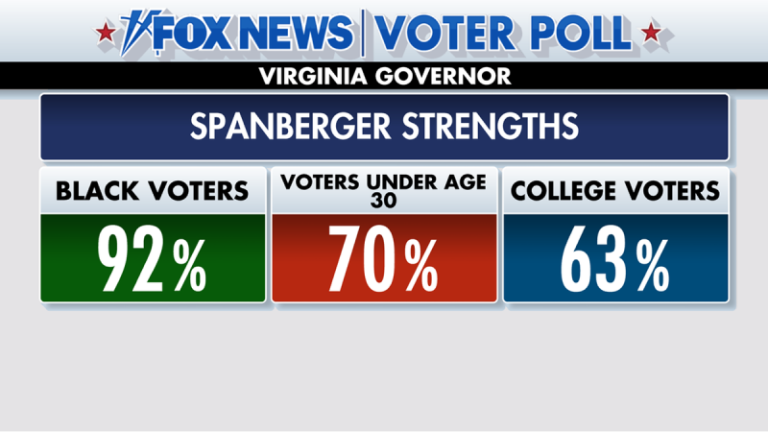
Aside from those sending a signal of opposition to Trump, Spanberger’s strong appeal to Black voters, college graduates and the young was more than enough to offset Earle-Sears’ strength among White men, White evangelicals and those with no college degree, according to near-final data from the Fox News Voter Poll, a survey of more than 4,000 Virginia voters.

Not even the prospect of voting for the first Black woman governor of any state seemed to move Black voters, who backed Spanberger by about a nine to one margin.

Spanberger also benefited from a significant gender gap. Indeed, 65% of women backed her compared to 35% for Earle-Sears, a 30-point advantage; and men supported Earle-Sears by 4 points (48% for Spanberger, 52% Earle-Sears) – leaving a gender gap of 34 points, one of the largest in recent memory.

Neither party is very popular in the state, half of voters said they have an unfavorable opinion of Democrats, and more than half felt that way about Republicans.

Between the two candidates, however, Spanberger garnered a net-positive rating – more than half had a favorable opinion of her – compared to Sears, and more than half viewed her unfavorably.

Voters continue to be happy with Youngkin. More than half approved of the job he is doing as governor.

The top characteristic Virginia voters wanted in a candidate was someone who shares their values, followed by someone who is honest and trustworthy.

Values voters broke for Earle-Sears while Spanberger carried those looking for honesty.

Spanberger focused heavily on the economy during the campaign, specifically banging home the deleterious effects that Trump administration efforts to upend government in DC are having on Virginia, home to a large number of federal workers.

More than six in ten of those federal employees backed Spanberger.

The economy was by far the top issue for Virginia voters – with close to half ranking it as the most important. Those voters broke significantly for Spanberger.

Healthcare was the second most important concern – another issue Spanberger hit hard in the wake of the federal government shutdown and people facing the possible loss of health benefits.

Those voters who said healthcare was their number one issue went overwhelmingly for Spanberger – by about four to one.

Overall, Virginia voters – about six in ten – think the economy is doing pretty well. Those voters backed Earle-Sears.

But when it comes to their own family’s finances, most said they were either holding steady or falling behind. Both of those groups went for Spanberger.

And of the six in ten voters who said the federal budget cuts had affected their family finances, they backed Spanberger as well.

Two issues that got significant attention from Earle-Sears in the campaign were controversies about trans rights, and the disclosure of violent texts from the Democratic candidate for Attorney General.

Fewer than half of voters found the texts sent by Democrat Jay Jones, threatening a fellow lawmaker, disqualifying from the job of attorney general. Those who did broke strongly for Earle-Sears.

The rest, though – who said the texts were concerning but not disqualifying, were not a concern, or who simply didn’t know enough – went strongly for Spanberger.

It was suspected that some voters might split their votes, backing Spanberger for governor but Republican Jason Miyares for attorney general. That did not happen. Those Democrats defecting to Miyares remained in the single digits, and Jones was declared the winner.

On transgender rights, voters have mixed views. Half said support has gone too far – the position Earle-Sears took, with special emphasis on its effect on schools and girls’ sports. The other half, however, said support has not gone far enough, or it’s been about right.

Those who said it’d gone too far backed Earle-Sears by almost four to one, while those who disagreed went hard for Spanberger.

In the end, the headwinds of Trump’s unpopularity and the ire of the vast number of federal workers in the state was too much for Earle-Sears to overcome.

Only about a third of Virginia voters are happy with the direction the country is going, and while these voters overwhelmingly backed Earle-Sears, the other two-thirds went big for Spanberger. Of the four in ten who are actually angry about how things are going, almost all of them – more than nine in ten – backed Spanberger.

Asked about Trump’s immigration enforcement efforts, more than half say it has gone too far, and, perhaps not surprisingly, most of these voters backed Spanberger.

Almost all Democrats voted for Spanberger, as did a few Republicans. Earle-Sears was unable to generate any sort of crossover appeal, while winning most Republicans. The small group of independents favored Spanberger.

The Fox News Voter Poll is based on a survey conducted by SSRS with Virginia registered voters. This survey was conducted October 22 to November 4, 2025, concluding at the end of voting on Election Day. The poll combines data collected from registered voters online and by telephone with data collected in-person from Election Day voters at 30 precincts per state/city. In the final step, all the pre-election survey respondents and Election Day exit poll respondents are combined by adjusting the share of voting mode (absentee, early-in-person, and Election Day) based on the estimated composition of the state/city’s final electorate. Once votes are counted, the survey results are also weighted to match the overall results in each state. Results among more than 4,500 Virginia voters interviewed have an estimated margin of sampling error of plus or minus 2.1 percentage points, including the design effects. The error margin is larger among subgroups.

This post appeared first on FOX NEWS

The most consequential moments of the Trump–Xi summit last week did not occur at South Korea’s Gimhae International Airport. Statements about ‘stabilizing relations’ and ‘reducing tensions’ were predictable, almost perfunctory. 

The real story unfolded in the weeks leading up to the summit – in the choreography, the pageantry and the unmistakable assertion of American power across the Indo-Pacific. By the time Xi Jinping sat across from Donald Trump, he was meeting a U.S. president who had already recommitted to America’s military preeminence in the region, reaffirmed its alliances, and reminded Beijing that the United States remains the indispensable Pacific power.

In the days before the summit, Trump delivered a series of moves that together amounted to a strategic message. When reporters aboard Air Force One asked about Taiwan, he replied simply, ‘There’s not that much to ask about it. Taiwan is Taiwan.’ 

The remark – off-the-cuff but unmistakable in meaning – pushed back against speculation that his administration might soften on the issue in pursuit of a grand bargain with Beijing. Trump’s statement told Xi that the United States would not barter away the foundation of East Asian stability for a better trade deal. Since 1979, American policy toward Taiwan has relied on strategic ambiguity – but Trump’s phrasing underscored deterrence, not doubt. 

Then came a tangible demonstration of alliance power. The Trump administration announced a new partnership with a leading South Korean shipbuilder to co-produce nuclear-powered submarines and expand U.S. shipyard capacity – a deal expected to bring billions of dollars in investment and jobs to American facilities, including in Philadelphia and along the Gulf Coast. 

For all the rhetoric about ‘America First,’ this was alliance diplomacy in practice: fusing allied industrial bases to strengthen deterrence. At a time when China is out-building the U.S. Navy at a breathtaking pace, the U.S.–ROK shipbuilding initiative signals that Washington is no longer content to outsource maritime capacity to its competitors.

Equally deliberate was Trump’s decision to post on Truth Social about nuclear-weapons testing – announcing that the United States would resume limited tests to ensure readiness. The statement came in direct response to China’s accelerated nuclear expansion. 

The Pentagon’s 2024 China Military Power Report estimated that Beijing had surpassed 600 operational nuclear warheads and was rapidly expanding its missile forces and fissile-material production capacity. In recent years, satellite imagery and open-source reporting have also suggested that China may be preparing renewed activity at its Lop Nur nuclear test site, reinforcing concerns that Beijing is edging toward a more aggressive testing posture.

In that context, Trump’s post was less provocation than deterrent signaling – a reminder that the U.S. will not allow the balance of nuclear credibility to tilt unchallenged. The move ignited controversy but achieved its purpose: it reassured allies and warned adversaries that American nuclear deterrence is not theoretical.

Perhaps the clearest articulation of this posture came aboard the USS George Washington two days before the summit. Standing on the carrier’s deck alongside Japan’s prime minister, President Trump declared that ‘the U.S. military will win – every time.’ The audience was not voters in the United States. The message was directed at Xi Jinping, the People’s Liberation Army, and America’s allies watching across the Indo-Pacific. 

With the Japanese prime minister by his side – who described the carrier as a ‘symbol of protecting freedom and peace in this region’ – the moment projected allied unity and deterrent resolve. It was as much a visual message as a verbal one: the United States and its partners were back in the business of winning, and Beijing would have to recalibrate its assumptions accordingly.

Taken together – the Taiwan statement, the South Korea shipbuilding accord, the nuclear-testing post, and the carrier speech – the president’s actions framed the summit before it even began. 

These were not the actions of a president declaring detente with Beijing. They told Xi that the United States would not arrive as a supplicant seeking stability at any price, nor should America First to be interpreted as ‘America Alone,’ retreating to the Western Hemisphere.

Instead, President Trump positioned himself at the helm of an American-led order in the Indo-Pacific in which its two most important allies–Japan and South Korea– play leading roles. His message was not isolation but orchestration: America’s strength is amplified through partnership.

This approach marks an evolution from President Trump’s first term, when ‘burden-sharing’ often meant brow-beating allies. Now his focus is on empowerment — accelerating allied shipbuilding, missile defense and joint exercises. 

The summit’s scripted pleasantries – calls for dialogue and vows to ‘manage competition responsibly’ – mattered less than the backdrop: a U.S. president reinforcing alliances, expanding shipbuilding and projecting confidence from ‘100,000 tons of diplomacy’–the deck of an aircraft carrier.

President Trump will return to Beijing in April for a follow-up summit with Xi – a test of whether his current posture endures. As any student of ‘The Art of the Deal’ knows, Trump’s instinct is to maximize leverage before negotiation. 

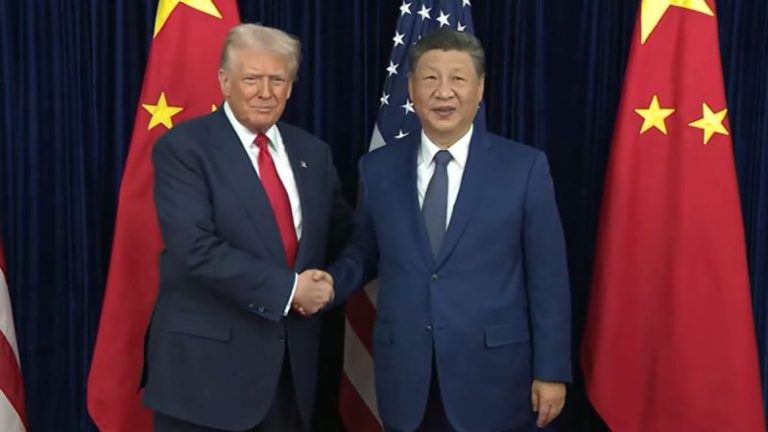
The handshake between Trump and Xi captured that dynamic: a confident Trump leaning into Xi knowing weeks of U.S. maneuvers had strengthened America’s hand in its competition with China. Whether that grip represents a lasting commitment to Indo-Pacific leadership or merely a pause before the next deal remains to be seen.

This post appeared first on FOX NEWS

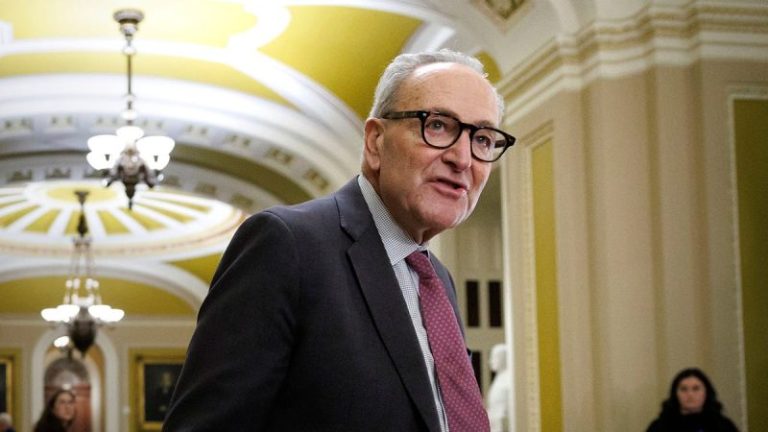
Senate Democrats are trying to figure out their exit strategy from the ongoing government shutdown as lawmakers on both sides remain cautiously optimistic that the end is near.

At hand are offers Senate Republicans have made since nearly the beginning of the shutdown, which crept into record-breaking territory Tuesday night.

Among the options Senate Minority Leader Chuck Schumer, D-N.Y., and his caucus mulled were a vote on expiring Obamacare subsidies, attaching a host of spending bills to the government funding extension and likely extending the House-passed continuing resolution (CR) until December or January.

Following a nearly three-hour, closed-door lunch, Schumer gave little indication as to what Democrats’ move would be. He noted that the longer-than-usual caucus lunch went well, and that Senate Democrats were ‘exploring all the options.’

If enough Senate Democrats join Republicans to reopen the government and take up the GOP’s offer, they’d effectively be caving after spending 36 days entrenched in their position that they needed an ironclad deal on the expiring Obamacare premium subsidies.

Like Schumer, many Democratic lawmakers were tight-lipped about their discussions.

‘It’s still a work in progress,’ Sen. Gary Peters, D-Mich., said.

One part of the equation is tacking on a trio of spending bills, known as a minibus, that would fund military construction and the Department of Veterans Affairs, the legislative branch, and agriculture and the Food and Drug Administration.

Senate appropriators, who have been the main protagonists of increased bipartisan talks, believe that jump-starting the government funding process could be the key to ending the shutdown.

‘The reason we’re in this position is that we have not passed appropriations bills,’ Sen. Katie Britt, R-Ala., said. ‘So beginning to break the logjam through doing that, we think would be incredibly effective.’

The other part of the equation is a guarantee from Senate Majority Leader John Thune, R-S.D., that Senate Democrats would get a vote on a bill that dealt with the expiring Obamacare subsidies.

But that attempt is almost certain to fail, given that Senate Republicans want to see major reforms made to the program.

‘It’s a universe that I think is pretty well-defined and established,’ Thune said. ‘I’ve said this before, but the question is whether or not we’ll take ‘yes’ for an answer.’

That’s where the deep-seated lack of trust that Senate Democrats have for their counterparts across the aisle and of President Donald Trump comes in that has underscored much of the shutdown. One of their demands is to have the healthcare bill voted on by a simple, 50-vote majority, which Thune and Republicans scoffed at.

Still, Senate Democrats are eyeing more of a solution to the healthcare issue rather than the promise of a process, which Thune has given.

‘I’m interested in negotiation, but a negotiation that ends up — that ends in a piece of legislation being passed,’ Sen. Chris Murphy, D-Conn., said. ‘An agreement to take a vote that Republicans are guaranteeing will fail doesn’t sound like an outcome that helps regular Americans.’

Others, particularly progressives in the Senate Democratic caucus, don’t want to see Schumer or their colleagues back down, even as federal workers and air traffic controllers go unpaid, and as the administration has wavered on funding federal food benefits despite a court order to do so.

‘If the Democrats cave on this, I think it will be a betrayal to millions and millions of working families who want them to stand up and protect their healthcare benefits,’ Sen. Bernie Sanders, I-Vt., said.

Despite promises of a vote, Republicans argue they can’t predetermine the future outcome nor guarantee that a Democratic proposal would pass.

‘[Thune] has said from Day 1 that he would provide them with a vote,’ Sen. Mike Rounds, R-S.D., said. ‘What he can’t do is provide them with an outcome.’

Rounds is one of a handful of Senate Republicans who has engaged in bipartisan talks throughout the shutdown and was hopeful that over a dozen Democrats would cross the aisle to reopen the government.

‘I think they’re tired of this,’ Rounds said.

This post appeared first on FOX NEWS